
In 1966, Time magazine ran a cover in stark black and red: “Is God Dead?” The question felt reasonable. Church attendance was falling across Europe. Enlightenment rationalism, Darwinian evolution, and two catastrophic world wars had shaken the foundations of Western faith. Sociologists had a name for what was happening — secularization — and most expected it to continue until religion quietly retired from public life.
It didn’t.
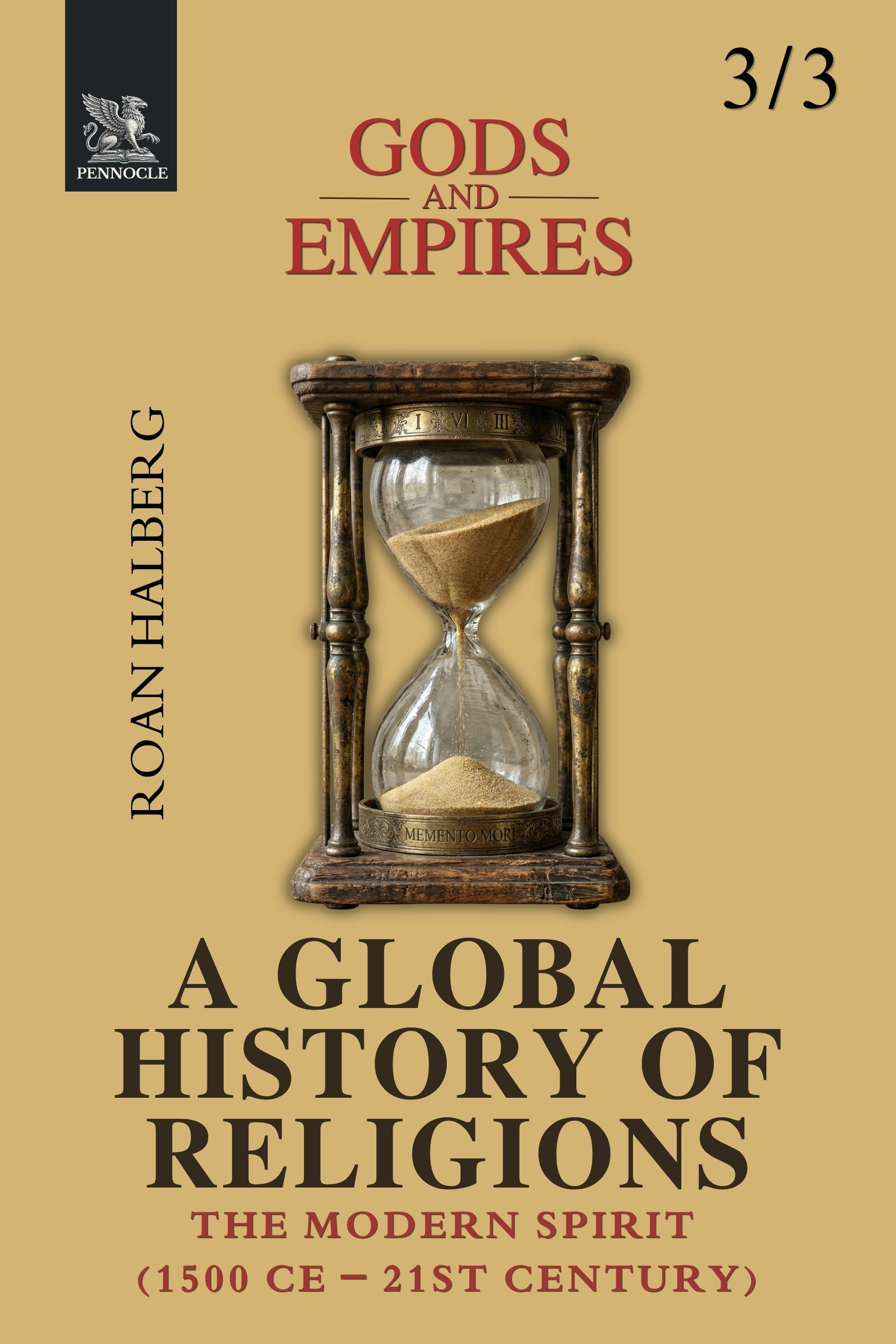
Volume III of GODS AND EMPIRES covers the five centuries between Martin Luther’s break with Rome and the present moment — a period defined not by religion’s defeat but by its repeated, unpredicted resilience, transformation, and occasional self-destruction.
The volume opens with the Reformation — not as doctrinal dispute but as the first information-age crisis, in which a printing press turned a German monk’s academic grievances into a continent-wide conflagration. It follows the fractures that resulted: Calvin’s Geneva, Henry VIII’s political Reformation, the Anabaptist kingdom of Münster, the Thirty Years’ War that killed a third of Germany’s population, and the Counter-Reformation’s baroque magnificence. It covers the Enlightenment’s challenge to religious authority, the French Revolution’s war against the Church, and the evangelical awakenings that swept Britain and America in response.
Then the harder history. Colonial Christianity’s entanglement with empire — missionaries who opposed slavery and missionaries who justified it, often within the same tradition. The slow scholarly dismantling of biblical certainty. Darwin’s twenty years of hesitation before publishing. The First World War’s destruction of providential confidence. The Holocaust’s exposure of Christian antisemitism’s two-thousand-year thread, and the Jewish theological responses that emerged from the ruins. Vatican II’s attempt to remake Catholicism from the inside. Liberation theology’s argument that Jesus was a revolutionary. The CIA’s complicated relationship with American evangelical networks during the Cold War.
And then the reversal. The year 1979 alone — Khomeini’s return to Tehran, Jerry Falwell’s Moral Majority, John Paul II’s first visit to Poland — announced that secularization was not destiny. Pentecostalism, barely a century old, became the fastest-growing religious movement in human history, transforming Latin America, sub-Saharan Africa, and East Asia with almost no coverage in Western media. Christianity’s demographic center shifted south. Buddhism arrived in California therapy offices. And across the world, the question that the modern era was supposed to have answered permanently remained stubbornly, fascinatingly open.
Five centuries of faith refusing to follow the script.