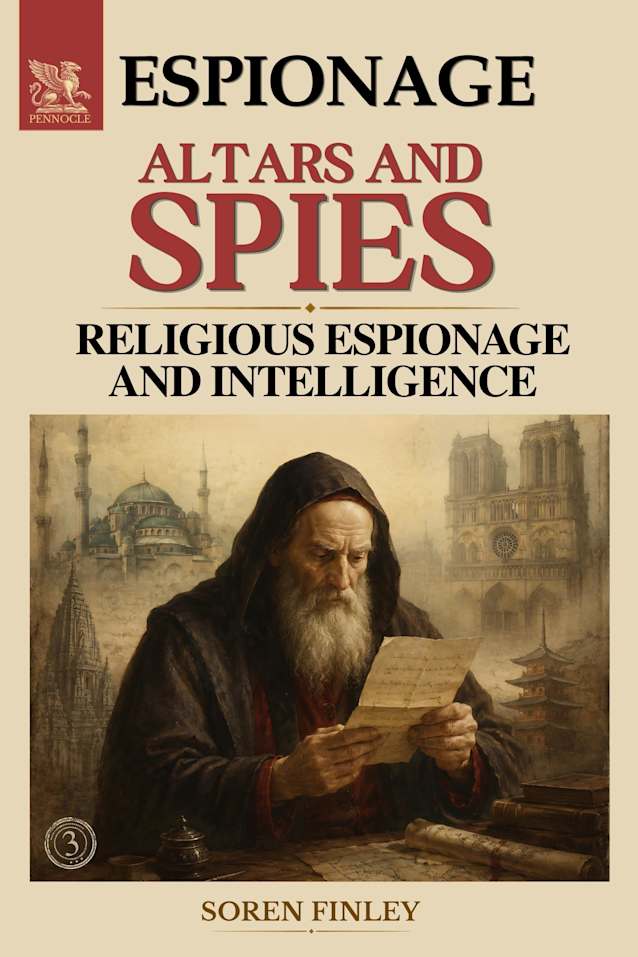
Altars and Spies.
About
Simon Wiesenthal, who spent decades working with and against every major intelligence service on earth, once described the Vatican’s intelligence apparatus as the best he had ever encountered. That remark tends to surprise people. It shouldn’t. The Holy Alliance has been running continuously since 1566 — which makes it older than the CIA, the KGB, MI6, the DGSE, and every other national service currently in operation.
Altars and Spies takes that observation as a starting point and follows it across five thousand years and six continents. The result is a history of how religious institutions — temples, monasteries, missions, confessionals, pilgrim routes, diaspora communities — have functioned as intelligence networks, often long before anything resembling a modern state existed.
Among the topics covered:
Mesopotamian temple archives and the Oracle at Delphi as information clearinghouses
Kautilya’s Arthashastra (c. 300 BCE) and its detailed instructions for using religious cover
The Abbasid Barid system, the Assassins, and Ibn Khaldun’s theory of intelligence
The Inquisition as a continent-wide information apparatus — not simply an instrument of terror
Jesuit missions in China and the industrial-espionage dimension of Father d’Entrecolles’ letters
Walsingham’s network, the Babington Plot, and the Catholic underground in Elizabethan England
The Kakure Kirishitan of Japan, whose clandestine network lasted 250 years
The British Pandits who mapped Tibet under cover of Buddhist pilgrimage
The CIA’s operation ST CIRCUS and the training of Tibetan monks at Camp Hale
The Mitrokhin files on the Russian Orthodox Church, including agent “Mikhailov”
The Stasi’s Department XX/4 and the recruitment of East German pastors
Russian Orthodox churches, the 2023 FBI warning, and intelligence in the digital age
Drawing on declassified archives, the Mitrokhin and Stasi records, Vatican sources, and recent international scholarship, the book treats religious institutions as organisations — not as targets for admiration or attack. The argument is structural: geographic reach, trusted networks, ideological motivation, and plausible cover are exactly what effective intelligence requires, and religious organisations have always had all four.
Part of the Espionage series.