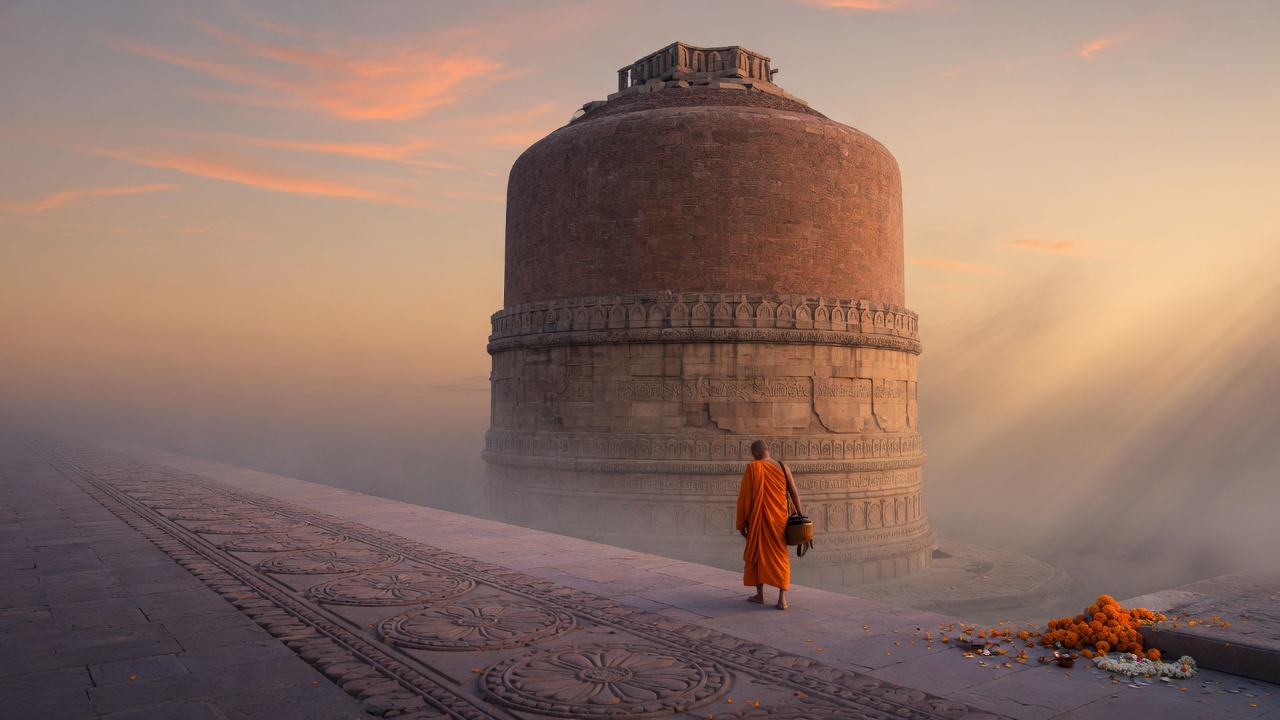
Table of Contents
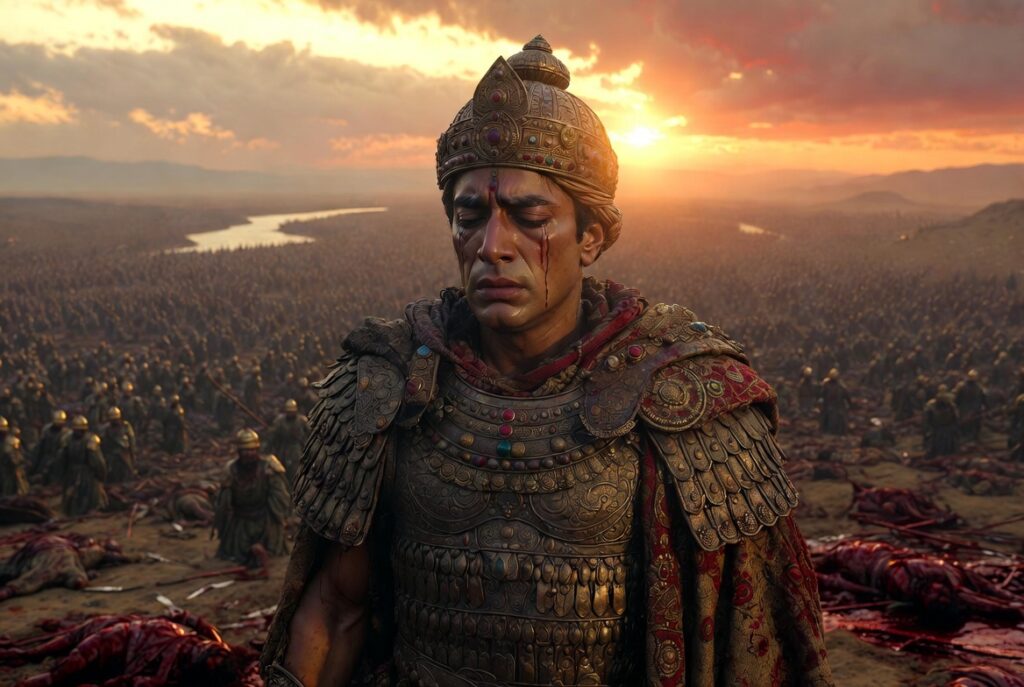
In 261 BCE, an Indian emperor stood on a battlefield strewn with roughly 100,000 corpses — a kingdom he had just destroyed in order to possess it. He had won. And yet, according to the rock inscription he ordered carved afterward, he was devastated.
That emperor was Ashoka, ruler of the Mauryan Empire and one of the most consequential figures in world history. His response to the Kalinga War would do something no military victory had ever done before: it would reshape the spiritual geography of an entire continent.
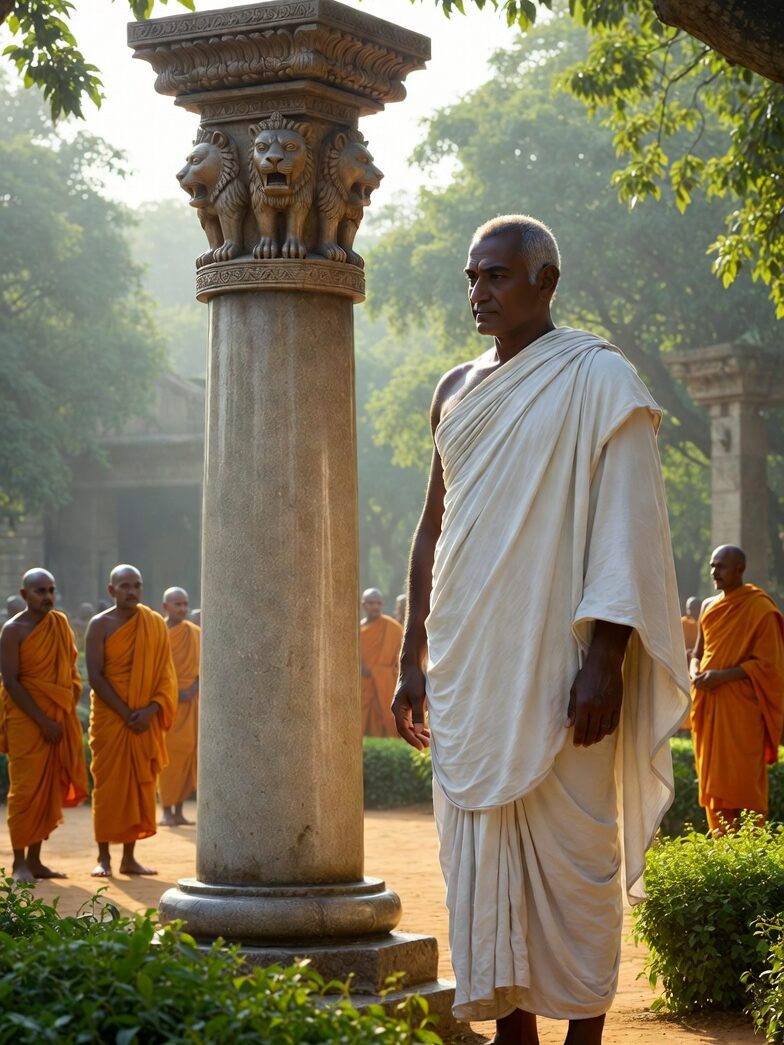
Today, Ashoka’s 24-spoked wheel sits at the centre of India’s national flag. His four-lion pillar capital is the national emblem. More than 2,200 years after his death, the symbols of his transformation govern the visual identity of the world’s largest democracy. Yet the man himself remains deeply complex — conqueror, convert, propagandist, philosopher-king.
This post traces Ashoka’s journey from Chandashoka — Ashoka the Cruel — to the ruler H.G. Wells called a lone star in the darkness of monarchical history. It examines what that journey meant for Buddhism, for Asia, and for us.
The Mauryan World: Ashoka’s Rise Before Buddhism
Ashoka (c. 304–232 BCE) was the third emperor of the Mauryan dynasty — grandson of its founder Chandragupta Maurya and son of the second emperor, Bindusara. When he came to power around 268 BCE after a violent succession struggle against his brothers, he inherited the largest empire the Indian subcontinent had ever known. It stretched from the Hindu Kush mountains in the northwest to Bengal in the east, and from the Himalayan foothills south to modern Karnataka. The ancient capital, Pataliputra — on the site of today’s Patna — was, by Greek ambassador Megasthenes’s account, a metropolis of extraordinary scale and organisation.
The Mauryan state was a sophisticated bureaucratic machine. Ministers oversaw agriculture, trade, taxation, and military intelligence. Chandragupta’s minister Chanakya had produced the Arthashastra, one of history’s first systematic treatises on statecraft — a cold-eyed manual of power that treated compassion as a tool, not a value.
Ashoka’s early reign showed no sign of the transformation ahead. Ancient texts and later Buddhist chronicles describe his youth as violent and his rule as merciless. He earned the epithet Chandashoka — “Ashoka the Fierce” — reportedly for the brutal elimination of rivals during the succession conflict. The Sanskrit Buddhist text Ashokavadana paints him in near-demonic colours: a king who maintained a palace of torture and executed rivals en masse. Historians treat these stories with caution, as they served clear narrative purposes within Buddhist hagiography. The consensus, however, is that the early Ashoka was no pacifist.
The Mauryan Empire at its height covered an estimated five million square kilometres and governed a population of perhaps 50 to 60 million people. Its armies fielded hundreds of thousands of infantry, tens of thousands of cavalry, and large numbers of war elephants. Against this imperial machine, the independent maritime kingdom of Kalinga — occupying roughly modern Odisha and parts of northern Andhra Pradesh — stood as a conspicuous and strategically irritating holdout. Ashoka would march against it in 261 BCE. What happened next changed everything.
💬 “Ancient legends describe Ashoka as Chandashoka — the dark, cruel conqueror — and as Dharmashoka — the righteous protector of dharma who gave up violence. These two identities are inseparable from any honest reckoning with his legacy.”
The Kalinga War and the Making of Dharmashoka
The Kalinga War of 261 BCE is one of the most consequential military campaigns in world history — not because of its strategic outcome, but because of the document it produced. Rock Edict XIII, one of Ashoka’s carved inscriptions, contains something almost without parallel in antiquity: a conquering king describing, in his own words, why his victory filled him with sorrow.
The edict records that 100,000 Kalinga soldiers were killed, that 150,000 were deported, and that “many more died.” Tradition holds that the Daya River ran red. Ashoka wrote: “His Majesty felt remorse on account of the conquest of Kalinga because, during the subjugation of a previously unconquered country, slaughter, death, and taking away captive of the people necessarily occur, whereas His Majesty feels profound sorrow and regret.”
No other ancient conqueror left behind a document quite like this. Caesar catalogued his victories; Alexander was celebrated in panegyrics; the great kings of Assyria boasted of conquered cities in temple inscriptions. Ashoka carved his anguish into polished sandstone. It was, by any measure, a remarkable public act.
In the years that followed, he turned from the sword to the dhamma (Pali for dharma). He embraced Buddhism, redirected the imperial machinery toward welfare rather than conquest, and began constructing a governance philosophy of moral authority. He built hospitals for humans and animals. He planted medicinal gardens, dug wells, and constructed rest houses along the roads. He appointed officials called dharma-mahamatras — officers of righteousness — whose role was to monitor the welfare of all subjects regardless of caste, creed, or social standing.
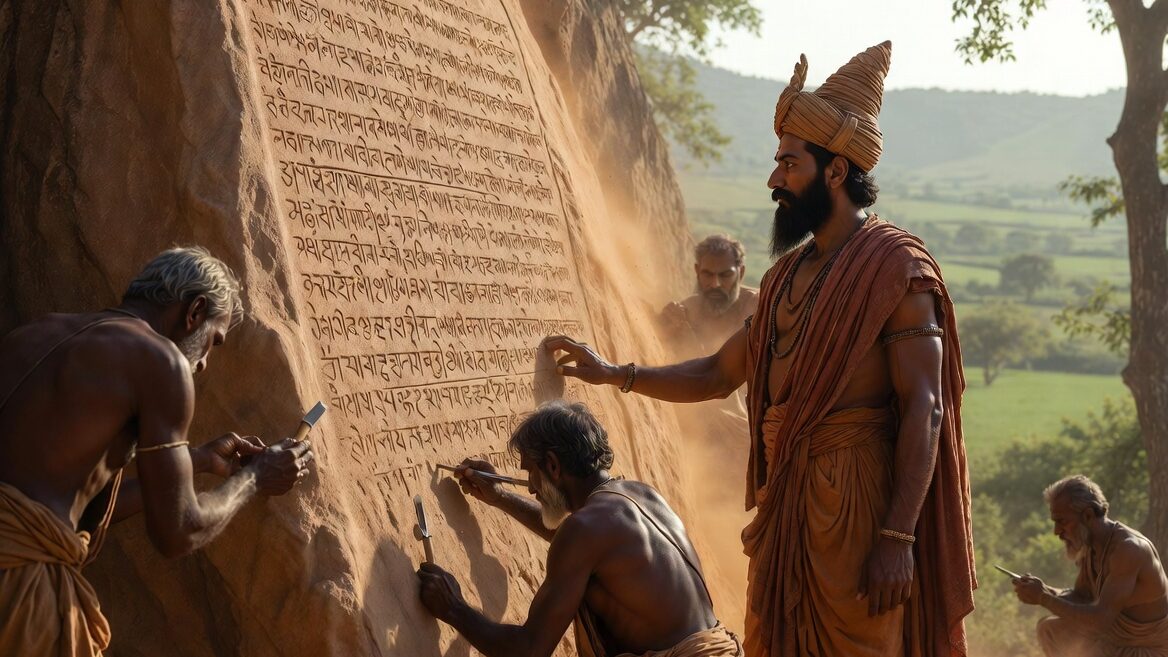
He also did something no ancient emperor had done at such scale: he spoke directly to his people. Across his empire — from Afghanistan to Karnataka, Gujarat to Bengal — he had his edicts inscribed in local languages on polished pillars and rock faces. Travellers, merchants, and villagers who passed these monuments could read his policies, his regrets, and his aspirations. Composed in Brahmi and Kharosthi scripts, and in Greek and Aramaic in the empire’s western reaches, the edicts were the ancient world’s most ambitious exercise in mass political communication.
📌 KEY INSIGHT
Rock Edict XIII stands as one of antiquity’s most remarkable primary documents: a victorious ruler publicly recording his own remorse. Unlike any other ancient sovereign, Ashoka did not commission a victory hymn after Kalinga — he confessed grief. This single act of self-examination permanently changed the moral vocabulary of Indian kingship and anchored Buddhism’s global story to a specific, historical moment of human suffering.
Ashoka’s Buddhist Legacy: A Chronological Overview
The transformation of Ashoka and the spread of Buddhism across Asia unfolded over decades and extended far beyond the Indian subcontinent. The following timeline traces the key milestones.
| Date (BCE) | Event |
|---|---|
| c. 322 | Chandragupta Maurya founds the Mauryan Empire |
| c. 304 | Ashoka born; grandson of Chandragupta |
| c. 268 | Ashoka crowned third Mauryan emperor after succession war |
| c. 264 | Minor rock edicts indicate early Buddhist affiliation — before Kalinga |
| 261 | The Kalinga War; ~100,000 killed, ~150,000 deported (Rock Edict XIII) |
| c. 260–250 | Ashoka issues Rock Edicts I–XIV; appoints dharma-mahamatras |
| c. 255 | Third Buddhist Council held at Pataliputra under royal patronage |
| c. 251–250 | Son Mahinda and daughter Sanghamitta sent as missionaries to Sri Lanka |
| c. 250 | Missions dispatched to Burma, Central Asia, and Hellenistic kingdoms |
| c. 250 | Construction of 84,000 stupas reportedly begins across the empire |
| 232 | Ashoka dies; Mauryan Empire begins its rapid contraction |
| c. 185 | Mauryan Empire collapses entirely; Buddhism continues to spread independently |
| 1947 | Independent India adopts the Dharma Chakra for its new national flag |
| 1950 | The Lion Capital of Sarnath becomes India’s national emblem |
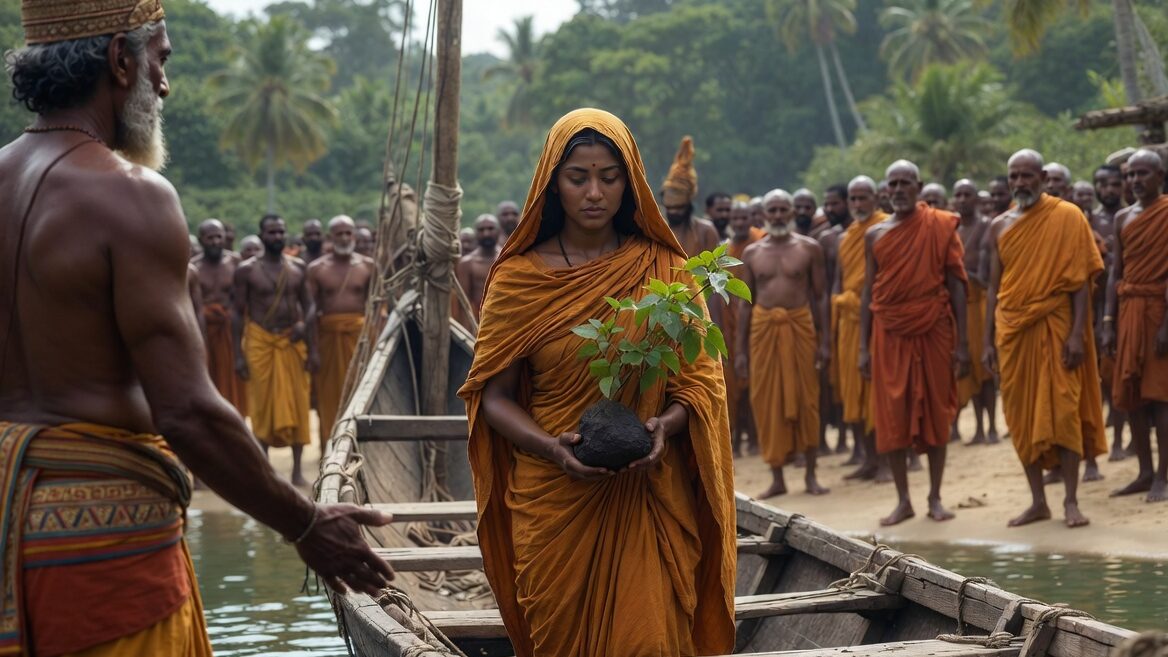
The Sri Lanka mission was especially consequential. According to the ancient chronicles Mahavamsa and Dipavamsa, Mahinda converted King Devanampiya Tissa to Buddhism and established the Mahavihara monastery in Anuradhapura — the foundational institution of Theravada Buddhism. Sanghamitta carried a sapling of the Bodhi tree — under which the Buddha achieved enlightenment — to Anuradhapura, where it still grows today as the Jaya Sri Maha Bodhi: one of the oldest historically documented trees on Earth.
Ashoka’s missions reached further still. Missionaries entered Burma, where the Mon kingdom received them around 250 BCE; others reached Gandhara and Bactria, planting Buddhism along what would become the Silk Road’s cultural arteries; and Rock Edicts II and XIII name the Hellenistic courts of Antiochus II (Syria), Ptolemy III (Egypt), Antigonus (Macedonia), Magas (Cyrene), and Alexander (Epirus) as destinations. Within a decade of Ashoka’s active patronage, Buddhism had transformed from a regional Indian philosophical tradition into a genuinely intercontinental religion.
What Ashoka’s Transformation Still Tells Us
Ashoka’s story raises questions that feel anything but ancient: Can power genuinely reform itself? Can a conqueror’s remorse produce lasting structural good? What does it mean to govern by moral authority rather than military force?
The policy he called Dhamma was not Buddhism imposed from above. Ashoka explicitly discouraged coercion in religious matters. Rock Edict XII records that he “honours members of all sects” — Hindu Brahmins, Jains, Ajivikas, and Buddhists alike — seeking to increase what he called “the essential doctrine of all sects.” This is among the earliest surviving formulations of official religious tolerance in world history. It predates the Edict of Milan (313 CE), often cited in Western histories as the founding document of religious coexistence, by nearly six centuries.
His welfare infrastructure was equally striking. Hospitals treating both humans and animals were established as government institutions, not private charity. Public wells were dug at regular intervals along major roads. Shade trees were planted for travellers’ relief. These were state commitments, inscribed for accountability and inspected by royal officials.
The modern resonance is hard to miss. India’s founders, including B.R. Ambedkar — the Dalit scholar and architect of the Indian constitution, who himself converted to Buddhism — saw in Ashoka a historical model for a pluralist, just state. The Dharma Chakra on India’s flag represents not just Buddhist dharma but the principle of endless, lawful forward motion — progress under constitutional order.
Ashoka also offers a sobering lesson about institutional fragility. After his death in 232 BCE, the Mauryan Empire contracted rapidly and collapsed entirely within fifty years. His welfare structures eroded without the sovereign will that had created them. The Buddhism he spread, however, continued to flourish in Sri Lanka, Southeast Asia, and Central Asia long after the Mauryan political architecture had crumbled to dust.
💬 “Ashoka’s is the rarest of historical stories: a man who held unchecked power, used it to conquer, and then chose — sincerely or strategically — to spend his remaining years attempting to undo the damage. Whatever his motives, the practical consequences for Asia’s spiritual and cultural history were immeasurable.”
The Debate Behind the Legend: Nuances and Open Questions
The narrative of remorse-driven conversion is powerful — and complicated. A significant problem lurks in the chronology. Minor rock edicts found across India suggest that Ashoka had already adopted Buddhist practice around 264 BCE, at least two years before the Kalinga War. The prominent Indologist A.L. Basham acknowledged that a pre-Kalinga conversion is historically plausible. No Buddhist canonical text explicitly links his conversion to the battle.
Some revisionist historians — most prominently economist and author Sanjeev Sanyal — argue that Ashoka’s famous inscriptions were primarily political propaganda: a carefully engineered rehabilitation of Chandashoka the Cruel rather than unmediated evidence of moral transformation. The Ashokavadana does record acts of violence against Ajivika sect members occurring after Ashoka’s supposed conversion, including a passage describing the mass execution of thousands in Bengal — a claim historians dispute but cannot cleanly dismiss.
The honest picture resists both hagiography and debunking. Ashoka may have had Buddhist sympathies before Kalinga that the horror of the war then radically deepened. He may have used the edicts simultaneously for genuine communication and image management while retaining elements of autocratic power. The welfare reforms were real. The religious tolerance was real and unusually advanced. The missionary activity was real and had lasting continental consequences that no amount of posthumous skepticism erases.
The most enduring question is not whether Ashoka was a saint — he evidently was not. It is whether political power can produce genuine moral progress when wielded by someone willing, even partially, to be changed by what they have done. Ashoka remains one of history’s most instructive, and most honestly ambiguous, case studies in that question.
Conclusion
Ashoka’s life describes one of the sharpest moral arcs in recorded history: from a prince who almost certainly killed his way to the throne, to an emperor whose wheel of dharma now rotates at the heart of a democratic flag. The Kalinga War produced extraordinary suffering — 100,000 dead, 150,000 displaced, according to the man who ordered it. It also produced Rock Edict XIII, one of the ancient world’s most remarkable acts of public self-reckoning.
Whether Ashoka’s transformation was complete, sincere, or partly strategic, its consequences were undeniably real. Buddhism spread from Sri Lanka to Burma to Central Asia, seeding traditions that today count approximately 500 million followers worldwide. H.G. Wells was right that among the tens of thousands of monarchs who crowd the columns of history, Ashoka “shines, and shines almost alone, a star” — not because he was perfect, but because he chose, uniquely, to carve his sorrow into stone for posterity.
The wheel still turns.
🔑 KEY TAKEAWAYS
- The Kalinga War (261 BCE) cost approximately 100,000 lives and displaced 150,000 more, by Ashoka’s own account in Rock Edict XIII — one of antiquity’s most unusual admissions of remorse from a conquering ruler.
- Ashoka redirected the Mauryan Empire’s resources toward welfare: building hospitals for humans and animals, planting roads with shade trees, digging public wells, and establishing religious tolerance as official state policy.
- His son Mahinda and daughter Sanghamitta converted Sri Lanka to Buddhism; separate missions reached Burma, Central Asia, and Hellenistic courts — making Ashoka the single most important architect of Buddhism’s global spread.
- The Dharma Chakra (Ashoka Chakra) and the Lion Capital of Sarnath appear on modern India’s national flag and national emblem respectively, giving Ashoka a direct presence in contemporary governance unmatched by almost any other ancient ruler.
- Historical scholarship questions whether Ashoka’s conversion truly followed Kalinga or predated it, and whether the edicts were sincere governance or political rehabilitation — a debate that adds honest complexity to a legend deserving neither uncritical veneration nor cynical dismissal.
Frequently Asked Questions
Why is Ashoka considered one of the greatest emperors in history?
Ashoka is considered exceptional because he voluntarily renounced military conquest after the Kalinga War, redirected a vast empire’s resources toward welfare and religious tolerance, and systematically spread Buddhism across Asia. Unlike most ancient rulers who celebrated conquest, Ashoka publicly recorded his remorse in durable stone. His symbols — the Dharma Chakra and Lion Capital — remain at the centre of India’s national identity more than 2,200 years after his death, an endurance matched by almost no other ancient sovereign.
How many people died in the Kalinga War?
According to Ashoka’s own Rock Edict XIII, the Kalinga War of 261 BCE resulted in approximately 100,000 deaths in battle and the deportation of 150,000 people, with additional casualties from famine and displacement in the aftermath. The total is often cited as approaching 250,000. The Kalinga War is considered one of the deadliest conflicts in ancient Indian history, and the fact that the victorious emperor recorded these figures himself makes the account unusually credible and historically rare.
Did Ashoka really convert to Buddhism because of the Kalinga War?
The traditional narrative links Ashoka’s conversion directly to the horror of the Kalinga War. However, minor rock edicts suggest he had already adopted Buddhist practice around 264 BCE — two years before the battle. Scholars including A.L. Basham acknowledge this pre-war connection is historically possible. The current scholarly consensus tends to view Kalinga as having deepened a pre-existing Buddhist commitment rather than creating it from nothing, and some historians argue the edicts also served as political image management for a ruler previously known as Chandashoka the Cruel.
How did Ashoka spread Buddhism across Asia?
Ashoka spread Buddhism through royal patronage, a vast inscription programme, and systematic missionary activity. He reportedly commissioned the construction of 84,000 stupas across his empire. His son Mahinda and daughter Sanghamitta converted the king of Sri Lanka, establishing the founding Theravada monastery at Anuradhapura. Separate missions reached Burma (received by the Mon kingdom around 250 BCE), Gandhara and Bactria along the Silk Road, and Hellenistic courts in Syria, Egypt, and Macedonia. These missions laid the groundwork for Buddhism’s dominance across South, Southeast, and Central Asia.
What are the Edicts of Ashoka?
The Edicts of Ashoka are royal proclamations inscribed on polished stone pillars and rock faces across Ashoka’s empire, composed between roughly 269 and 232 BCE. They are among the oldest deciphered texts from the Indian subcontinent, written primarily in Brahmi script in Prakrit, and in Kharosthi, Greek, and Aramaic in the empire’s western regions. The edicts address governance, animal welfare, religious tolerance, and the promotion of dharma, and they remain one of the most important primary sources for Mauryan history and for the history of early Buddhism.
What is Ashoka’s connection to modern India’s national symbols?
Ashoka’s influence on modern India is concrete and direct. The 24-spoked Dharma Chakra from the abacus of his Sarnath pillar was adopted as the central motif of India’s national flag in 1947. The four-lion capital from the same pillar became India’s national emblem in 1950, with the national motto Satyameva Jayate (“Truth alone triumphs”) inscribed below it. The Ashoka Chakra on the flag replaced the spinning wheel of the independence movement, a deliberate choice by India’s founders to root the new republic’s identity in one of history’s most striking experiments in ethical governance.
What happened to the Mauryan Empire after Ashoka’s death?
Ashoka died around 232 BCE after ruling for approximately 36–40 years. The Mauryan Empire declined rapidly in the decades following his death, weakened by contested succession, regional separatism, and possibly the financial strain of extensive welfare programmes. The empire collapsed entirely around 185 BCE when the last Mauryan emperor was assassinated. The Buddhism Ashoka had propagated, however, continued flourishing independently in Sri Lanka, Southeast Asia, and along the Silk Road long after the political structure that had first carried it across Asia had disintegrated.
Sources & further reading:
- Kalinga War — Wikipedia
- Ashoka — Encyclopaedia Britannica
- Ashoka’s Conversion — Lumen Learning / World Civilisation
- King Ashoka: His Edicts and His Times — Colorado State University (Malaiya)
- Ashoka’s Empire: The First Buddhist State and Its Impact — Fabrizio Musacchio