Table of Contents
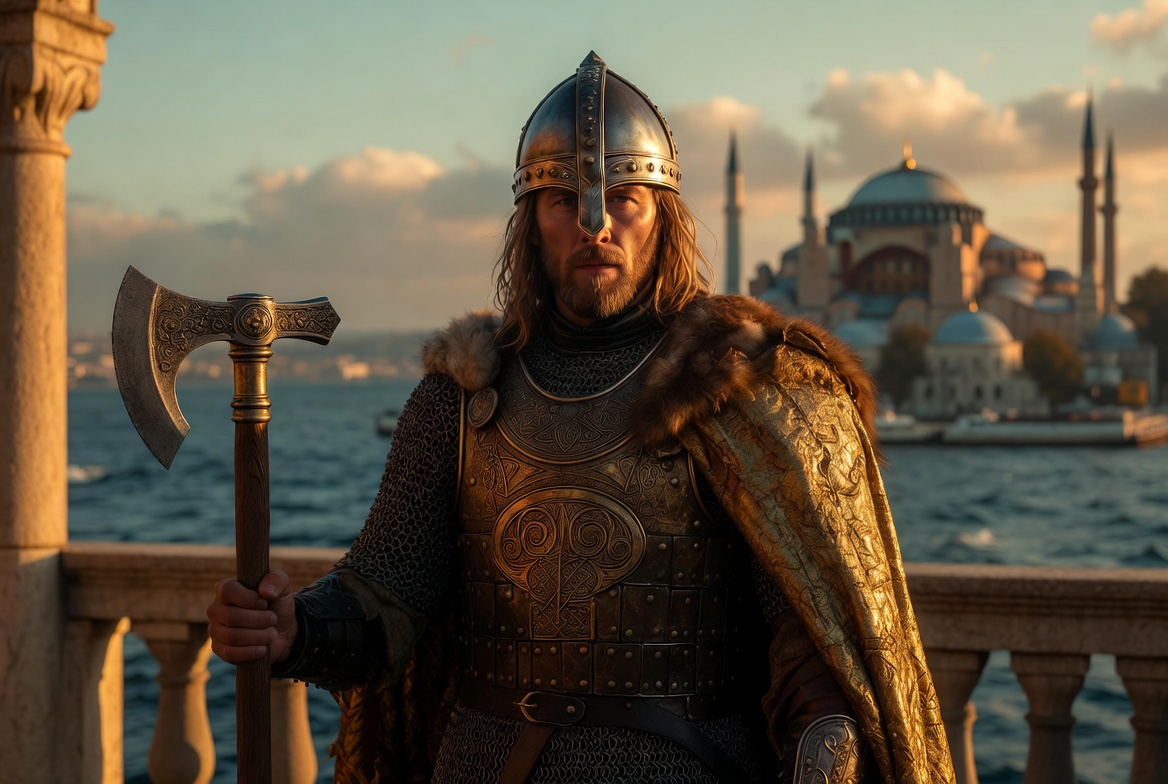
Imagine standing at the heart of the world’s most powerful medieval empire — a city of gleaming marble, gilded domes, and labyrinthine court intrigue — and discovering that the emperor’s last line of defence is a phalanx of towering, axe-wielding Norsemen. Not Romans. Not Greeks. Vikings.
The Varangian Guard is one of history’s most improbable yet enduring military institutions. For more than three centuries, beginning around 988 CE, Scandinavian and later Anglo-Saxon warriors served as the personal bodyguards of the Byzantine emperors in Constantinople — the city they called Miklagard, “the great city.” Their story weaves together Norse ambition, Byzantine paranoia, medieval geopolitics, and a cultural fusion that most popular histories overlook entirely.
This post unpacks who the Varangians really were, why an emperor chose foreign “barbarians” over his own subjects to guard his life, what made their service legendary across the medieval world, and what their remarkable story reveals about power, loyalty, and identity.
Who Were the Varangians? Origins and Formation of the Guard
The word “Varangian” derives from the Old Norse Væringjar, meaning sworn companions or “men of the pledge” — warriors bound by mutual oath. Before they became the emperor’s elite guard, Varangians were Norse and Swedish traders and mercenaries who had been navigating the great river routes of Eastern Europe since the ninth century, establishing trade links, founding cities such as Novgorod and Kiev, and entering the service of various regional rulers.
Their contact with Byzantium was not sudden. As early as 911 CE, a treaty between Rus King Oleg and Emperor Leo IV established a formal military relationship, permitting Norse warriors to serve in Byzantine forces. By the mid-tenth century, small units of Varangians had already demonstrated their fighting value to Constantinople’s generals.
The decisive moment came in 988 CE. Emperor Basil II faced a catastrophic double threat: a shattering military defeat at the hands of Bulgarian forces and a full-scale internal rebellion led by two powerful aristocratic generals, Bardas Sclerus and Bardas Phocas. Desperate for reliable troops, Basil turned to Prince Vladimir of Kiev. In exchange for the hand of Basil’s sister, Princess Anna — a politically enormous concession — Vladimir sent 6,000 battle-hardened Varangian warriors to Constantinople. As part of the arrangement, Vladimir also converted to Orthodox Christianity, an event that would permanently shape the religious history of Eastern Europe.
The Varangians performed brilliantly. Basil crushed both rebellions and, deeply impressed by his northern warriors, elevated them to a permanent, institutionalised role: the Varangian Guard (Greek: Tágma tōn Varángōn), the personal bodyguard of the Byzantine emperor. They were stationed in the Great Palace of Constantinople, guarding the emperor’s chambers, treasury, and public appearances with equal rigour.
💬 “These men are, without exception, armed with shields and the rhomphaia — they serve as a bodyguard to the emperors of the day and make a show of their weapons on feast days.” — 11th-century historian Michael Psellos
The Varangian Guard’s Central Purpose: The Loyalty Paradox
The founding logic of the Varangian Guard reveals something profound about the nature of power. Byzantine emperors were among the most politically vulnerable rulers in the medieval world. Between 602 and 1453 CE, over half of all Byzantine emperors were either murdered, blinded, deposed, or forced into monastic exile. The men most likely to betray a ruler were precisely those closest to him — native generals with political ambitions, aristocratic palace guards with family loyalties, and court officials serving rival patrons.
The genius of the Varangian Guard was precisely their foreignness. Norse warriors from Scandinavia had no ties to Byzantine noble families, no stake in Greek court politics, no local patrons to serve, and no debts to powerful factions. Their loyalty was entirely transactional and institutional — bound by solemn oath and cemented by extraordinary compensation.
📌 KEY INSIGHT
A Varangian guardsman earned between 30 and 40 gold nomismata per month — up to three times the salary of a standard Byzantine soldier. Service was so prestigious and lucrative that aspiring recruits paid an entry fee in gold for the privilege of joining. Those admitted could retire as wealthy men. Those rejected still made names for themselves in lesser Byzantine mercenary companies.
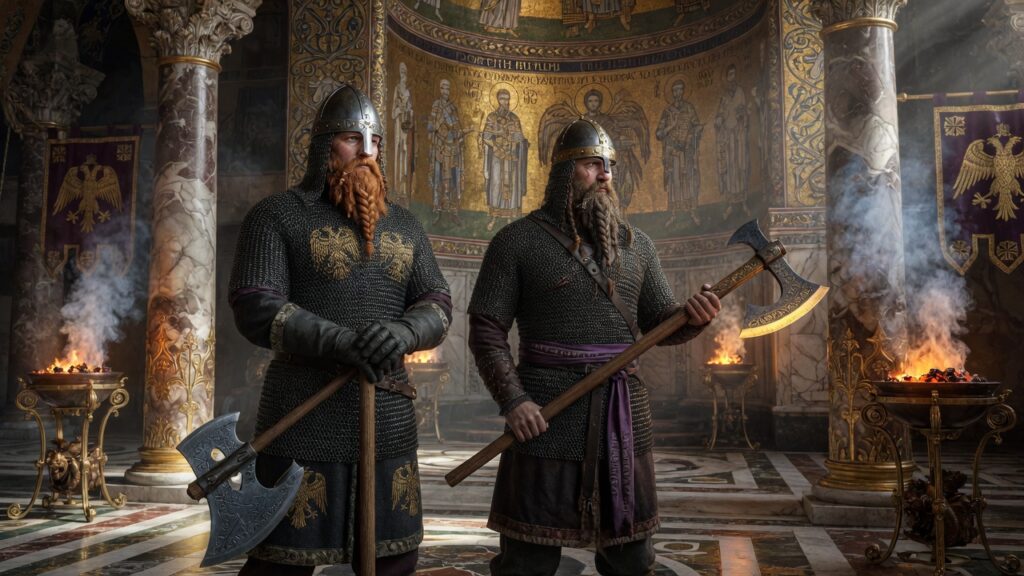
This financial logic was reinforced by one of the most extraordinary customs in medieval military history: the polutasvarf, or “palace pillaging.” On the night of an emperor’s death, the Varangian Guard held the traditional right to enter the imperial treasury and take as much gold as each man could physically carry in his hands. Possibly derived from an Old Norse ritual, the custom was formally tolerated by the Byzantine court and served a brilliantly perverse institutional purpose: the Varangians had every financial reason to keep the emperor alive for as long as possible, and a guaranteed golden payout when he finally died. According to the Icelandic sagas, Harald Hardrada alone participated in palace pillaging three times during his decade of Byzantine service.
The emperor’s own native guardsmen could never be trusted with the same certainty. They had families to protect, factions to appease, and futures to calculate in purely Byzantine terms. The Varangians, by contrast, were defined entirely by their service. As one strand of Byzantine scholarship puts it, they were bound to the emperor by oath and gold rather than blood or politics — and in the paranoid, conspiratorial world of Constantinople, that made them more dependable than any native soldier.
Evidence in Action: Harald Hardrada, Anglo-Saxon Exiles, and the Guard’s Evolution
No figure illustrates the Varangian Guard’s sweep and ambition more vividly than Harald Sigurdsson, known to history as Harald Hardrada — the “Hard Ruler.” Exiled from Norway at fifteen after the Battle of Stiklestad in 1030, Harald made his way to Constantinople via Kiev and joined the Guard around 1034. He rose rapidly through its ranks to become its commander. Under the great Byzantine general George Maniakes, Harald and his Varangians campaigned across Sicily, capturing both Messina and Syracuse, and also fought in Asia Minor, Bulgaria, and possibly the Holy Land.
The Icelandic sagas record that Harald returned to Scandinavia carrying more gold than any man in the North had ever been seen to possess from a single source of service. His decade in Byzantine employ gave him the resources and the prestige to claim the Norwegian throne. He died, famously, at the Battle of Stamford Bridge in September 1066 — the same year that would trigger the Guard’s most surprising demographic transformation.
After William the Conqueror’s victory at Hastings in October 1066, thousands of Anglo-Saxon warriors found themselves dispossessed, landless, and without meaningful prospects in their own country. Many followed the old Norse river routes southward to Constantinople. The influx was so substantial that within a generation, English had become the functional spoken language of the Varangian Guard. A mid-fourteenth-century account of Byzantine court ceremonies recorded that at Christmas, the guards hailed the emperor in their native tongue — which it specified as English.
Sweden had already passed laws discouraging Norse warriors from emigrating to Byzantine service, threatening loss of inheritance rights for any man who left. The fact that such legislation was deemed necessary speaks to how powerfully attractive the Guard had become.
Varangian Guard — Composition Over Time
| Period | Dominant Composition | Key Events |
|---|---|---|
| 988–1066 CE | Norse/Scandinavian (Rus-origin) | Founded by Basil II; 6,000 Rus warriors; Harald Hardrada’s service |
| 1066–1200 CE | Increasingly Anglo-Saxon | Norman Conquest drives English warriors eastward |
| 1200–1300 CE | Anglo-Saxon dominant | English becomes primary language; Fourth Crusade (1204) |
| 14th–15th century | Ceremonial/declining | Reduced to court duties; Byzantine territory contracts |
What the Varangian Guard Means for Power and Trust
The Varangian Guard offers a counterintuitive lesson that resonates far beyond the medieval world: the most reliable loyalty can come not from those who share your culture, language, or heritage, but from those defined entirely by their service rather than their origins. Byzantine emperors understood that a guardsman with no family ties to local aristocracy, no stake in palace factions, and no realistic prospect of personal political advancement was structurally resistant to corruption in ways that native guards fundamentally could not be. Foreignness was not a liability to be tolerated. It was the operational specification.
💬 “Employing mercenaries was a trademark of Byzantine military history even in earlier centuries. But the recruitment of the Varangians was certainly different in scope, simply because of the loyalty factor. The native Byzantine guards were genuinely mistrusted by the Emperor.” — Realm of History
The Guard also functioned as a remarkable engine of cultural exchange. Warriors returned home to Scandinavia and England bearing Eastern silks, Byzantine gold, new metallurgical techniques, and stories of a world wholly unlike the North. Runic inscriptions on memorial stones in Sweden commemorate men who “went to Miklagard” — Constantinople — and never returned. The Guard was not merely a military unit; it was a vector of medieval globalisation operating across a corridor stretching from the Norwegian fjords to the Bosphorus.
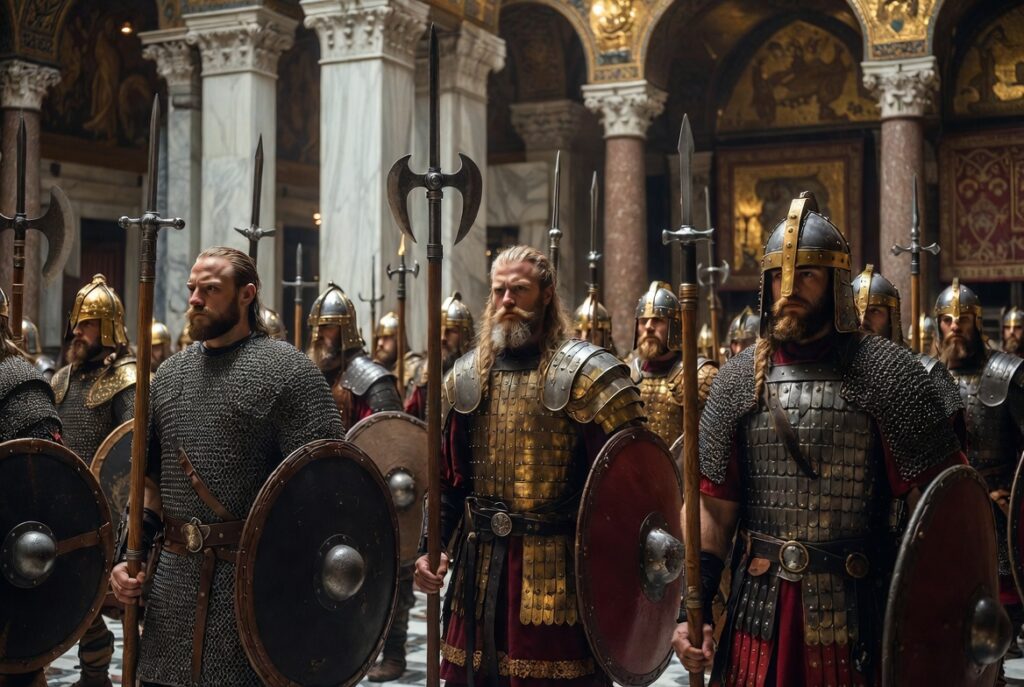
This cultural role deserves more recognition than it typically receives. The Guard brought Eastern craft traditions into Scandinavian material culture, and Norse oral traditions — the sagas recording Harald Hardrada and Bolli Bollason — preserved Byzantine court life in vivid, if sometimes exaggerated, detail for future generations.
Nuances, Counterpoints, and the Guard’s Long Decline
The Varangians were not, however, paragons of decorum. Byzantine sources frequently noted their excessive drinking, street brawls, and rough treatment of civilians off-duty. They were nicknamed “wine-bags” by some Byzantine writers. Imperial authorities tolerated these excesses as, bluntly, the price of loyalty — a calculated trade-off that itself reveals much about how the Byzantine court valued the Guard’s institutional function over its social behaviour.
Scholars also debate whether Varangian loyalty was ever truly unconditional. During the catastrophic Fourth Crusade of 1204 — when Crusader forces turned on Constantinople itself — some Varangian units may have negotiated survival terms rather than fighting to the last man. Whether this reflects pragmatic professionalism or an oath broken under impossible circumstances remains genuinely contested among Byzantine historians.
The Guard’s decline was gradual. In the thirteenth century, restored imperial forces used Varangians to reclaim territory in the Balkans and Anatolia. By the early fourteenth century, however, they no longer participated in active military operations, reduced to ceremonial appearances and city-guard duties as the empire itself contracted. The last known historical reference to the Varangian Guard dates to the fifteenth century — within living memory of Byzantium’s final fall to the Ottoman Turks in 1453.
Conclusion
The Varangian Guard endures as one of history’s most compelling military paradoxes: an empire that survived for centuries partly because it entrusted its most vital function — the emperor’s life — to men who were, by every conventional measure, outsiders. Their story cuts across the standard Viking narrative of raiders and longships to reveal something far richer: a genuinely global medieval world, in which Norse warriors could rise to command the bodyguard of the Roman emperor’s successor, in a city of gold, thousands of miles from the fjords of home.
They were mercenaries, yes. But they were also cultural ambassadors, economic migrants, and — in their own way — nation-builders who carried pieces of two worlds back and forth across the medieval map. In an era when loyalty was the scarcest and most precious commodity of all, the Varangian Guard found a way to make it their greatest export. The next time you picture a Viking, consider that one of them may have been standing guard outside the most magnificent throne room on earth.
🔑 KEY TAKEAWAYS
- The Varangian Guard was formally established in 988 CE when Basil II received 6,000 Norse warriors from Prince Vladimir of Kiev as part of a political-military alliance that also Christianised the Kievan Rus.
- Byzantine emperors chose foreign warriors as bodyguards precisely because their lack of local ties made them structurally immune to palace conspiracies and political factions.
- Varangian guardsmen earned up to three times the salary of regular Byzantine soldiers, paid entry fees in gold to join, and held the extraordinary right to plunder the imperial treasury upon each emperor’s death.
- After the Norman Conquest of 1066, the Guard underwent a dramatic ethnic shift from Norse to Anglo-Saxon; by the mid-14th century, English had become its primary spoken language.
- The Guard lasted over three centuries and functioned as a major channel of cultural and material exchange between Northern Europe and the Byzantine world.
Sources & further reading:
World History Encyclopedia: The Varangian Guard — https://www.worldhistory.org/Varangian_Guard/ Ancient Origins: Varangian Guard — Bodyguards and Berserkers of the Byzantine Empire — https://www.ancient-origins.net/history-important-events/varangian-guard-berserkers-byzantine-empire-003144 Aspects of History: Anglo-Saxons in the Varangian Guard — https://aspectsofhistory.com/anglo-saxons-in-the-varangian-guard/ Warfare History Network: The Byzantine Army’s Varangian Guard — https://warfarehistorynetwork.com/article/varangian-gaurd-of-the-byzantine-army/Realm of History: 10 Fascinating Facts about the Varangian Guard — https://www.realmofhistory.com/2022/06/13/10-fascinating-facts-varangian-guard/
Frequently Asked Questions
What was the Varangian Guard and why was it created?
The Varangian Guard was an elite military unit of the Byzantine Empire, founded around 988 CE, that served as the personal bodyguard of Byzantine emperors. Emperor Basil II created it after receiving 6,000 Norse warriors from Prince Vladimir of Kiev. The Guard was deliberately composed of foreigners — primarily Norse and later Anglo-Saxon warriors — because their lack of ties to Byzantine politics made them far more trustworthy than native soldiers in a court plagued by intrigue.
Were the Varangian Guard actually Vikings?
Yes, initially. The original Varangians were Norse warriors, primarily from Sweden and the Kievan Rus, who had been trading and mercenary-fighting across Eastern Europe since the ninth century. After 1066 CE, when the Norman Conquest displaced large numbers of Anglo-Saxon warriors from England, the composition of the Varangian Guard shifted significantly toward English recruits. By the mid-14th century, English had become the Guard’s primary spoken language.
How much were Varangian Guard soldiers paid?
Varangian Guard members were among the best-compensated soldiers in the medieval world. An ordinary guardsman earned between 30 and 40 gold nomismata per month — estimates suggest up to three times the salary of a standard Byzantine soldier. Beyond regular pay, they received a share of battle plunder and held the extraordinary right called polutasvarf: upon the death of an emperor, each guardsman could enter the imperial treasury and take as much gold as he could carry in his hands.
Who was the most famous member of the Varangian Guard?
Harald Hardrada (Harald Sigurdsson) is the most celebrated Varangian Guard member. Exiled from Norway at fifteen, he joined the Guard around 1034 CE and eventually rose to command it. He campaigned across Sicily, Asia Minor, Bulgaria, and possibly the Holy Land under Byzantine general George Maniakes. Harald left Constantinople wealthy enough to claim the Norwegian throne and died as King of Norway at the Battle of Stamford Bridge in September 1066.
Why did the Varangian Guard decline?
The Guard’s decline was gradual, driven by the broader contraction of the Byzantine Empire. By the early 14th century, it had been reduced from an active battlefield force to a ceremonial role. The catastrophic Fourth Crusade of 1204, which saw Constantinople sacked by Crusader forces, accelerated the Guard’s weakening. As Byzantine territory shrank in the 14th and 15th centuries, the Varangian Guard persisted largely as a symbol of imperial prestige, with the last known reference to it dating to the 15th century.
How did the Varangian Guard connect the Viking world to Byzantium?
The Varangian Guard created a direct cultural and economic corridor between Northern Europe and the Byzantine world. Norse and Anglo-Saxon warriors returning home brought Eastern silks, Byzantine gold, and new craft traditions back to Scandinavia and England. Runic memorial stones across Sweden commemorate men who “went to Miklagard” (Constantinople). Icelandic sagas preserved detailed — if sometimes exaggerated — accounts of Byzantine court life, and the Guard’s extraordinary pay attracted so many emigrants that Sweden legislated against warriors leaving to join it.
Is the Varangian Guard depicted accurately in popular culture?
Popular depictions, including the TV series Vikings: Valhalla, capture some elements reasonably well — particularly Harald Hardrada’s rise to prominence within the Guard. However, most portrayals focus heavily on Scandinavian members and underplay the dramatic Anglo-Saxon phase of the Guard’s history, when displaced English warriors after 1066 came to numerically dominate and culturally reshape the unit. The Guard’s role as a financial institution and cultural exchange mechanism is also rarely explored in fiction.