Table of Contents
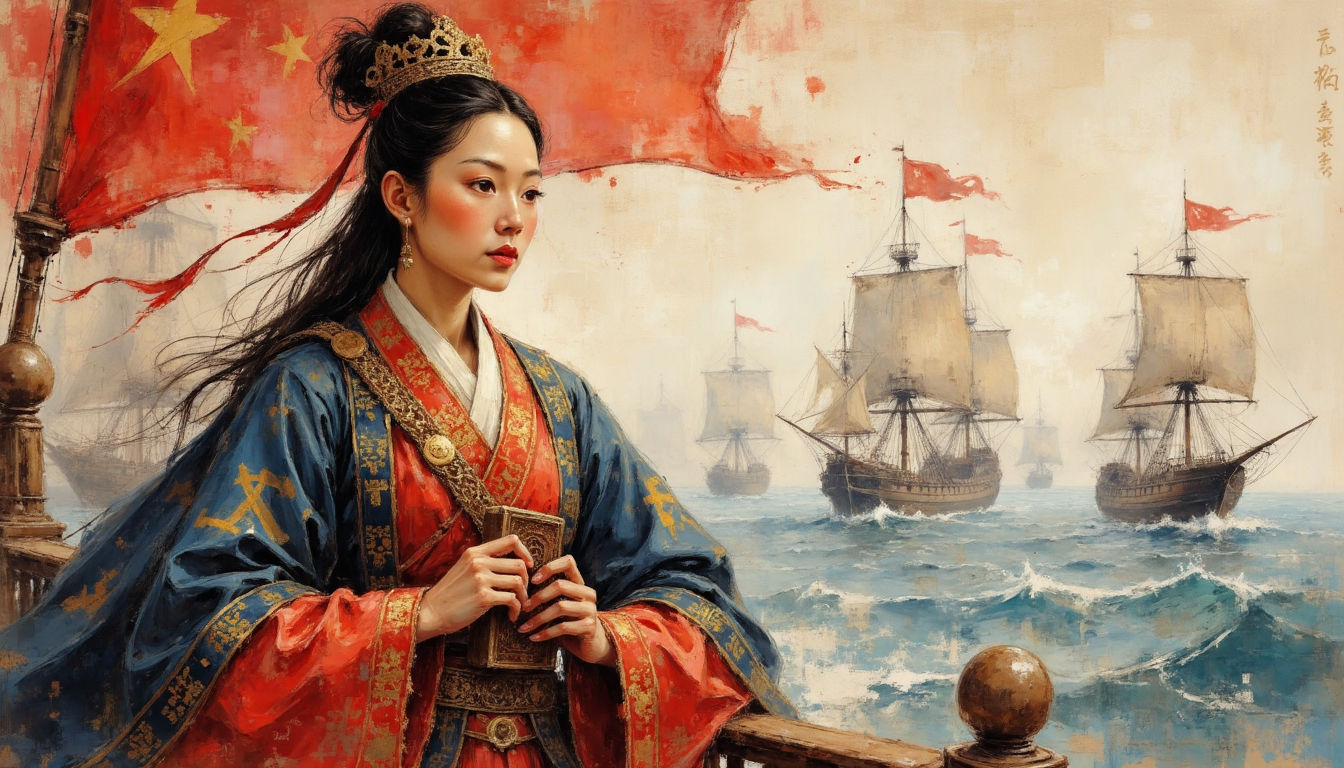
At the height of his infamy, the pirate Blackbeard commanded four ships and roughly 300 men. In the same century, a former sex worker from Canton commanded 1,800 warships and an estimated 80,000 pirates — and every major naval power in the world failed to stop her. When she finally stepped back from the South China Sea, she did so on her own terms, with her wealth intact, her freedom guaranteed, and her enemies relieved just to see her gone.
Her name was Ching Shih. Or more precisely, Zheng Yi Sao — “Wife of Zheng Yi.” The name is almost comically understated for someone who outmanoeuvred the Chinese Empire, the Portuguese Navy, and the British East India Company simultaneously.
This post tells the full story of the most successful pirate in recorded history: where she came from, how she built an empire governed by law and fear, why no one could defeat her, and what made her final act the most audacious move of all.
From a Flower Boat to a Fleet: The Origins of a Pirate Queen
To understand how Ching Shih became the force she was, you first need to understand what she came from.
Born around 1775 in Guangdong Province, southern China, she entered the world into grinding poverty. By early adolescence, she was working on a flower boat — one of the floating brothels that lined the ports of Canton. It was a life defined by powerlessness, yet she refused to be powerless within it. She quickly developed a reputation not just for beauty, but for shrewd intelligence, networking, and the ability to extract information and leverage from her high-profile clientele, which included military commanders, merchants, and imperial courtiers.
In 1801, the pirate commander Zheng Yi encountered her. Accounts differ on whether she accepted a proposal or was abducted — but what is clear is that she refused to be merely acquired. Before agreeing to marry Zheng Yi, she reportedly demanded a 50 percent share of his plunder and joint command of his fleet. He agreed. She was 26 years old.
Zheng Yi was already powerful, commanding a growing confederation of pirate fleets in the South China Sea. Under the influence of their partnership, that confederation expanded rapidly. By the time a typhoon killed Zheng Yi in November 1807, the fleet numbered up to 600 ships and 40,000 men. Most women in her position would have lost everything at that moment. Ching Shih moved immediately to consolidate it.
💬 “She was absolutely, unquestionably the greatest pirate who ever lived. She pirated longer. She made more money.” — Laura Sook Duncombe, author of Pirate Women: The Princesses, Prostitutes, and Privateers Who Ruled the Seven Seas
The Red Flag Fleet: An Empire Built on Law and Terror
The moment Ching Shih took command of the Red Flag Fleet is the moment she stopped being a story about gender and became a story about governance.
Her first act was not military — it was organisational. She cemented her authority by taking Zheng Yi’s charismatic adopted son, Zhang Bao, as her second-in-command, later marrying him. This secured loyalty from the fleet’s existing power structure. Then she did something remarkable for the early nineteenth century — she wrote a constitution.
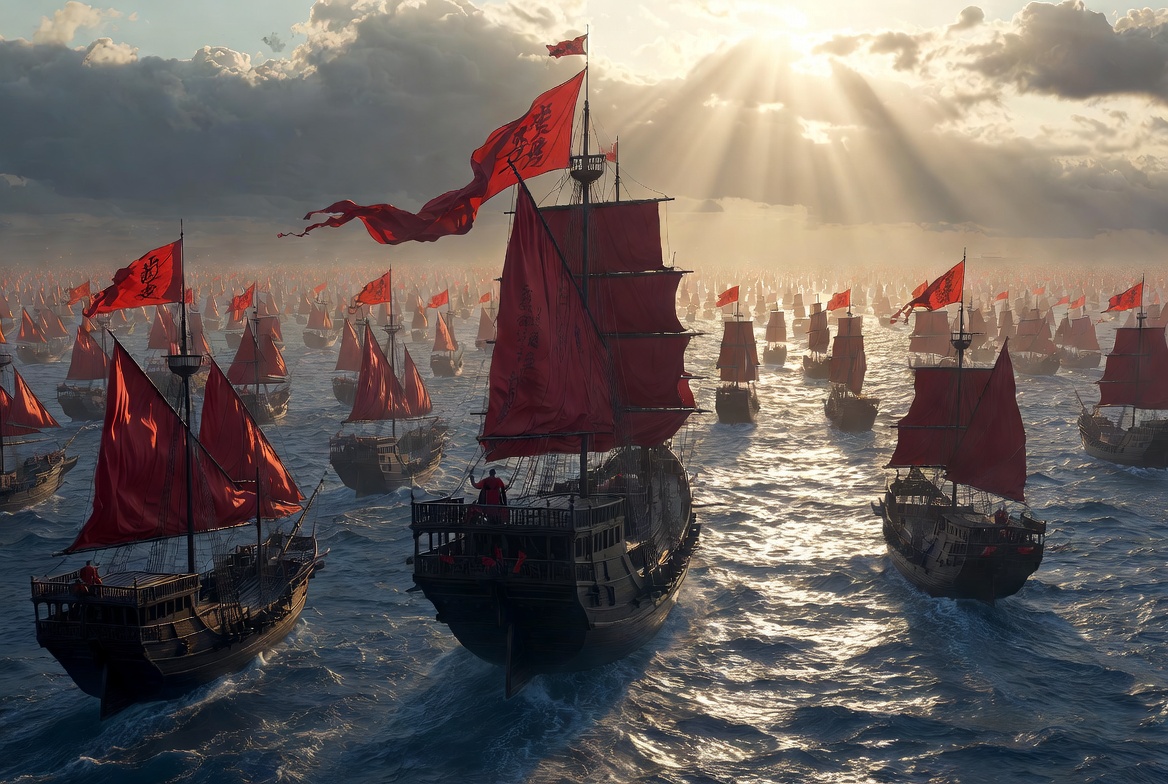
Her Code of Conduct governed every ship in the confederation and was displayed in a common area on every vessel. Its rules were exacting and the penalties were absolute:
| Rule | Penalty for First Offence | Penalty for Second Offence |
|---|---|---|
| Attack without authorisation | Beheading | — |
| Conceal plunder from the fleet | Flogging | Death |
| Desert your post without permission | Ears cut off, paraded publicly | Death |
| Rape a female captive | Beheading | — |
| Steal from coastal villages that supplied the fleet | Death | — |
This was not merely cruelty for its own sake. It was institutional design. By standardising punishment, Ching Shih eliminated arbitrary violence that could fracture loyalty, ensured that loot was distributed through the chain of command (building financial dependency on her system), and, crucially, built a reputation for disciplined reliability that made coastal communities and merchants far more willing to cooperate with her fleet’s protection schemes.
The Red Flag Fleet levied protection money from merchant ships leaving port and taxed coastal towns from Macau to Canton. By 1810, this semi-feudal maritime economy effectively gave her control over most of Guangdong Province — not just its waterways, but its commerce, its fishing rights, and its supply chains.
📌 KEY INSIGHT
Ching Shih did not just build a pirate fleet — she built a functioning parallel state with tax collection, legal codes, supply logistics, and a command hierarchy sophisticated enough to coordinate operations across hundreds of miles of coastline. No other pirate in history came close to this level of systemic organisation.
Evidence, Data & Examples: Against All Comers
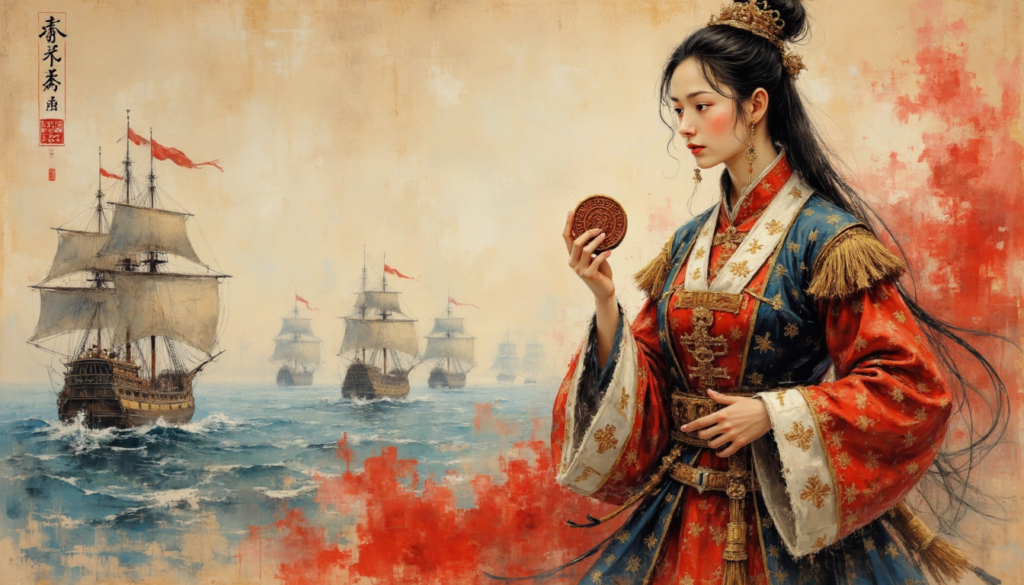
The scale of what Ching Shih faced — and defeated — is almost difficult to comprehend.
Fleet comparison: Ching Shih vs. the most famous pirates in history
| Pirate | Era | Ships | Estimated Personnel |
|---|---|---|---|
| Ching Shih | 1807–1810 | ~1,800 | ~80,000 |
| Blackbeard (Edward Teach) | 1716–1718 | 4 | ~300 |
| Bartholomew Roberts | 1719–1722 | ~4 | ~520 |
| Henry Morgan | 1660s–1670s | ~36 (at peak) | ~2,000 |
| Sir Francis Drake | 1570s–1580s | ~30 (at peak) | ~1,500 |
Much of what we know about the fleet’s internal operations comes from Richard Glasspoole, a British East India Company officer captured by the Red Flag Fleet in September 1809 and held for four months. His written account after release described the organisation and discipline of the confederation in extraordinary detail — including his estimate of 80,000 people operating under her command.
The Qing dynasty’s military campaigns against her followed a grim pattern of escalation and failure. In July 1808, a 35-ship imperial flotilla under Admiral Lin Guoliang was decimated. A second force of 100 ships — half the available Qing navy — was also repelled. After both defeats, the Emperor turned to European powers for help. A joint Chinese-Portuguese fleet attempted to blockade the Red Flag Fleet in Tung Chung Bay during the September 1809 Battle of the Tiger’s Mouth. For three months, the Portuguese attempted to destroy her ships. When the government launched “suicide boats” — vessels loaded with explosives and set alight — Ching Shih’s pirates extinguished the flames, repaired the ships, and folded them into their own fleet. The Chinese commander in charge of the operation falsified his reports to hide the scale of his failure, then later took his own life in shame.
She also converted defeats into recruitment. After each victory over imperial forces, she offered the surviving Qing sailors amnesty — join the Red Flag Fleet or leave unharmed. The fleet grew with every confrontation.
Practical Implications: What Her Story Actually Teaches Us
Ching Shih’s story is often told as a tale of inspiration — a woman rising against all odds. That is true, but it understates the precision of what she actually did.
Her methods map directly onto principles that management theorists and military strategists would not formalise until centuries later:
Standardised rules reduce friction at scale. A workforce of 80,000 people spread across hundreds of ships cannot be managed through personal charisma alone. Her Code of Conduct created predictable expectations that held the confederation together without requiring her constant presence.
Incentive structures determine loyalty. By ensuring that loot was distributed systematically through the hierarchy, she aligned the financial interests of every lieutenant with the continuation of her system. Betrayal was economically irrational.
Strategic retreat is not defeat. When Ching Shih recognised in 1810 that internal fractures — particularly the jealousy of the Black Flag Fleet’s commander, Kuo P’o-Tai, who refused to support her against the Portuguese — were beginning to weaken the confederation, she did not fight to the last ship. She negotiated.
The amnesty deal she secured was extraordinary. Her pirates received pardons and were allowed to keep their plunder. Many former pirates were absorbed into the imperial military. Zhang Bao was given a command in the Qing navy. Ching Shih herself walked away with her wealth, a small retained fleet, and — in some accounts — an honorary title from the very government that had spent years and enormous resources trying to destroy her.
💬 “The Qing Empire effectively concluded that bargaining with her was easier than defeating her.” — Sevenswords.uk
She spent the remaining thirty-four years of her life running a gambling house in Canton, dying peacefully in 1844 at approximately 69 years of age. For a pirate ruler of the nineteenth century, that outcome, as one historian wrote, “borders on absurdly successful.”
Nuances, Counterpoints & What’s Next
History as clean as Ching Shih’s tends to invite scrutiny, and some is warranted.
The historical record is fragmentary. Surviving Chinese sources from the Qing period are incomplete, and some of what we know was filtered through Western accounts — including Glasspoole’s, which, while detailed, was the perspective of a captive. The scholar Dian Murray, whose work on Chinese piracy remains authoritative, notes that the figure of 80,000 pirates may be a high estimate, and that the internal rivalry between the Red and Black Flag Fleets played a larger role in Ching Shih’s eventual retirement than many popular accounts acknowledge. “Mounting pressure from the outside and internal loss of cohesion” — Murray’s words — paint a more complicated picture than pure invincibility.
There is also a moral dimension that hagiographic accounts tend to glide past. The Red Flag Fleet terrorised coastal communities. Villages were burned. Civilians were killed in large numbers, including a reported massacre of 80 people at Sansham whose severed heads were displayed as warnings. Thousands were robbed, some were murdered, and others were sold into slavery. Ching Shih was a brilliant leader, but the people who experienced her fleet’s protection rackets were not always in a position to appreciate the distinction.
Her cultural legacy, however, continues to grow. She inspired the character of Mistress Ching in Pirates of the Caribbean, appeared in a Doctor Who special in 2022, and features in video games, graphic novels, and a growing body of popular history. As Western audiences increasingly seek out histories that complicate the standard roster of European male adventurers, she stands as one of the most compelling alternatives the historical record has to offer.
Conclusion
Ching Shih built the largest pirate confederation in recorded history from nothing — from a flower boat in Canton to a maritime empire that humbled three navies. She ran it with a legal code more consistent than most states of the era, outlasted every military force sent against her, and retired wealthy and free while her enemies were grateful just to be rid of her.
What makes her story remarkable is not only the scale of what she achieved, but how deliberately she achieved it. Every decision — the marriage negotiation, the Code of Conduct, the alliance with Zhang Bao, the timing of the amnesty — reflects a mind that understood power structurally, not just situationally.
History is full of powerful men who died violently at the peak of their power. Ching Shih is the rare figure who knew exactly when to stop, and exactly what to ask for when she did. The most successful pirate in history did not burn out. She cashed out.

🔑 KEY TAKEAWAYS
- Ching Shih commanded approximately 1,800 ships and 80,000 pirates — dwarfing every other pirate in recorded history by an order of magnitude.
- Her rise from poverty and sex work to supreme maritime command was enabled by sharp negotiation skills she deployed from the very beginning, including the conditions of her own marriage.
- The Red Flag Fleet operated under a written Code of Conduct with severe, standardised penalties — a governance innovation that gave the confederation unusual stability and discipline.
- Three Qing imperial fleets, the Portuguese Navy, the British East India Company, and Dutch naval forces all failed to defeat her. No external enemy ever brought down the Red Flag Fleet.
- Ching Shih retired on her own terms in 1810 with full amnesty, all her plunder, and a peaceful life — dying at 69, which is essentially unheard of for major pirate leaders of any era.
Frequently Asked Questions
Who was Ching Shih and why is she famous?
Ching Shih (also known as Zheng Yi Sao) was a Chinese pirate leader who commanded the Red Flag Fleet in the South China Sea from 1807 to 1810. She is famous for commanding an estimated 80,000 pirates and 1,800 ships — the largest pirate confederation in recorded history. No naval force of the era, including the Chinese imperial, Portuguese, and British fleets, could defeat her.
How did Ching Shih become a pirate?
Ching Shih began her adult life working on a flower boat — a floating brothel — in Canton. In 1801, she married pirate commander Zheng Yi, reportedly demanding 50 percent of his plunder and joint command as conditions of the marriage. After his death in 1807, she took control of his fleet and rapidly expanded it into an empire that dominated the South China Sea.
What was Ching Shih’s Code of Conduct?
Ching Shih’s pirate Code of Conduct was a written legal framework displayed on every ship in her fleet. It mandated that all plunder be declared and distributed through the hierarchy, prohibited unauthorized attacks, banned desertion, and imposed the death penalty for the rape of female captives. Violations were met with flogging, public humiliation, or beheading depending on severity.
Why did Ching Shih retire instead of continuing to fight?
By 1810, internal divisions — particularly the rivalry between the Red Flag and Black Flag Fleets — were weakening the confederation from within. Recognising this, Ching Shih chose to negotiate rather than fight a deteriorating situation. She secured an extraordinary amnesty deal from the Qing dynasty, allowing her fleet to keep their plunder and retire peacefully, with many pirates absorbed into the imperial military.
How does Ching Shih compare to Blackbeard and other famous pirates?
The comparison is almost absurd in scale. Blackbeard commanded four ships and around 300 men. Ching Shih commanded roughly 1,800 ships and 80,000 people. Even the most celebrated Western pirates — Bartholomew Roberts, Henry Morgan, Sir Francis Drake — never commanded forces remotely comparable. Most historians and scholars describe her as the most successful pirate in recorded history.
Did any navy successfully defeat Ching Shih in battle?
No external navy defeated the Red Flag Fleet outright. The Qing dynasty sent multiple flotillas, all of which were repelled or destroyed. A joint Chinese-Portuguese fleet failed to break her at the 1809 Battle of the Tiger’s Mouth. The British East India Company negotiated a truce rather than fight her. She was ultimately weakened by internal confederation rivalries, not external military force.
Is Ching Shih based on real history or is she a legend?
Ching Shih is a fully historical figure, documented in Qing administrative records, the writings of the Chinese scholar Yuan Yung-lun, and the eyewitness account of British East India Company officer Richard Glasspoole, who was held captive by her fleet for four months in 1809. While some details are disputed or lost to history, the core facts of her command, her battles, and her amnesty negotiation are well-established.
Sources & further reading:
- Zheng Yi Sao — World History Encyclopedia
- Ching Shih: The Chinese Pirate Queen’s Red Flag Fleet — Atlas Obscura
- A Chinese Woman Led the Largest and Most Successful Pirate Fleet in History — Military.com
- 10 Facts About Ching Shih, China’s Pirate Queen — History Hit
- Ching Shih: The Pirate Queen Who Terrified the South China Sea — Sevenswords.uk