Table of Contents
A religion founded on ahimsa — the sacred principle of non-violence — produced some of history’s most feared armies. The Shaolin monks of Tang-Dynasty China and Japan’s sōhei warrior monks carried staffs, spears, and blades while wearing robes that were supposed to signify renunciation of the world. For centuries they were courted by emperors, feared by warlords, and condemned by their fellow Buddhists.
How does a philosophy of compassion end up on the battlefield? The answer is less about theology than about power — and about what inevitably happens when monasteries become the wealthiest, most politically influential institutions in their civilizations. This post traces the parallel rise of warrior monks in two cultures, examines the forces that militarized the monastery, and asks what that history means for how we understand both Buddhism and institutional power.
The Paradox at the Heart of Buddhist Monasticism
Buddhism’s first precept is unambiguous: pāṇātipātā veramaṇī — abstain from taking life. The principle of ahimsa, meaning non-harm, is not a minor footnote in Buddhist ethics; it is woven into the Eightfold Path itself, embedded within Right Action and Right Intention. The Vinaya — the monastic code governing monks and nuns — reinforces this with explicit prohibitions on violence.
Yet Buddhism is also a tradition that took root in ancient India, a world of kings, standing armies, and caste-bound warriors, before spreading through feudal China and medieval Japan. As monasteries grew wealthy from royal patronage and land grants, they became landholders, political actors, and targets. Protecting that wealth required force. A monastery that refused to engage could simply be raided, absorbed, or burned out of existence.
Historian Meir Shahar, in his landmark study The Shaolin Monastery (University of Hawaii Press, 2008), identifies the key theological move that made Buddhist martial culture possible. In Chinese Buddhist practice, he argues, the achievement of physical strength was increasingly understood as an integral part of the quest for spiritual perfection. The body became a site of cultivation, not merely restraint. A monk who had mastered his body through rigorous training had, in this logic, mastered his mind — reframing the staff not as a weapon of aggression but as an instrument of inner discipline.
Japan’s sōhei operated under a parallel but distinct justification: defending the Dharma — the Buddhist teaching and its community — was itself a sacred duty. If the monastery was the vessel of the Dharma, then protecting it by force was not violence. It was devotion.
💬 “The achievement of physical strength was often viewed as an integral component of the quest for spiritual perfection.” — Meir Shahar, The Shaolin Monastery, University of Hawaii Press, 2008
The Making of a Warrior Monk: Two Civilizations, One Logic
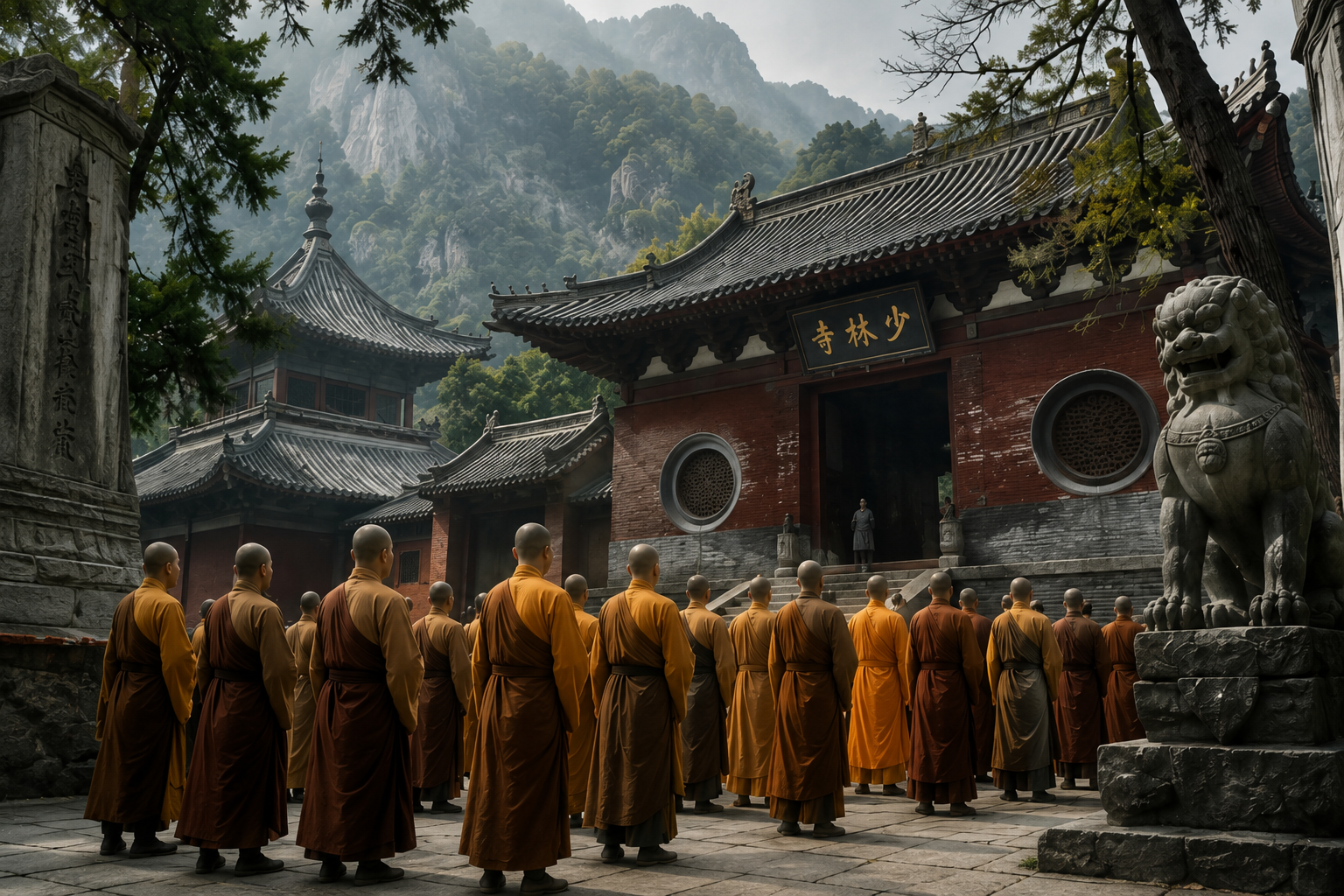
The Shaolin Monastery was founded in 496 AD on Song Mountain in Henan Province, China, as a Chan Buddhist centre of meditation and study. Its early centuries were unremarkable. By the Sui–Tang transition in the early 7th century, however, the temple had developed a culture of martial training robust enough to field a small combat force — and a political grievance sharp enough to deploy it.
The defining moment came in 621 AD. As Li Shimin — the future Emperor Taizong — fought to consolidate Tang power against the warlord Wang Shichong, the Tang army found itself overstretched. Wang had already seized Shaolin’s lands, turning the monks into natural allies. Thirteen Shaolin monks, led by the monk Tan Zong, descended from Song Mountain, ambushed a Zheng army garrison, and captured Wang’s nephew. A stone stele erected at the Shaolin Temple in 728 AD names every one of the thirteen monks involved — making this one of the best-evidenced acts of monastic warfare in Chinese history.
📌 KEY INSIGHT BOX
In 621 AD, just thirteen Shaolin monks helped determine the fate of a dynasty. Emperor Taizong’s reward — official state sanction to train armed monks — legitimised military practice at Shaolin for over a millennium, and seeded the global spread of kung fu through a single imperial decree.
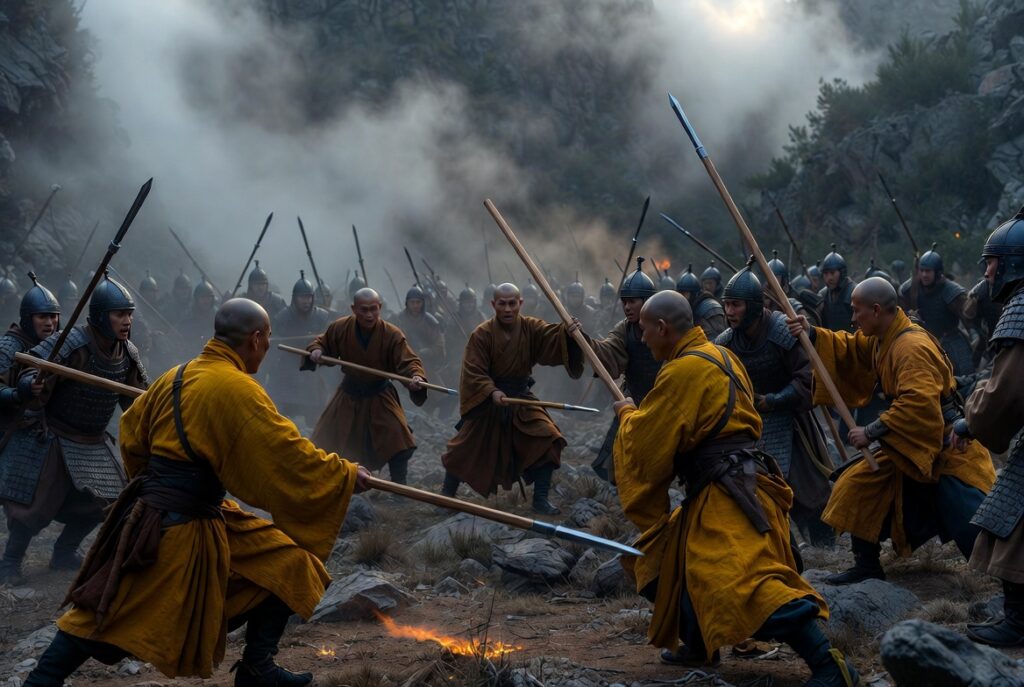
Emperor Taizong rewarded the monastery generously. He granted Shaolin formal permission to maintain warrior monks, sent gifts of wine and meat (exempting the Shaolin monks from standard dietary precepts), and designated it the supreme temple in China. That final privilege scandalized orthodox Buddhists at the time and continues to divide scholars today.
In Japan, the trajectory was structurally similar but institutionally distinct. The sōhei (僧兵 — literally “monk-soldiers”) first appeared around 970 AD when Enryakuji, the great Tendai temple on Mount Hiei overlooking Kyoto, established a standing armed militia in response to a dispute with the Yasaka Shrine. The trigger was mundane — a quarrel over an administrative appointment — but the institution it produced was formidable. By the 11th century, three great warrior-monk complexes — Enryakuji, Kofukuji, and Mii-dera — were fielding armies of hundreds, sometimes thousands. They marched on the imperial capital, extorted feudal lords, and burned each other’s temples to the ground. The Mii-dera was completely razed twice: in 1121 and again in 1141, both times by Enryakuji’s sōhei.
Key Events and Turning Points
TIMELINE — Warrior Monks in History (496 AD–1571 AD)
| Year | Event | Location |
|---|---|---|
| 496 AD | Shaolin Monastery founded on Song Mountain | China (Henan) |
| 621 AD | 13 Shaolin monks assist Li Shimin; Tang Dynasty secured | China |
| 728 AD | Shaolin Stele erected, recording the monks’ military deeds | China |
| 970 AD | Enryakuji establishes the first permanent sōhei army | Japan |
| 981 AD | First armed conflict between rival Tendai sub-sects | Japan |
| 1121 AD | Enryakuji sōhei raze Mii-dera temple to the ground | Japan |
| 1180 AD | Sōhei armies participate in the Genpei Civil War | Japan |
| 1351 AD | Shaolin Temple looted and burned in the Red Turban Rebellion | China |
| 1371–1644 | Shaolin monks fight pirates and bandits under Ming patronage | China |
| 1571 AD | Oda Nobunaga destroys Enryakuji; the sōhei era ends | Japan |
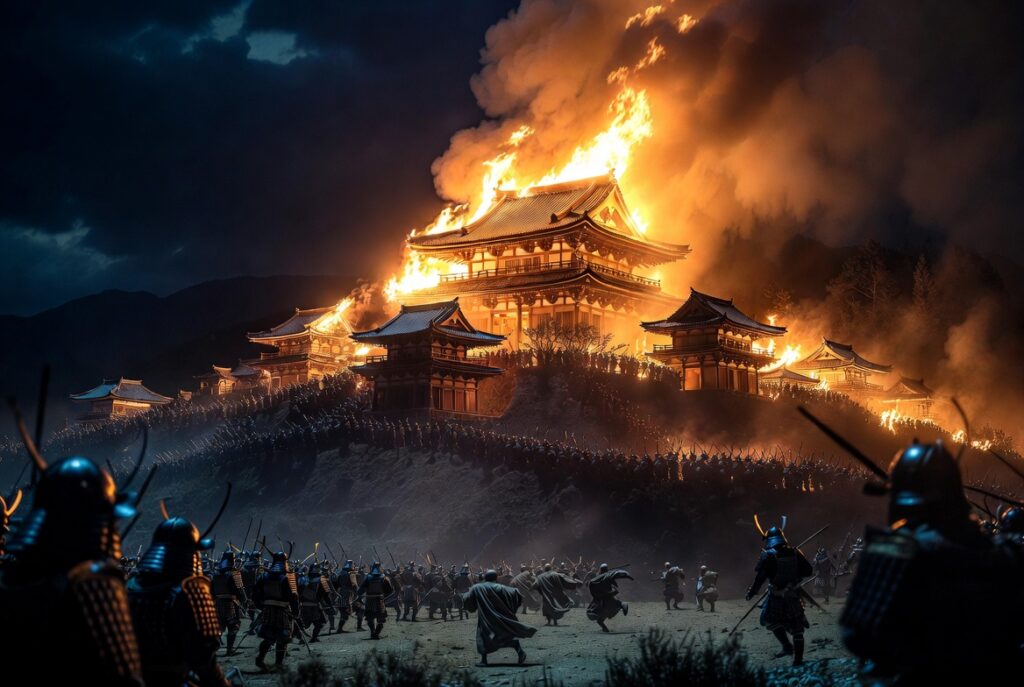
The end of the sōhei was as dramatic as their rise. On the night of September 30, 1571, the warlord Oda Nobunaga surrounded Mount Hiei with 30,000 soldiers divided into three columns, cut off every escape route, and set the sacred mountain ablaze. Enryakuji — at its peak a complex of over 3,000 buildings housing up to 25,000 residents — was reduced to ash. Between 1,500 and 4,000 people died, including scholars, priests, women, and children. Only a single small hall, the Ruridō, survived. Nobunaga’s message was unambiguous: no institution, however sacred, stood above political authority.
Religion, Power, and the Long Shadow of Monastic Violence
The most instructive insight warrior monks offer is not theological but institutional: they were not an anomaly within Buddhism — they were an inevitability within feudalism.
Monasteries in medieval China and Japan were not secluded retreats. They were landowners, bankers, educational centres, and employers. Enryakuji at its height controlled vast agricultural estates around Kyoto. Any institution of that scale, operating in a world without reliable state protection, must either develop its own coercive capacity or become prey to others’. The monastery’s choice of the staff over submission was rational by the standards of its time.
Many sōhei, it should be noted, maintained a communal and highly disciplined way of life within their factions — sharing possessions, welcoming orphans and widows, and following strict training regimens passed from generation to generation. Their violence, at least in their own understanding, was protective. It was the Dharma, not plunder, that they were defending.
This logic has never fully left Buddhist institutional life. In Myanmar, Sri Lanka, and Thailand, monks have been involved in organized communal violence as recently as the 2010s — in every case framed as the defence of a Buddhist community under existential threat. The theological grammar of the sōhei echoes across centuries.
💬 “The temple was the vessel of the Dharma. To let it burn undefended was not peace — it was surrender.”
Nuances, Counterpoints, and Open Questions
The warrior monk tradition is contested at multiple levels. Modern scholars debate how genuinely “monastic” the sōhei were: some were fully ordained monks; others were laypeople employed by temples who shaved their heads for social or tactical reasons. The boundaries between monk, mercenary, and militiaman were consistently porous.
The Shaolin case is equally complicated. Shahar’s research reveals that the monastery’s martial identity was significantly constructed and amplified retroactively — through Ming-Dynasty fiction, popular legends, and later, 20th-century cinema. The kung fu tradition associated with Shaolin today bears only a partial resemblance to actual historical monastic practice.
Critics within Buddhism have long rejected the entire tradition. Theravāda communities in Southeast Asia largely maintained stricter separation between monk and soldier, adhering more faithfully to the Vinaya’s non-violence clauses. Whether violence can ever be genuinely compatible with Buddhist ethics remains an open question — one that the warrior monk tradition raised in blood and iron, and left unresolved.
Conclusion
The warrior monks of Shaolin and Mount Hiei were not a contradiction within Buddhism — they were a consequence of Buddhism inhabiting the world. When monasteries became wealthy enough to attract enemies, they became powerful enough to field armies. When emperors needed allies, they found them on sacred mountains. The line between spiritual discipline and martial discipline dissolved because both were understood, in their time and place, as paths to the same mastery of self.
What endures is not the violence itself but the question it poses: Can any institution, however genuinely committed to peace, maintain that commitment under the full weight of political and economic power? The 728 AD stele at Shaolin and the single surviving hall on Mount Hiei are not merely historical relics. They are still asking.
🔑 KEY TAKEAWAYS
- Buddhism’s first precept prohibits taking life, yet Shaolin monks and Japan’s sōhei both developed major martial traditions — driven by institutional self-defence and political entanglement, not doctrinal revision.
- In 621 AD, thirteen Shaolin monks helped secure the Tang Dynasty; Emperor Taizong’s reward was official state sanction for armed monks, legitimising martial practice at Shaolin for over a millennium.
- Japan’s sōhei first emerged around 970 AD from inter-temple rivalry; by the 16th century their armies rivalled those of secular warlords and had reshaped the political map of medieval Japan.
- Oda Nobunaga ended the sōhei era in 1571 by destroying Enryakuji with 30,000 soldiers — a decisive demonstration that centralised secular power would ultimately prevail over armed religion.
- The theological logic behind warrior monks — that protecting the Dharma justifies force — has never fully disappeared from Buddhist institutional life and continues to surface in 21st-century political contexts.
Frequently Asked Questions
What are warrior monks in Buddhism?
Warrior monks in Buddhism — known as sōhei (僧兵) in Japan and wǔsēng (武僧) in China — were monastics or monastery-aligned fighters who combined religious life with military training. While Buddhism’s core teachings prohibit violence through the principle of ahimsa, warrior monks emerged in medieval China and Japan as monasteries accumulated land, wealth, and political power that required armed defence.
Did Shaolin monks really fight in ancient Chinese wars?
Yes. The most documented instance is from 621 AD, when thirteen Shaolin monks assisted Li Shimin — the future Emperor Taizong — in securing the Tang Dynasty by ambushing enemy forces and capturing a key general. A commemorative stele erected at the Shaolin Temple in 728 AD names each of the thirteen monks, making this one of the best-evidenced acts of Buddhist monastic warfare in Chinese history.
Why did Japanese sōhei warrior monks become so powerful?
Japanese sōhei grew powerful because their parent institutions — major Tendai temples like Enryakuji — accumulated enormous wealth, extensive land holdings, and deep political influence during the Heian period (794–1185 AD). As temples competed for imperial appointments and territory, armed monks became instruments of institutional coercion. By the 11th and 12th centuries, sōhei armies were large enough to march on Kyoto and enforce monastic demands on secular rulers.
How did Oda Nobunaga end the warrior monk era in Japan?
On September 30, 1571, Oda Nobunaga surrounded the Enryakuji complex on Mount Hiei with approximately 30,000 soldiers, set the mountain’s forests ablaze, and killed an estimated 1,500 to 4,000 people — monks, scholars, women, and children. The complex of over 3,000 buildings was almost entirely destroyed. This event marked the definitive end of the sōhei as an independent military and political force in Japan.
Does Buddhism actually allow violence in self-defence?
This remains a genuinely contested question within Buddhist thought. The primary Theravāda interpretation holds that violence is always harmful and that monks must observe strict non-violence. Mahāyāna traditions — dominant in China and Japan — developed more flexible ethical frameworks, sometimes permitting force in defence of the Dharma and the Buddhist community. Warrior monks relied on these interpretations, but they were always controversial among more orthodox Buddhists.
What weapons did warrior monks use?
Shaolin monks became most identified with the staff (棍, gùn), which became the monastery’s emblematic weapon after the 621 AD campaign. Japanese sōhei are most often depicted wielding the naginata — a curved-blade polearm — alongside spears and swords. Some sōhei adopted arquebuses (early firearms) by the Sengoku period. Both traditions favoured long-reach weapons suited to fighting armoured opponents in open terrain.
Are there Buddhist warrior monks today?
No formal tradition of warrior monks as a military-political institution survives. Modern Shaolin monks continue to practise martial arts as a spiritual and cultural discipline rather than actual combat. The sōhei ceased to exist as a distinct class after the 16th century. However, the broader tension between Buddhist ethics and political violence has re-emerged in the 21st century in Myanmar, Sri Lanka, and Thailand — where some monks have supported or participated in communal conflicts, raising questions the warrior monk tradition never fully resolved.
Sources & further reading:
- Meir Shahar, The Shaolin Monastery: History, Religion, and the Chinese Martial Arts (University of Hawaii Press, 2008)
- Enryakuji — World History Encyclopedia
- Siege of Mount Hiei — Wikipedia
- Buddhist Warrior Monks: The Sōhei of Medieval Japan — Medievalists.net
- The Shaolin Monks in Battle: A Complete Historical Record — Shaolin Kung Fu Academy