Table of Contents
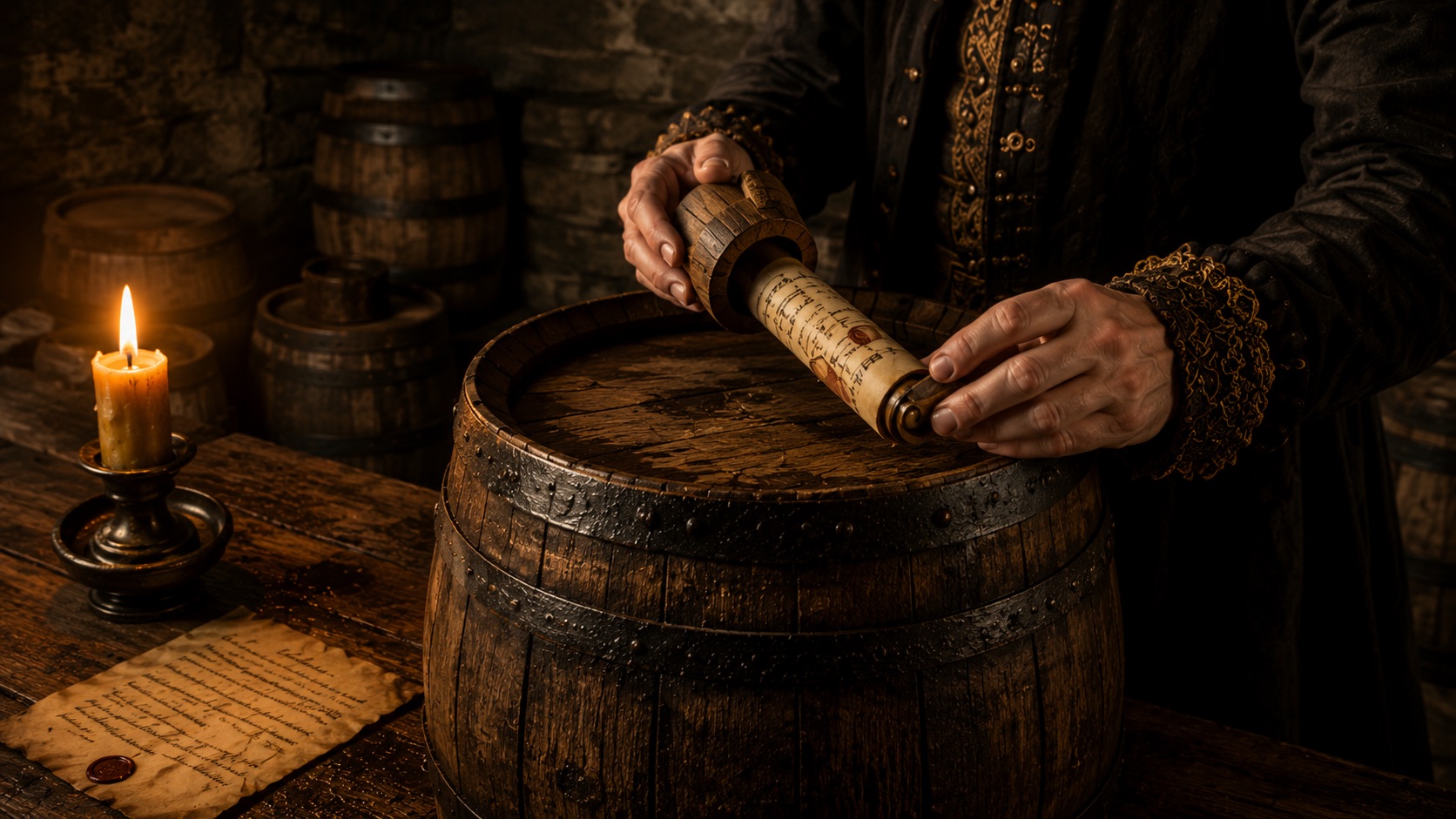
Somewhere in England in 1586, a barrel of beer was quietly delivering state secrets. Hidden inside the cork was an encrypted letter from Mary Queen of Scots to a group of Catholic conspirators planning to assassinate Queen Elizabeth I. What Mary did not know was that every letter she had sent and received for months had been intercepted, copied, decoded, and read by one man’s operatives before being carefully resealed and forwarded. The trap was already sprung. She just didn’t know it yet.
That man was Sir Francis Walsingham — Elizabeth I’s Principal Secretary, and arguably the most consequential intelligence officer in history. Four centuries before the NSA, GCHQ, or the CIA, Walsingham built something the world had never seen: a centralised, professional, multi-continental intelligence service with dedicated cryptanalysts, double agents, a training school, and a doctrine for turning information into power. This post traces how he did it, why it worked, and why every modern spy agency on earth owes him a debt it has never fully repaid.

The World Walsingham Inherited — And the Threats That Built His Network
To understand why Walsingham’s creation was so radical, you first have to understand just how dangerous Elizabethan England was. When Elizabeth I came to the throne in 1558, she was a Protestant queen in an era when the Pope had essentially declared open season on Protestant monarchs. She had been excommunicated. Spain, the era’s superpower, was hostile. France was unpredictable. And England harboured thousands of Catholic subjects whose allegiance to Rome arguably superseded their loyalty to their queen.
The threat was not abstract. In 1584, William of Orange, leader of the Protestant resistance in the Netherlands, was shot dead by a Catholic assassin. Closer to home, Elizabeth faced a succession of serious assassination plots: the Ridolfi Plot (1571), the Throckmorton Plot (1583), and eventually the Babington Plot (1586). Each was designed not merely to kill the queen but to replace her with a Catholic alternative — most often Mary Queen of Scots, who had been imprisoned in England since 1568.
England, meanwhile, could not compete with Spain on a conventional military footing. Philip II commanded the wealth of the Americas and the most formidable army in Europe. Elizabeth’s advisers recognised that England’s survival would depend not on matching Spain soldier for soldier, but on knowing Spain’s plans before Spain could execute them. Intelligence was not a supplementary tool — it was the primary weapon.
Walsingham was appointed Principal Secretary in 1573, a role roughly equivalent to a combined foreign secretary and national security adviser. He had already served as Elizabeth’s ambassador to France and witnessed the St Bartholomew’s Day Massacre in 1572, in which thousands of Huguenots were slaughtered in a single night. The experience left him with a lifelong, bone-deep conviction: that enemies of Protestant England would not hesitate to use any means necessary, and that the only effective response was to know everything, everywhere, always.
💬 “They note him to have had certain curiosities, and secret ways of intelligence above the rest.” — Sir Robert Naunton, Fragmenta Regalia, 1641
The Architecture of the First Modern Intelligence Service
What made Walsingham genuinely unprecedented was not that he used spies — princes had used informants for millennia. What was new was the system he constructed around them.
He built what historians now describe as Europe’s first modern intelligence service: a structured organisation combining what would today be the functions of MI5 (domestic counter-intelligence), MI6 (foreign intelligence gathering), GCHQ (signals interception and cryptanalysis), and the Metropolitan Police’s Special Branch (surveillance of domestic radicals). All of this was the creation of one man, funded substantially from his own pocket.
At its operational peak, the network comprised 53 active spies, 18 agents stationed in foreign countries, and a far larger web of domestic informants. Walsingham received regular intelligence from 12 locations in France, 9 in Germany, 4 in Italy, 4 in Spain, and additional posts across Europe — with reach extending as far as Constantinople, Algiers, and Tripoli.
📌 KEY INSIGHT
Walsingham’s intelligence service was reportedly so efficient that secret communications dispatched from Rome were said to reach London before they arrived in Spain. He achieved this not through superior technology, but through systematic human placement — merchants, diplomats, priests, and courtiers all cultivated as sources across a continent.
His methods were equally sophisticated. He used dead-letter boxes for clandestine message handoffs, complex ciphers and invisible ink for secure communications, and double agents planted at the highest levels of hostile courts in Rome and Spain. He ran a dedicated team of experts in the technical black arts of the trade: not just spies, but specialists — men who could crack codes, forge documents, and open sealed letters without leaving a trace.
Most remarkably, Walsingham ran a spy school inside his own London home. There he trained recruits in cipher, forgery, and field tradecraft. The school’s most successful graduate was Thomas Phelippes — fluent in five languages, trained in Al-Kindi-style frequency analysis, and, in the words of one biographer, “as a cryptographer, forger, and gatherer of secret correspondence” without equal. Phelippes became England’s first professional cryptanalyst, and the consequences of his work would change history.
The Babington Plot — Tradecraft at Its Most Ruthless
The episode that cemented Walsingham’s reputation — and secured Mary Queen of Scots’ death warrant — was the Babington Plot of 1586. It stands as one of the most sophisticated intelligence operations in history, and the techniques involved would not look out of place in a modern signals-intelligence manual.
In early 1586, Anthony Babington and a circle of Catholic conspirators were planning to assassinate Elizabeth and place Mary on the throne. Walsingham was aware a plot was forming. His challenge was not simply to stop it, but to acquire the one thing that would make Mary’s guilt legally incontestable: her own written words, in her own cipher, endorsing regicide.
He deployed a double agent named Gilbert Gifford, who posed as a Catholic courier and established a covert communications channel between the imprisoned Mary and the outside world. Letters were smuggled to Mary hidden in the corks of beer barrels regularly delivered to her household. What Mary did not know was that Gifford supplied every letter to Walsingham before delivery, and that Phelippes was decrypting each one.
The cipher Mary and Babington used was a nomenclator — a substitution cipher mixing letter symbols with codewords for frequent names and phrases. To modern cryptographers it looks fragile. Phelippes cracked it using frequency analysis: counting which symbols appeared most often and mapping them against the known distribution of letters in English. Once the letter glyphs were mapped, the codeword glyphs fell quickly from context.
On 17 July 1586, Mary wrote to Babington explicitly endorsing the assassination of Elizabeth. Walsingham had his evidence. But he was not yet finished. He ordered Phelippes to add a forged postscript to Mary’s letter — written in her own cipher — asking Babington to name his six co-conspirators. It was, in modern terminology, a man-in-the-middle attack: content injected into a communication stream the recipient believed was secure.
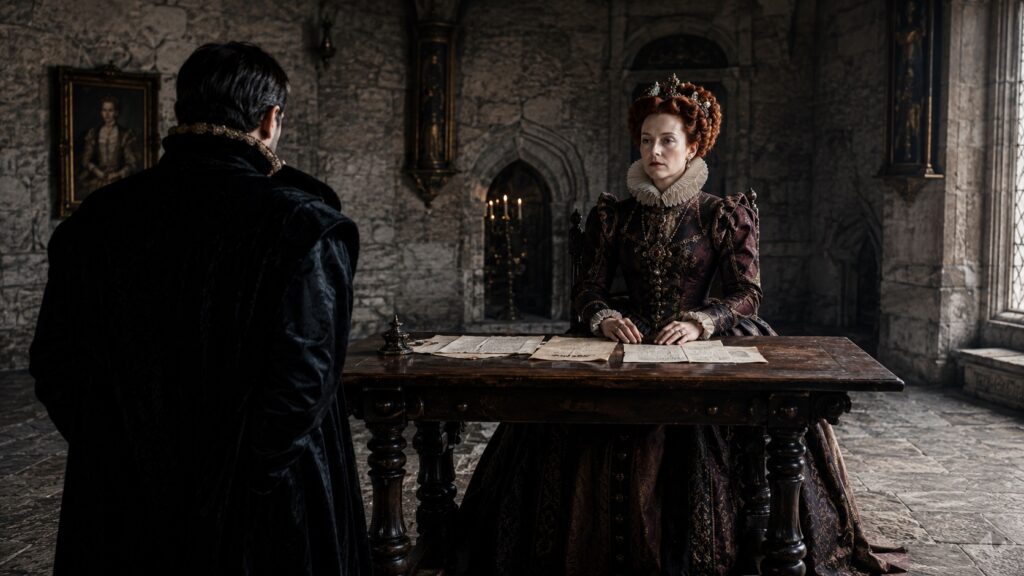
The Babington Plot is the first case in recorded history where cryptanalysis was the documented cause of a state execution. Mary Queen of Scots was beheaded on 8 February 1587. She had been undone not by force, but by mathematics.
| Walsingham’s Method | Modern Equivalent |
|---|---|
| Dead-letter box (beer barrel cork) | Secure brush-pass or dead drop |
| Nomenclator cipher | End-to-end encrypted messaging |
| Frequency analysis by Phelippes | Automated statistical cryptanalysis (GCHQ/NSA) |
| Forged postscript injected into letter | Man-in-the-middle (MITM) attack |
| Double agent Gifford | Managed asset / agent provocateur |
| Spy school in Walsingham’s home | Intelligence officer training academies |
| Network of merchant informants | Non-official cover (NOC) officers |
From Beer Barrels to the Spanish Armada — Strategic Intelligence in Practice
The defeat of the Spanish Armada in 1588 is remembered as an English naval triumph. Less celebrated is the fact that it was also an intelligence triumph — and that Walsingham’s network was arguably more important to the outcome than any English admiral.
By the mid-1580s, Walsingham had placed agents at the heart of Spanish naval planning. One of his most valuable assets, Anthony Standen, operated under the code name “Pompeo Pellegrini” and provided detailed intelligence on Spanish preparations — including fleet sizes, embarkation dates, and the identity of commanders. Walsingham’s cryptanalysts, working with Dutch rebel sources, cracked Philip II’s codes. This gave Sir Francis Drake the intelligence he needed to launch a preemptive strike on the Spanish port of Cadiz in 1587, destroying supply ships and delaying the Armada by a critical year.
When the Armada finally sailed in 1588, the English were not surprised. Walsingham’s intelligence on the fleet’s location, composition, and tactical intentions allowed English commanders to make decisions that conventional naval intelligence alone could never have supported.
Beyond collection, Walsingham also ran an active disinformation campaign — feeding false intelligence through double agents about English harbour conditions, tide times, and coastal geography. This combination of collection, analysis, and deception is the template every modern intelligence service follows.
💬 “His security apparatus and international financial machinations were major factors in the defeat of the Spanish Armada.” — Warfare History Network
Yet here lies one of history’s cruelest ironies. Walsingham died in April 1590, two years after the Armada, deeply in debt. He had funded much of his intelligence network from his own resources, and the Elizabethan state never adequately reimbursed him. He was buried at night, in a secret ceremony — possibly to prevent his creditors from seizing his body in lieu of payment. The man who saved England died broke.
The Limits of Genius — What Walsingham Left Behind, and What He Didn’t
Walsingham’s legacy is immense, but it is also complicated by a fundamental fragility: the entire apparatus was held together by one man’s personal authority, personal finances, and personal relationships.
When he died in 1590, the network did not survive the transfer of power intact. The Earl of Essex and Sir Robert Cecil both attempted to step into the vacuum, but without a single co-ordinating authority, English intelligence fragmented. Agents failed to collaborate. Information fell through gaps. Most strikingly, Walsingham’s successors received no advance warning of the second and third Spanish armadas sent against England in the 1590s — fleets that would have been catastrophic had storms not dispersed them.
This reveals the central tension in Walsingham’s achievement. He invented the concept of a modern intelligence service, but he built it around himself rather than around an institution. The CIA, MI6, and GCHQ are agencies — structures that outlive any individual. Walsingham’s creation was, at bottom, a man with an idea.
There are also darker dimensions to confront. The same network that intercepted letters and cracked codes also authorised torture in the Tower of London, entrapped men with evidence manufactured by forgers, and created what Atlas Obscura has called an “original surveillance state” — a regime in which Elizabeth’s subjects could trust no conversation, no letter, and no messenger. The techniques that defended liberty were also tools of its suppression.
The possible involvement of playwright Christopher Marlowe as one of Walsingham’s agents adds a further layer of intrigue. Marlowe’s mysterious long absences from Cambridge, his inexplicable wealth as a scholarship student, and his sudden violent death in 1593 have led historians to speculate — without definitive proof — that he moved in Walsingham’s world. If true, it would mean that the man who inspired Shakespeare was also, in some sense, a spy.
Conclusion
Francis Walsingham spent 17 years building a machine the world had not seen before — one that combined human intelligence, signals interception, cryptanalysis, counterintelligence, disinformation, and asset management into a coherent system of state power. He did it under constant threat, with insufficient funding, and in the face of a queen who was often reluctant to act on his intelligence until it was almost too late.
Every modern intelligence agency bears his fingerprints: the doctrine that information beats firepower; the use of double agents to collapse enemy operations from within; the cryptanalytic imperative to read what adversaries believe is unreadable; the understanding that deception is as important as collection. The rose on his wax seal sits on MI5’s coat of arms to this day.
He died in debt, buried in secret, having arguably saved his country twice. If you want to understand why modern states invest billions in signals intelligence and human networks, the answer does not start in Langley or Cheltenham. It starts in a London house in the 1570s, where a driven, ruthless, and quietly brilliant man was teaching his recruits how to forge a letter, crack a cipher, and never be seen.
🔑 KEY TAKEAWAYS
- Francis Walsingham, Elizabeth I’s Principal Secretary from 1573–1590, built what historians consider the world’s first modern, centralised intelligence service.
- At its peak, his network operated 53 spies, 18 foreign-stationed agents, and informants in cities from Paris to Constantinople.
- The Babington Plot (1586) was the first documented case in history where cryptanalysis — the breaking of an enemy cipher — caused a state execution.
- Walsingham ran a dedicated spy school in his own home and employed England’s first professional cryptanalyst, Thomas Phelippes, who pioneered frequency analysis.
- His intelligence work was a decisive factor in the English defeat of the Spanish Armada in 1588, through agent networks, code-breaking, and active disinformation.
Frequently asked questions
Who was Francis Walsingham and why is he important?
Sir Francis Walsingham (c. 1532–1590) served as Principal Secretary to Queen Elizabeth I and built England’s first systematic intelligence service. He is important because he invented the institutional framework of modern espionage — combining agents, double agents, cryptanalysts, and disinformation into a single centralised operation. Historians regard him as the direct ancestor of modern agencies like MI5, MI6, and the CIA.
What was the Babington Plot and how did Walsingham use it?
The Babington Plot was a 1586 Catholic conspiracy to assassinate Queen Elizabeth and install Mary Queen of Scots. Walsingham used a double agent to intercept Mary’s encrypted letters and deployed his cryptanalyst Thomas Phelippes to decode them. He even forged a postscript in Mary’s own cipher to extract the names of her co-conspirators — a technique strikingly similar to a modern man-in-the-middle attack. The plot led directly to Mary’s execution in 1587.
Did Christopher Marlowe work as a spy for Walsingham?
There is strong circumstantial evidence but no definitive proof. Marlowe’s mysterious long absences from Cambridge, spending well beyond a scholarship student’s means, and the Privy Council’s unusual intervention on his behalf at graduation have led many historians to believe he worked for Walsingham’s service. His patron, Thomas Walsingham, was a cousin of Francis’s and conducted intelligence operations. No document directly confirms Marlowe’s role as an agent.
How did Walsingham’s spy network contribute to defeating the Spanish Armada?
Walsingham placed agents inside Spanish naval planning circles — most notably Anthony Standen, who operated under the alias “Pompeo Pellegrini.” His network provided advance intelligence on fleet composition, departure timing, and Spanish intentions. His cryptanalysts broke Philip II’s codes. The intelligence enabled Sir Francis Drake’s 1587 raid on Cadiz, which delayed the Armada by a year, and gave English commanders crucial tactical knowledge when the fleet finally sailed in 1588.
How large was Walsingham’s spy network?
At its peak, the network consisted of 53 active spies, 18 agents stationed in foreign countries, and a larger web of domestic informants. Walsingham received regular intelligence from reporting stations in 12 locations in France, 9 in Germany, 4 in Italy, 4 in Spain, plus outposts elsewhere in Europe and even in Constantinople, Algiers, and Tripoli. He reportedly personally funded much of this operation, dying heavily in debt in 1590.
What modern intelligence techniques did Walsingham pioneer?
Walsingham pioneered techniques that remain foundational today: systematic use of double agents, dead-letter box communication, frequency analysis for code-breaking, forged document insertion into enemy communications (equivalent to modern MITM attacks), active disinformation campaigns, and the systematic cultivation of merchants and diplomats as non-official-cover intelligence sources. He also established the first known formal training programme for intelligence officers.
Why did Walsingham’s intelligence network collapse after his death?
Walsingham built his network around his own authority and personal finances rather than around a durable institution. When he died in April 1590, no successor commanded the same unified control. Essex and Cecil competed for influence, agents failed to share intelligence, and England received no advance warning of subsequent Spanish armada attempts. This institutional weakness revealed the fundamental difference between one man’s genius and a sustainable intelligence apparatus — a problem modern agencies were specifically designed to solve.
Sources & further reading:
- Sir Francis Walsingham — Encyclopaedia Britannica
- The Ruthless 16th-Century Spy Network That Kept Queen Elizabeth I Safe — History.com
- Queen Elizabeth I’s Vast Spy Network Was The First Surveillance State — Atlas Obscura
- Sir Francis Walsingham — Warfare History Network
- The Babington Plot Cipher (1586) — The Cipher Museum