Table of Contents
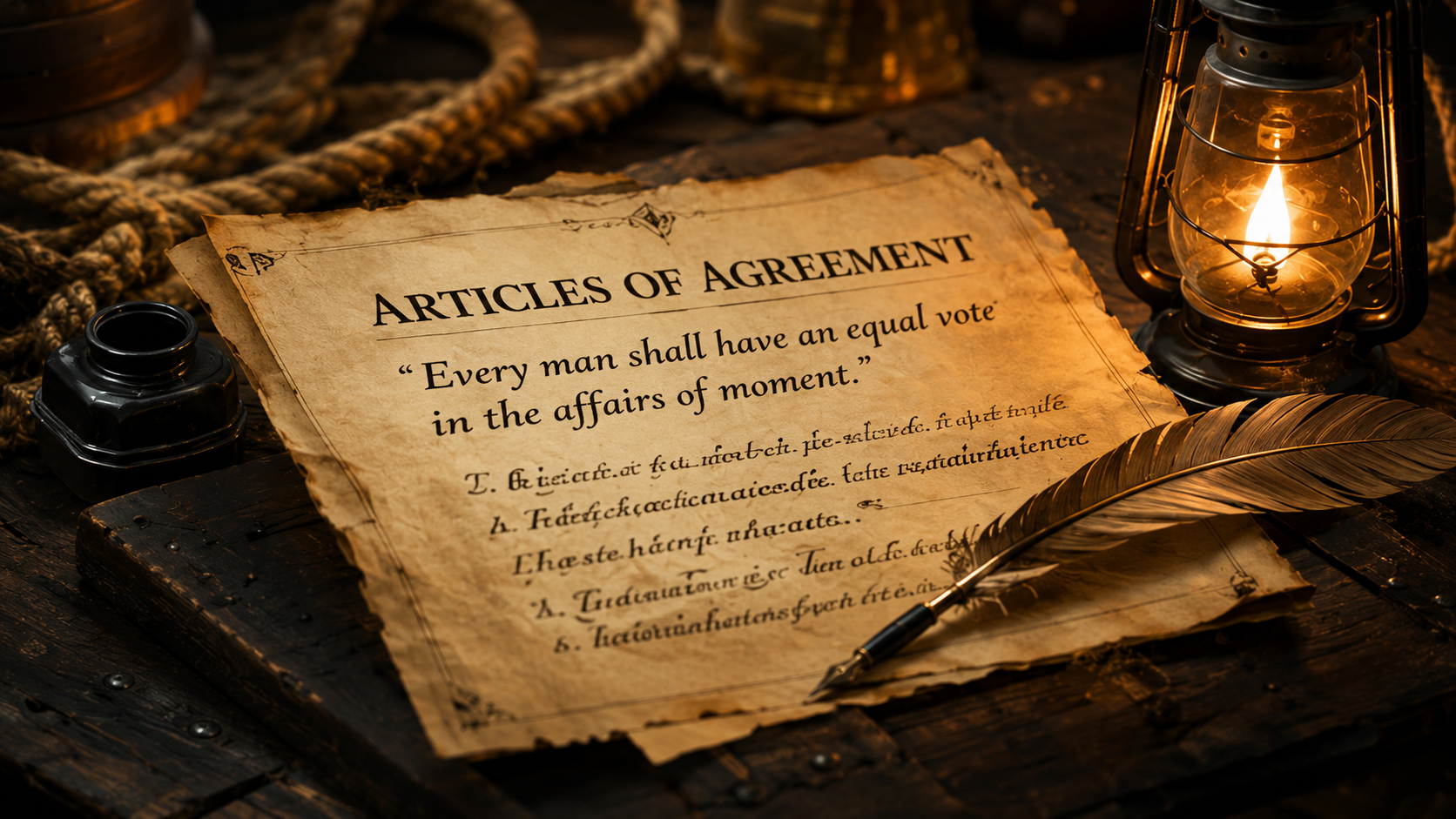
Around 1721, a Welsh pirate captain named Bartholomew Roberts composed a document aboard his ship that opened with a startling declaration: “Every man shall have an equal vote in the affairs of moment.” He was not a political philosopher or a statesman. He was the most successful pirate of his era, having seized over 400 vessels across three oceans. And yet, the rules he set down read less like a criminal charter and more like a constitutional draft—one that would not look out of place in Philadelphia sixty years later.
The question of whether pirate ships represented an early form of democracy is no longer confined to popular folklore. Historians and economists have spent decades examining the surviving evidence, and what emerges is both surprising and nuanced. Pirates of the Golden Age operated under written codes of governance—complete with elections, separation of powers, equitable profit-sharing, and even early forms of workers’ compensation—that predated many of the political structures we now consider foundational to liberal democracy.
This post traces the origins of the pirate code, examines its democratic mechanics in detail, and asks what these floating constitutions reveal about the nature of governance itself.
The World That Made Pirates—and the Codes They Wrote
To understand why pirates developed democratic institutions, it helps to understand what they were escaping. Most Golden Age pirates were former sailors: men who had served under merchant captains or in the Royal Navy under conditions that bordered on feudal. Officers exercised absolute authority, pay was routinely withheld, food was controlled as a form of discipline, and punishment was arbitrary and brutal. The sea was a world of extreme hierarchy, and ordinary seamen sat at its very bottom.
The Golden Age of Piracy spanned roughly 1650 to 1730, with its most concentrated phase occurring between 1716 and 1726. It intensified partly because the Treaty of Utrecht (1713), which ended the War of the Spanish Succession, left thousands of privateers—sailors legally licensed to raid enemy ships—abruptly unemployed. Many turned to piracy not out of pure malice but out of economic necessity, and they carried aboard their ships a burning resentment of the authority they had just escaped.
Out of this context emerged the Articles of Agreement—the formal name for what we now call the pirate code. The concept had earlier roots. Caribbean buccaneers of the 1650s–1680s already operated under a system known as the chasse-partie (“custom of the coast” or “Jamaica Discipline”), which established principles of shared plunder and mutual obligation among crews. Later Golden Age pirates built on these buccaneer precedents, elaborating them into far more sophisticated constitutional documents.
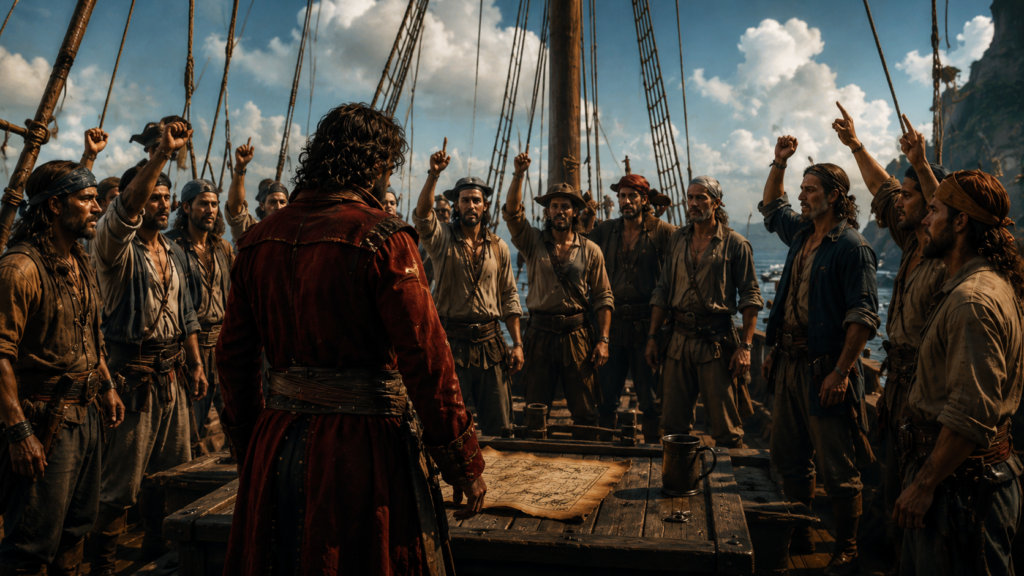
Each code was unique to its vessel, drafted by the crew before the voyage began, and required the explicit consent of every member before departure. Those who could write signed their names; those who could not pressed an inked thumb to the parchment. The act of signing was simultaneously a legal contract and a moral oath. No one could claim ignorance of the rules, and no one—captain included—stood above them.

Only four complete sets of pirate articles survive from the Golden Age, all preserved in Captain Charles Johnson’s 1724 work A General History of the Pyrates—the indispensable primary source for the period. They belong to Bartholomew Roberts, Edward Low, John Phillips, and John Gow, and together they reveal a governance system far more ordered and deliberate than the popular image of pirates as anarchic bandits would suggest.
💬 “The pirate codes were significantly ahead of their time. The pirates encoded democratic principles into their constitutions almost a century before the American and French Revolutions.” — Steven Johnson, “The Pirate Codes” (2021)
A Constitution at Sea: The Democratic Mechanics of the Pirate Code
The most radical feature of pirate governance was also its most straightforward: every man had a vote. This was not a ceremonial provision. Pirate crew democracy meant real, binding decisions—where to sail, which ships to attack, whether to continue a voyage or turn for port. Most critically, crews voted for their captain, and they could remove him.
A pirate captain held significant power during battle, where rapid, unambiguous command was essential to survival. Outside combat, his authority was tightly limited. The crew could depose a captain for cowardice, cruelty, or simple incompetence by majority vote, and several Golden Age captains were removed in exactly this way. Edward England was deposed by his own crew for treating a captive too generously. The captain served entirely at the pleasure of the men.
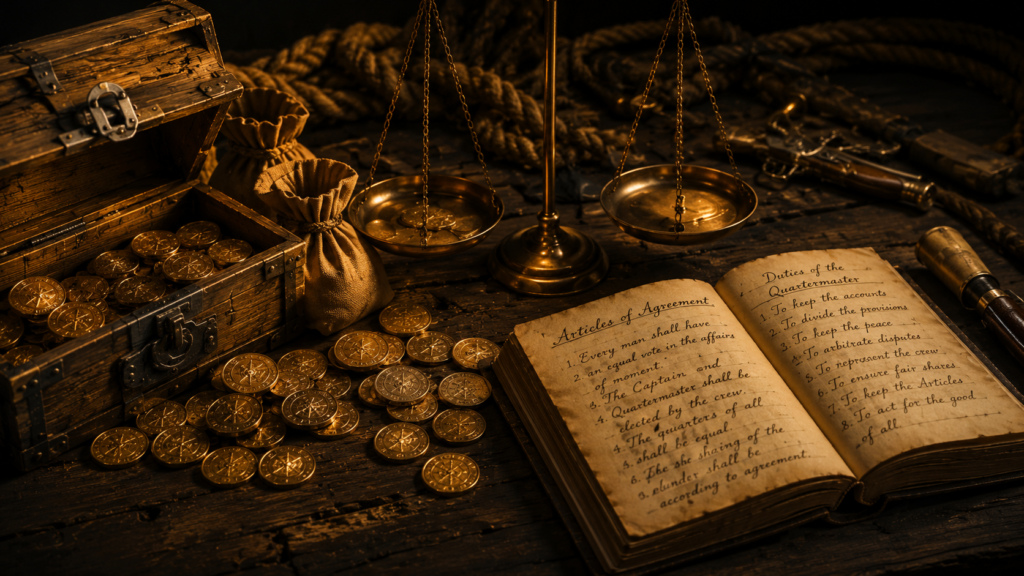
The most ingenious structural innovation in pirate governance was the formal separation of power between captain and quartermaster. The quartermaster was elected independently, serving as the crew’s representative against both officers and external threats. He controlled the distribution of food and plunder, adjudicated minor disputes, and acted as a constitutional check on the captain’s authority. Historian Marcus Rediker, in Villains of All Nations (2004), characterises the quartermaster as “the treasurer and counterweight to the captain”—a second power centre whose very existence made unilateral tyranny structurally difficult.
Peter T. Leeson, an economist at George Mason University, goes further in his landmark 2009 study The Invisible Hook. He argues that pirates “privately forged a system of constitutional democracy—complete with separated powers and checks and balances—long before the United States developed a similar system of governance.” His key insight is economic rather than ideological: pirates designed these institutions not out of principled commitment to liberty but from rational self-interest. A crew that trusted its governance structure would cooperate more effectively, fight more reliably, and share intelligence more openly. Pirate democracy was, at its core, a profit-maximising strategy.
📌 KEY INSIGHT BOX
Roberts’ opening article—”Every man shall have an equal vote in the affairs of moment”—was composed around 1721: roughly 55 years before the American Declaration of Independence and 68 years before France’s Declaration of the Rights of Man. Pirates did not theorise democracy. They practised it, in writing, under oath, on the open ocean.
The profit-sharing structure reinforced the democratic principle from below. Unlike the Royal Navy or the East India Company—where senior officers claimed multiples of what ordinary sailors received—pirate ships functioned more like worker cooperatives. Each man was a shareholder in the voyage. Captains earned more than ordinary crew, but the ratio was deliberately kept narrow. The symbolic message was as important as the material one: no single man’s contribution was worth infinitely more than another’s.
The Code in Practice: Evidence from the Golden Age
The most fully documented pirate code is Bartholomew Roberts’ Articles of Agreement, composed around 1721 and preserved in Johnson’s General History. Roberts—known as Black Bart—was a teetotaller and fierce disciplinarian who governed one of the most effective pirate enterprises in history, capturing over 400 vessels between 1719 and 1722 before his death in battle off the West African coast.
His articles covered governance in remarkable detail. Musicians were guaranteed rest on Sundays. Gambling was restricted to prevent debt-related conflict among crew. Lights were extinguished by 8 p.m. near gunpowder stores. Disputes between crew members were to be settled ashore, not at sea—a prescient conflict-resolution provision that kept lethal violence off the ship during voyages.
The share distribution in Roberts’ code was structured to align incentives while preserving a principle of rough equality:
| Rank | Share of Prize |
|---|---|
| Captain | 2 shares |
| Quartermaster | 1.5 shares |
| Master, Boatswain, Gunner | 1.5 shares |
| Carpenter and Surgeon | 1.5 shares |
| Ordinary Seaman | 1 share |
| Boys / Apprentices | 0.5 shares |
The differential between a captain and an ordinary sailor—two shares versus one—is strikingly modest compared to any contemporary legitimate institution. On East India Company vessels, the power and pay gap between officers and common sailors was vastly larger.
Perhaps the most remarkable provision of all was the injury compensation schedule—a pre-modern form of workers’ compensation. Roberts’ articles guaranteed fixed payouts from the common fund for specific injuries sustained in service: a lost arm, leg, eye, or finger each carried a defined compensation, drawn from communal resources. A crew member who risked his body for the voyage would not be abandoned by it. Academic analysis by Dr Ed Fox, cited in pirate surgery scholarship, confirms that at least six different Golden Age pirate groups included detailed wound compensation provisions in their surviving articles.
TIMELINE — The Evolution of Pirate Democratic Governance (c.1650–1730)
- c.1650s — Caribbean buccaneers develop the chasse-partie: the first systematic written codes for dividing plunder and governing crews
- 1660s–70s — Henry Morgan’s expeditions formalise injury compensation and detailed share rules among buccaneers
- 1696 — Captain William Kidd’s articles: one of the earliest surviving documented pirate codes
- 1715 — Treaty of Utrecht leaves thousands of privateers unemployed; third and most intense phase of Golden Age piracy begins
- 1716–1718 — Nassau, Bahamas functions as a de facto pirate republic under Benjamin Hornigold and contemporaries
- 1718 — Governor Woodes Rogers suppresses Nassau; ~300 pirates accept royal pardons
- 1719–1722 — Bartholomew Roberts active across three oceans; his articles become the model of pirate constitutionalism
- 1721 — Roberts’ Articles of Agreement composed—the most detailed and philosophically striking pirate code on record
- 1724 — Charles Johnson publishes A General History of the Pyrates, preserving four complete sets of articles for posterity
- c.1730 — Aggressive Royal Navy suppression ends the Golden Age; pirate governance fades from history
What Pirate Democracy Can Teach Us About Governance
The significance of the pirate code reaches well beyond nautical history. It poses a direct challenge to a prevailing assumption about democratic institutions: that they require Enlightenment philosophy, stable nation-states, and literate political classes to take root. Pirates had none of these things. What they had was a shared problem to solve, a common enemy in arbitrary authority, and the intelligence to build institutions that served their interests better than any alternative.
Leeson’s economic analysis argues that pirate democratic structures were responses to a specific governance challenge: how do you prevent a captain from abusing power on a vessel far from any legal accountability? The solution—elections, separation of powers, written articles—mirrors almost exactly the constitutional logic articulated in the Federalist Papers decades later. Necessity, not philosophy, produced the form. The pirates reached the same institutional destination as Madison and Hamilton, but they arrived there first, for entirely practical reasons.
💬 “Pirates understood the advantages of constitutional democracy—a model they adopted more than fifty years before the United States did so.” — Peter T. Leeson, The Invisible Hook (Princeton University Press, 2009)
Rediker’s social history adds a complementary reading. In Villains of All Nations, he frames Golden Age pirates as a class-conscious counter-society—men who had suffered the worst of hierarchical labour and deliberately constructed an alternative. Their codes were, in this reading, as much a protest movement as a governance mechanism, written in law rather than manifestos.
A 2025 paper in Capital & Class (SAGE) by Aykut Örküp frames this even more provocatively, describing pirate governance as a “prefigurative commoning movement”—an attempt to enact, however temporarily and imperfectly, a commons-based social order aboard a wooden ship in the Atlantic. The framing is deliberately anachronistic in its political theory, but it captures something real: these were people actively imagining and building an alternative to the economic and political order that had exploited them.
What all these interpretations share is an insistence that pirate democracy was not accidental. It was designed, documented, and enforced. It created accountability where none had previously existed, and it worked—within the boundaries the pirates themselves defined.
The Limits of the Jolly Roger’s Democracy
The democratic record of pirate ships deserves serious attention—but not uncritical celebration. The most visible limitation is one of membership. The articles governed the crew, and the crew was almost exclusively male. Women were formally barred from most ships, a provision Roberts and others made explicit. The famous female pirates Anne Bonny and Mary Read sailed with Calico Jack Rackham, but only by concealing their identities. Their gender was revealed only at capture.
The treatment of enslaved people was equally contradictory. Some historians estimate that 25–30% of Golden Age pirates were formerly enslaved Africans who served as full crew members, voted, and received equal shares—a genuinely radical departure from the norms of the colonial Atlantic. Yet many of these same crews traded enslaved people when profitable, or used enslaved people as part of the compensation structure in their injury schedules. The democracy was genuine for the crew; for those outside the articles, it offered nothing.
Historian Douglas Burgess, writing in The Pirates Pact (2009), challenges what he describes as the romanticisation of “so-called pirate democracy,” arguing that scholars like Rediker draw too sweeping conclusions from too narrow a body of evidence. The surviving source base is genuinely thin: four complete codes, all filtered through a single intermediary—Johnson’s General History—whose authorship and accuracy remain subjects of debate.
Finally, it is worth stating plainly: democratic articles existed alongside real violence. Punishments for violations included death and marooning. The social contract was enforceable, but it was enforced on a ship, at sea, where alternatives were limited. The consent that created the code was genuine; the conditions under which it operated were not always free.
Conclusion
The pirate code was not a romantic invention or a Hollywood anachronism. It was a written, sworn, collectively enforced system of governance that provided elections, power-sharing, defined profit distribution, and basic injury protections—all at a time when such ideas remained largely theoretical in the political world ashore. The men who signed these articles were not idealists. They were practical people solving practical problems, and their solutions happened to resemble constitutional democracy.
None of this dissolves the violence, the exclusions, or the criminality that surrounded pirate governance. What it does is complicate the story in a genuinely instructive way. If a group of 18th-century outlaws, operating outside every legal system, far from any state, could design institutions that checked tyranny and guaranteed a measure of collective voice—and could make those institutions work—it raises an uncomfortable question for the statesmen who came after them: What, exactly, were they waiting for?
🔑 KEY TAKEAWAYS
- Pirate codes (Articles of Agreement) were written, signed constitutional documents, drafted by the full crew and agreed upon before every voyage—not arbitrary rules imposed by a captain
- Pirate captains were elected by majority vote and could be removed by the same; their authority was explicitly limited to battle, balanced by a separately elected quartermaster
- The Golden Age pirate code predated the American Declaration of Independence by more than five decades, encoding equal voting rights, equitable profit-sharing, and injury compensation
- Economist Peter Leeson argues that pirates built constitutional democracy—with separated powers—through rational self-interest, not political philosophy, arriving at the same institutional solutions as the American Founding Fathers but earlier and independently
- The pirate code had genuine limits: women were formally excluded from most ships, and the democracy extended only to crew members, not to captives or enslaved people whom pirates also traded
Frequently Asked Questions
What was the pirate code of conduct?
The pirate code—formally called the Articles of Agreement—was a written set of rules governing life aboard a pirate ship during the Golden Age of Piracy. Each crew drafted its own version before sailing and every member agreed to the articles before departure. The code covered voting rights, the division of plunder, injury compensation, rules against gambling and violence between crew members, and specific punishments for violations such as theft or desertion.
Did pirates actually vote for their captain?
Yes, electing the captain was a core feature of pirate democracy. Under the pirate code, crew members voted to select their captain and could remove him by majority vote if he proved cowardly, abusive, or incompetent. Edward England, for example, was deposed by his own crew for being too lenient with a captive. This stood in stark contrast to naval and merchant ships of the era, where captains held near-absolute, legally backed authority over their crews.
How were pirate profits divided?
Pirate profits were divided by a pre-agreed share system defined in the articles. Captains typically received two shares of any prize, officers and specialists around one to one-and-a-half shares, and ordinary seamen one share each. This was far more equitable than on Royal Navy or merchant vessels, where senior officers claimed disproportionate rewards. Cargo was inventoried and distributed by the elected quartermaster, adding a second democratic check to the process.
Were pirate ships really democratic?
Within significant limits, yes. Pirate ships during the Golden Age featured genuine democratic mechanics: elected captains removable by vote, an independent quartermaster as a counterweight to the captain’s power, equal votes for all crew on key decisions, and written constitutions signed by the entire crew. Economist Peter T. Leeson argues in The Invisible Hook that these constitutional arrangements preceded America’s founding documents by over half a century.
Who was Bartholomew Roberts and why is his pirate code significant?
Bartholomew Roberts, known as Black Bart, was the most successful pirate of the Golden Age by ships captured—over 400 vessels between 1719 and 1722. His Articles of Agreement, composed around 1721, are the most detailed surviving pirate code. They established equal voting rights, an injury compensation schedule, profit-sharing ratios for every rank, and rules governing everything from musicians’ rest days to gambling. Roberts’ code is the clearest documented example of formal pirate constitutionalism.
Did pirates have something like workers’ compensation?
Remarkably, yes. Multiple pirate codes, including those of Bartholomew Roberts and others documented by Dr Ed Fox, included explicit injury compensation provisions drawn from the common fund. Crew members who suffered permanent injuries—a lost limb, eye, or hand—were entitled to a fixed payout agreed in advance. This principle of compensating workers for injuries sustained in service predates formal national workers’ compensation legislation in most countries by nearly two centuries.
What were the main weaknesses of pirate democracy?
The pirate code’s democracy was real but bounded. Women were formally excluded from almost all Golden Age pirate ships. The articles governed the crew exclusively; captives, enslaved people, and outsiders had no standing under the code. Some pirate crews also traded enslaved people as cargo, a contradiction that undermines any simple progressive reading. Historian Douglas Burgess has also challenged the extent to which the surviving evidence—largely filtered through a single source—supports the breadth of claims made by later scholars.
Sources & further reading:
- Leeson, Peter T. The Invisible Hook: The Hidden Economics of Pirates. Princeton University Press, 2009.
- Rediker, Marcus. Villains of All Nations: Atlantic Pirates in the Golden Age. Beacon Press, 2004.
- Johnson, Steven. “The Pirate Codes.” Adjacent Possible (Substack), February 2023.
- World History Encyclopedia. “Golden Age of Piracy.” Reviewed 2021.
- Örküp, Aykut. “The Jolly Roger Against Capital: Golden Age Piracy as a Prefigurative Commoning Movement.” Capital & Class, SAGE, August 2025.