Table of Contents
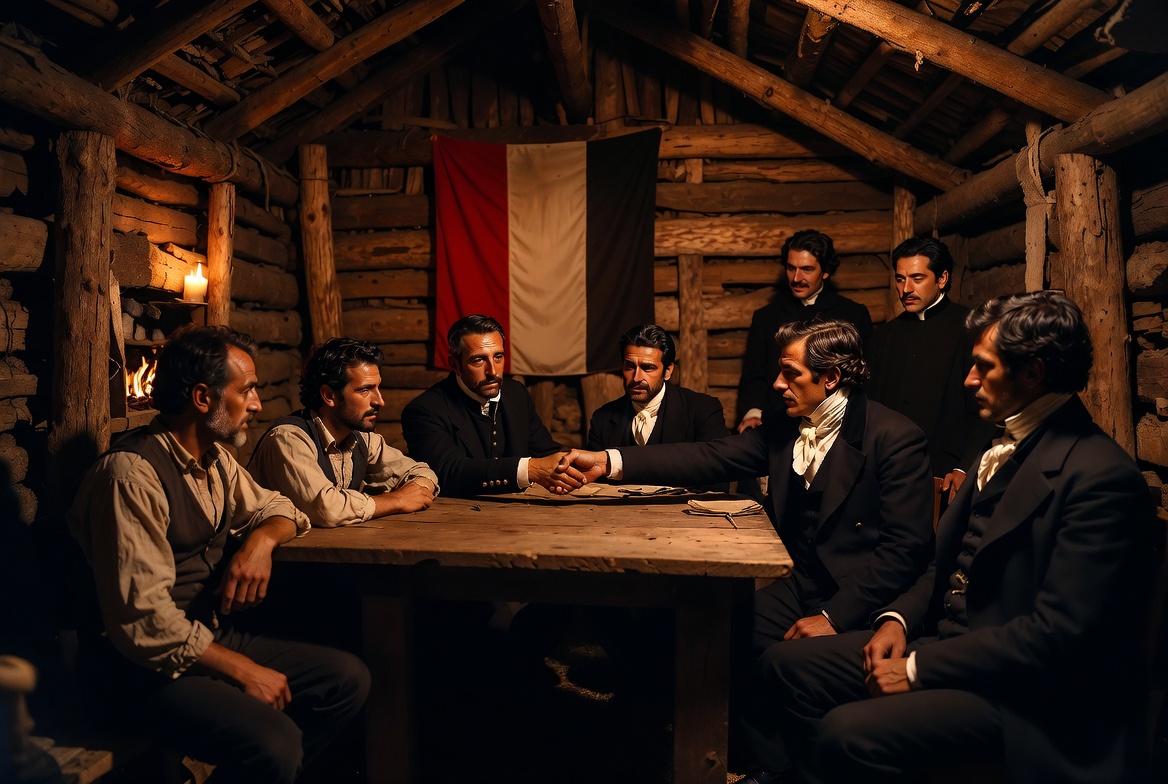
Picture this: a hillside in Calabria, sometime around 1815. A group of men gather in a charcoal-burner’s hut, exchanging coded handshakes and speaking in a vocabulary borrowed from the timber trade. One calls another buon cugino — “good cousin.” Anyone outside the circle is a pagano, a pagan. On the wall hangs a flag: red, white, and black. These men are peasants, lawyers, army officers, and at least one Catholic priest. They are the Carbonari — the charcoal burners — and they are plotting the end of the old European order.
This is not a story of a secret society that succeeded. The Carbonari’s uprisings were crushed, their leaders imprisoned or exiled, and the organisation itself effectively dissolved by the early 1830s. But history, as it so often does, reserves its deepest ironies for those who appear to lose. This article traces how a clandestine network of idealists and conspirators, active barely three decades, laid the intellectual and organisational groundwork for the birth of modern Italy.
Origins and Structure: Understanding the Carbonari Secret Society
The name alone is a puzzle. Why would a revolutionary organisation bent on toppling kings and expelling foreign armies name itself after charcoal burners?
The answer is deceptively practical. Charcoal burning was a common trade across the Apennines, particularly in Calabria, Campania, and the Abruzzi. Small groups of workers regularly gathered in remote forest huts (baracche) to tend their fires — gatherings that, to any suspicious constable, looked entirely unremarkable. The Carbonari borrowed this cover wholesale. Their meeting places were called vendite (literally “places of coal sale”), their lodges baracche, and their members buoni cugini — good cousins, the term charcoal workers used among themselves. Non-members were pagani, heathens — those outside the light.
The society emerged in the Kingdom of Naples during the first decade of the nineteenth century, most likely as a reaction to French imperial domination under Napoleon’s brother-in-law Joachim Murat. Its precise origins remain disputed among historians. Some argue the Carbonari grew organically from Neapolitan Freemasonry. Others suggest a French branch imported the model to Italy with the Napoleonic armies. What is clear is that by the time of Murat’s rule (1808–1815), the organisation had moved from a loosely affiliated mutualist fraternity into a structured political force.
Structurally, the Carbonari were ahead of their time. Each lodge operated as an independent cell, aware only of its own members and immediate superiors — a design that would later become the standard template for underground resistance movements across the twentieth century. Members progressed through two grades: apprentice (apprendista) and master (maestro), separated by a mandatory waiting period of at least six months. Rituals borrowed heavily from both Freemasonic ceremony and Catholic imagery: initiation rites invoked “the lamb torn by wild beasts” as a symbol of tyranny; clearing “the forest of wolves” stood for the liberation of Italy.
Hierarchically, the central authority was the Alta Vendita — the High Sale — the supreme lodge whose membership was kept almost entirely secret even from ordinary members. This structure allowed the movement to survive repeated crackdowns. Arrest one cell and you could not reach the next.
💬 “The Carbonari had lodges throughout Italy, but their main centres were in central Italy and the south, where they took up a decisively anti-Bourbon attitude — and their influence prepared the way for the Risorgimento, which resulted in Italian unification in 1861.” — Encyclopædia Britannica
The Central Argument: Why the Carbonari Secret Society Mattered
The standard historical verdict on the Carbonari is a polite shrug: a romantic but ultimately futile secret society that failed in its immediate objectives. This verdict is both technically accurate and almost entirely wrong.
To understand why, it helps to consider the context into which the Carbonari erupted. The Congress of Vienna (1814–1815) had returned the Italian peninsula to a mosaic of conservative, foreign-dominated states. The Habsburgs controlled Lombardy and Venetia directly. Bourbon kings sat in Naples and Sicily. The Pope held central Italy. Piedmont-Sardinia in the north remained the peninsula’s only nominally independent Italian dynasty. The liberal reforms of the Napoleonic period — rational law codes, weakened aristocratic privilege, expanded middle-class influence — were being systematically dismantled. There was no Italian state, no Italian army, no Italian press free to discuss Italian identity.
Into this political vacuum stepped the Carbonari. Unusually for a secret society, they made no single ideological demand. Some cells wanted a republic; others wanted a constitutional monarchy. Some dreamed of a federated Italy; others imagined a centralised unitary state. Some were devoutly Catholic; others anti-clerical. This apparent incoherence was actually a source of strength: it made the Carbonari a vessel into which almost any educated Italian with liberal sympathies could pour their aspirations.
What united members across these differences was a shared conviction that foreign domination was intolerable, that constitutions were necessary, and that change would not come from above. In a political environment where simply owning reformist literature could bring imprisonment, the Carbonari created a protected social space where opposition could crystallise, be named, and be transmitted.
📌 KEY INSIGHT BOX
Authorities in some territories passed ordinances condemning to death anyone who merely attended a Carbonari meeting — and yet the movement continued to grow. Fear of execution was, for thousands of Italians in the 1810s and 1820s, less powerful than the appeal of constitutional government. That willingness to risk everything — not the failed uprisings themselves — is what makes the Carbonari historically consequential.
Evidence, Data & Examples: A Timeline of the Carbonari’s Arc
The following timeline maps the Carbonari’s trajectory from formation to their indirect triumph in Italian unification.
TIMELINE: The Carbonari and the Road to Italian Unification (1800–1861)
| Year | Event |
|---|---|
| c. 1800 | First Carbonari lodges (vendite) form in the Kingdom of Naples, likely as an offshoot of Freemasonry under Napoleonic influence |
| 1808–1815 | The movement grows during Joachim Murat’s reign over Naples; Murat himself reportedly courted the Carbonari in 1815, shortly before his capture and execution |
| 1814 | Cardinals Consalvi and Pacca issue a papal edict against secret societies, explicitly targeting both the Freemasons and the Carbonari |
| 1815 | Congress of Vienna restores conservative Bourbon rule to Naples. King Ferdinand I attempts to destroy the Carbonari using a violent counter-society (the Calderari), which fails. Membership surges |
| 1820 | The Carbonari’s greatest tactical triumph: General Guglielmo Pepe, backed by thirty Carbonaro officers, mutinies at Caserta. Ferdinand I is forced to swear allegiance to a new constitution modelled on the Spanish Constitution of 1812. A parliament assembles in Naples |
| 1821 | Austrian troops march into Naples under the authorisation of the Holy Alliance. The constitutional government collapses. Simultaneously, a Carbonari-backed revolt in Piedmont forces Victor Emmanuel I to abdicate — but Charles Felix, with Austrian help, suppresses it. Carbonarism is declared high treason across much of the peninsula |
| 1821 | Pope Pius VII formally condemns the Carbonari (September 13). Prince Louis — the future Napoleon III — is known to be a member of the Roman vendita |
| 1821 | Lord Byron arrives in Ravenna at Christmas 1820, joins the Carbonari through his lover Teresa Guiccioli’s family, smuggles guns, and briefly commands his own turba (irregular unit) |
| 1831 | Carbonari-backed uprisings flare in Modena and the Papal States. They are rapidly crushed. The movement effectively dissolves as a coherent force |
| 1831 | Giuseppe Mazzini, former Carbonaro, founds Young Italy (La Giovine Italia) — explicitly rejecting secrecy in favour of open nationalist agitation |
| 1858 | Elements connected to the former Carbonari condemn Napoleon III to death for abandoning Italian unification. Felice Orsini, with ties to the old networks, nearly assassinates him in Paris (the Orsini affair) |
| 1861 | Italy is unified under the House of Savoy. Among the architects: Giuseppe Mazzini (former Carbonaro) and Giuseppe Garibaldi (former Carbonaro) |
The timeline reveals a crucial pattern: the Carbonari did not build Italy. They built the people who built Italy.
Practical Implications: What the Carbonari Model Teaches Us
History rewards readers who ask not only “what happened?” but “why does it still matter?”
The Carbonari offer one of the most instructive case studies in the history of political change: the distinction between tactical failure and strategic success. Every armed insurrection the Carbonari launched was crushed. The 1820 Neapolitan constitution survived less than a year. The Piedmontese revolt of 1821 lasted weeks. The 1831 uprisings barely registered. By any conventional military or political metric, the Carbonari were a failure.
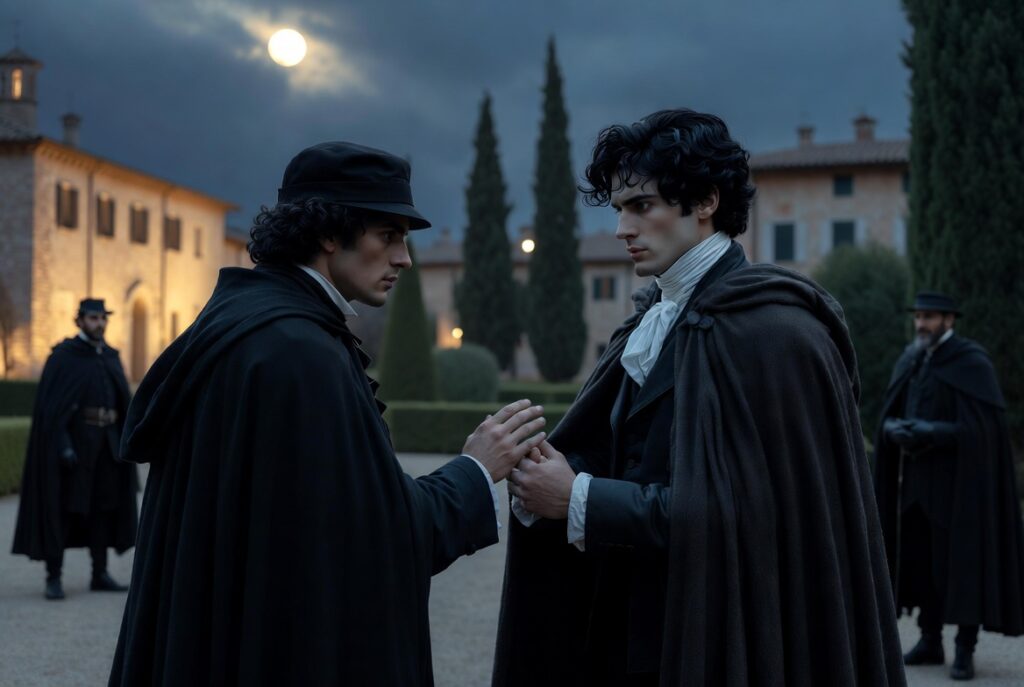
And yet: modern Italy exists. The man who articulated its philosophical foundations, Giuseppe Mazzini, was a Carbonaro who learned everything the movement had to teach — including what not to repeat. The man who conquered its southern half in 1860 with a volunteer army of a thousand, Giuseppe Garibaldi, had been shaped by the Carbonari tradition of clandestine resistance. The emotional and cultural vocabulary of the Risorgimento — martyrdom, sacrifice, the nation as a living organism — was written in Carbonari blood.
The lesson for understanding political change is uncomfortable: movements rarely succeed on their own timeline. The Carbonari’s real contribution was generational. They created the martyrology — Silvio Pellico’s harrowing memoir of his Austrian imprisonment, Le mie prigioni (My Prisons), sold across Europe and made foreign occupation of Italy viscerally real to an international audience. They proved to educated Italians that organised resistance was possible. They gave future leaders a network of contacts, a set of organisational precedents, and a canon of sacrifices to honour.
The Carbonari also represent an early model of transnational political activism. Their ideas and methods crossed borders with remarkable speed. By 1821, a French branch — the Charbonnerie — had spread through France, triggered military mutinies, and alarmed the restored monarchy. Portuguese and Spanish radicals adopted similar models. Branches appeared in South America. For a movement supposedly local and secretive, the Carbonari achieved a genuinely international reach.
💬 “By failing, the Carbonari contributed powerfully to the mythology of the Risorgimento and to the growing number of exiles. Above all, they clearly associated Austria with the preservation not merely of a divided Italy but of anti-liberal governments everywhere.” — War History Online
Nuances, Counterpoints and Open Questions
Any honest account of the Carbonari must grapple with the movement’s serious limitations and the historiographical debates it has generated.
The first problem is ideological incoherence. The Carbonari never agreed on what Italy should look like after unification — or even whether unification was the goal. Some cells wanted constitutions without independence; others wanted independence without democracy. This vagueness was politically useful in the short term, but it also meant the Carbonari could never mount a coordinated national strategy. The 1820 and 1821 revolts collapsed partly because revolutionaries in Naples and Piedmont failed to coordinate, and partly because neither knew what they were fighting for beyond the immediate demand for a constitution.
The second problem concerns social base. Carbonari membership was drawn overwhelmingly from the nobility, military officers, minor landowners, and the educated middle class. The peasantry — the vast majority of the Italian population — was largely indifferent or actively hostile. When the 1820 Sicilian revolt erupted alongside the Neapolitan revolution, it was driven not by Carbonari idealism but by old feudal grievances. The tension between liberal nationalism (a middle-class project) and the material needs of the rural poor would haunt Italian politics well beyond unification.
There is also a question about the Carbonari’s relationship to violence. While their overall record, as the 1911 Encyclopædia Britannica notes, was comparatively restrained, some cells in Romagna carried out targeted killings. The Calderari counter-society unleashed by Ferdinand I committed far worse atrocities, but the Carbonari were not entirely clean-handed.
Finally, the deeper irony: the man the Carbonari condemned to death for betraying Italian unity — Napoleon III — was himself a former member. He had joined the Roman vendita as Prince Louis in the early 1820s. By 1858, when Felice Orsini’s bombs exploded under his carriage in Paris, killing eight bystanders and wounding over a hundred, the wheel had come full circle. The movement had turned on one of its own.
Conclusion
The Carbonari secret society endures in historical memory not because it succeeded but because it failed in ways that turned out to be fertile. Every crushed uprising produced exiles who carried liberal Italian nationalism across Europe. Every imprisoned Carbonaro became a symbol. Every failed constitution demonstrated to the next generation that the old order could be made to crack — and would crack again, under sufficient pressure.
The Italy that emerged in 1861 was not the Italy the Carbonari imagined — it was a constitutional monarchy, not the republic many of them dreamed of, and it was built by diplomacy and professional armies as much as by romantic conspiracy. But its architects — Mazzini, Garibaldi, Cavour’s liberal milieu — operated in an intellectual landscape the Carbonari had planted.
The charcoal burners are gone. The fire they lit has never gone out.
🔑 KEY TAKEAWAYS
- The Carbonari (1800–1831) were a network of Italian secret revolutionary cells whose name derived from the charcoal-burning trade used as organisational cover.
- Their cell-based structure — where each lodge knew only its own members — was an early precursor of modern underground resistance models and made the movement almost impossible to fully destroy.
- Their greatest tactical win, the 1820 Neapolitan revolution, collapsed within a year under Austrian military pressure — but turned the Habsburg Empire into a visible symbol of tyranny for the next generation of reformers.
- Notable members included Lord Byron, the future Napoleon III, Giuseppe Mazzini, and Giuseppe Garibaldi — the last two becoming the philosophical and military architects of Italian unification in 1861.
- The Carbonari’s true legacy was not the revolutions they attempted but the ideological infrastructure — martyrology, nationalist vocabulary, organisational precedents — that made the Risorgimento possible.
Frequently asked questions
What were the Carbonari and why were they called charcoal burners?
The Carbonari (Italian for “charcoal burners”) were a secret revolutionary society active in Italy from around 1800 to 1831. They took the name from charcoal burners whose forest huts provided natural cover for clandestine meetings. The group used an elaborate vocabulary drawn from the coal trade — meeting places were called vendite (coal depots), members addressed each other as buoni cugini (good cousins) — to communicate without alerting authorities.
Did the Carbonari secret society actually succeed in any of its goals?
In immediate terms, their greatest success was forcing King Ferdinand I of Naples to grant a constitution in 1820 — a dramatic short-term victory that was reversed within eight months by Austrian military intervention. Long-term, their influence was far more substantial: former Carbonari members Giuseppe Mazzini and Giuseppe Garibaldi became central figures in the Risorgimento, which achieved Italian unification in 1861.
How was the Carbonari secret society organised?
The Carbonari were structured as a network of small, independent cells called vendite (lodges). Each cell had minimal knowledge of others, making the movement highly resilient to infiltration. Members progressed through two grades — apprentice and master — separated by a waiting period. At the top sat the Alta Vendita, a supreme council whose membership was kept secret even from most members.
Who were some famous members of the Carbonari?
The Carbonari attracted a remarkable range of figures. The English Romantic poet Lord Byron joined the society through his lover’s family in Ravenna in 1820–21, smuggled arms, and commanded his own irregular unit. Prince Louis — the future French Emperor Napoleon III — was a member of the Roman vendita in the 1820s. Italian revolutionary Giuseppe Mazzini and military leader Giuseppe Garibaldi were both shaped by the Carbonari tradition before founding their own movements.
Why did the Carbonari fail to achieve Italian unification themselves?
The Carbonari’s failures stemmed from three main weaknesses. First, they lacked ideological unity — some cells wanted a republic, others a constitutional monarchy, others only limited reform. Second, the uprisings of 1820 and 1821 were geographically isolated: Naples and Piedmont failed to coordinate. Third, and decisively, the great powers of the Holy Alliance — especially Austria — were willing and able to deploy armies to suppress liberal revolts, a military force that the Carbonari’s small, loosely organised cells could not match.
What was the relationship between the Carbonari and the Freemasons?
The Carbonari likely evolved from Freemasonry, sharing a hierarchical lodge structure, initiation ceremonies, secret symbols, and a broadly anti-clerical, liberal outlook. However, the two differed importantly in emphasis: Freemasonry was predominantly philanthropic and philosophical; the Carbonari were explicitly political, revolutionary, and nationalist. The 1911 Encyclopædia Britannica describes them as “probably an offshoot of the Freemasons, from whom they differed in important particulars.”
How did the Carbonari influence revolutionary movements outside Italy?
The Carbonari’s influence spread rapidly across Europe in the 1820s. A French branch, the Charbonnerie, arose in Paris in 1821 and quickly triggered military mutinies. Portuguese and Spanish radicals adopted similar cell-based models. The movement extended even further, inspiring revolutionary networks in South America. The Carbonari’s cell structure, its martyrology of political prisoners, and its insistence on constitutional government all became reference points for European liberal nationalism throughout the nineteenth century.
Sources & further reading:
- Carbonari — Encyclopædia Britannica
- Carbonari — Wikipedia
- 1911 Encyclopædia Britannica: Carbonari — Wikisource
- Byron and the Carbonari — The Byron Society
- Italian Unification — New World Encyclopedia
- Revolution in Italy 1820s, Part I — War History Online
- The Risorgimento: The Long Road to the Unification of Italy — The Collector