Table of Contents
The world’s most influential strategy book was written before the Roman Empire existed—and its chapter on spies reads like a modern intelligence agency’s field manual.
Around 500 BCE, Chinese military strategist Sun Tzu composed The Art of War, a thirteen-chapter treatise that has shaped military thinking across two and a half millennia. Its final chapter, “On the Use of Spies,” does something remarkable: it classifies intelligence operatives into five distinct categories that correspond almost precisely to the roles employed by the CIA, MI6, and every major intelligence service operating today.
The five types are the local spy, the inside spy, the converted spy, the doomed spy, and the surviving spy. Together, Sun Tzu argued, they form an invisible network—what he called “divine manipulation of the threads”—whose strategic value surpasses any weapon.
This post unpacks all five categories, traces their fingerprints through history from World War II to the Cold War, and examines why a 2,500-year-old text remains not just philosophically interesting but operationally precise.
The Book Behind the Blueprint
The Art of War is, by most measures, the most widely read strategic text ever written. YouGov ranks it the ninth most popular non-fiction book among general readers—extraordinary longevity for a military manual composed before the invention of gunpowder. A 2024 Cambridge University Press analysis, Three Faces of Sun Tzu by Yale professor Scott Boorman, confirms its sustained application to everything from Warring States China to contemporary US-China cyber competition and great-power rivalry.
Sun Tzu—likely a military general serving the state of Wu in the 6th century BCE—wrote with a pragmatism that is startling by the philosophical standards of his era. He was not interested in battlefield glory. His recurring argument is that the best victory is won without fighting, and that victory depends entirely on foreknowledge.
His instruction on the source of that foreknowledge is unambiguous: it cannot come from spirits, from calculation, or from analogy with past events. It must come from people who know the enemy’s situation directly.
Chapter 13, “On the Use of Spies,” is the logical conclusion of that philosophy. If knowledge is the decisive weapon, then the people who gather it are the most valuable soldiers in any army. Sun Tzu was explicit on their status: no one in the armed forces should be treated as familiarly, rewarded as richly, or handled as secretly as spies.
This was not conventional wisdom. In most ancient military cultures, spying was considered dishonorable—the work of the low-born or the treacherous. Sun Tzu inverted that judgment entirely, elevating the intelligence operative to the highest rank of strategic importance.
💬 “Hence it is only the enlightened ruler and the wise general who will use the highest intelligence of the army for purposes of spying, and thereby they achieve great results.” — Sun Tzu, Chapter 13, The Art of War
The Five Types of Spies — Anatomy of an Intelligence Network
Sun Tzu’s taxonomy is deceptively simple: five categories, each with a distinct function, and each feeding information that enables the others to operate. What makes the framework a masterpiece of systems thinking is the integration—the five types are not parallel tools but interlocking gears.
1. The Local Spy (Native Agent) Recruited from among the inhabitants of the enemy’s territory, the local spy leverages insider knowledge of terrain, customs, and social networks. Their value is naturalization: they move without suspicion because they belong. Sun Tzu’s instruction is straightforward—employ the services of the locals. These agents don’t require elaborate cover identities because their identity is the cover. In modern intelligence terms, this maps onto a recruited foreign national: a local who provides contextual intelligence no outsider could easily replicate.
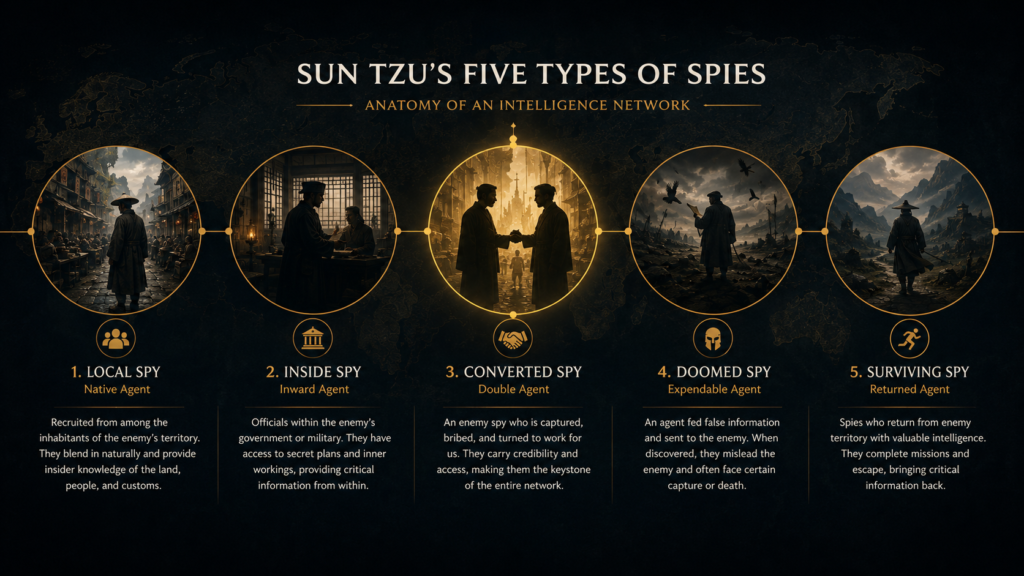
2. The Inside Spy (Inward Agent) Where the local spy offers geographic breadth, the inside spy offers hierarchical depth. These are officials within the enemy’s own government or military command structure—people with access to plans, decisions, and inner workings. Sun Tzu regarded them as uniquely precious and argued they should be handsomely rewarded. The inside spy is, in modern terms, the mole or recruited insider: a government official or executive who passes classified information to an adversary. Intelligence analysts use the acronym MICE to describe the classic motivations—Money, Ideology, Compromise, Ego—a framework that Sun Tzu would have recognized entirely.
3. The Converted Spy (Double Agent) This is Sun Tzu’s strategic masterstroke. When an enemy spy is captured, the instinct is to eliminate them. Sun Tzu’s instruction is the opposite: bribe them, turn them, and put them to work against their former employer. A converted enemy operative is exponentially more valuable than a fresh recruit—they already carry credibility, access, and established channels of communication with the adversary.
📌 KEY INSIGHT
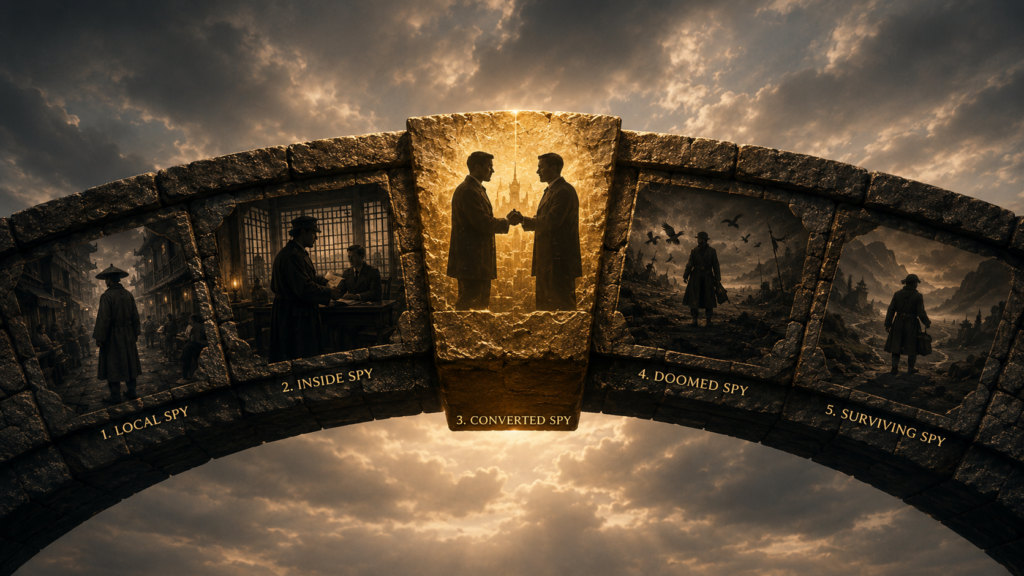
Sun Tzu considered the converted spy so central to the entire intelligence structure that he argued all other spy types ultimately depend on them. The intelligence obtained from a converted operative reveals which locals are willing to inform, what false information the enemy will find credible, and how best to direct field agents. The converted spy is not just one tool among five—it is the keystone of the arch. Remove it, and the whole system loses its cohesion.
4. The Doomed Spy (Expendable Agent) The most morally disturbing category. A doomed spy is an agent—often unknowingly—fed fabricated information that they will then carry to the enemy. The “doomed” designation reflects the near-certain consequence: once the adversary discovers the deception, the agent who delivered it faces execution. Sun Tzu was entirely pragmatic about this. The doomed spy is a precision instrument of strategic deception. Their sacrifice, calculated or incidental, can mislead an opponent about troop movements, invasion targets, or operational capability.
5. The Surviving Spy (Field Intelligence Officer) The surviving spy is the type closest to what modern audiences recognize from popular culture: the operative who penetrates enemy territory, observes and records, and returns to report. Sun Tzu insisted these agents must possess exceptional acuity—capable of sustained deception, deep observation, and reliable recall under pressure. In modern terms, they are field intelligence officers or deep-cover agents operating without official cover.
What makes Sun Tzu’s framework endure is the systemic logic. When all five types are active simultaneously—none aware of the others’ routes—the resulting network becomes effectively invisible. He called this condition “divine manipulation of the threads.”
Two and a Half Millennia of Proof
Sun Tzu’s five categories are not a theoretical construct. They describe, with remarkable precision, operations that intelligence services have run across very different centuries, technologies, and political contexts.
The Doomed Spy in Action: Operation Mincemeat (1943)
In April 1943, a corpse dressed in the uniform of a Royal Marines major washed ashore on the coast of southern Spain. Chained to his wrist was a briefcase containing documents indicating the Allies planned to invade Greece and Sardinia—not Sicily. Nazi high command believed the deception. Adolf Hitler ordered armored divisions transferred from France to the Balkans. When Allied forces invaded Sicily on July 10, 1943, they encountered dramatically weakened defenses.
Operation Mincemeat—conceived in part by a young naval intelligence officer named Ian Fleming—is the defining doomed-spy operation of the modern era. The agent (a deceased Welsh man named Glyndwr Michael) was used to deliver false intelligence with maximum credibility. Historians widely regard it as the most successful single deception operation of the entire Second World War.
The Converted Spy at the Cold War’s Heart: Oleg Gordievsky
Oleg Gordievsky was a colonel in the Soviet KGB—an inside spy by career and training. After witnessing the construction of the Berlin Wall in 1961 and the Soviet suppression of Czechoslovakia in 1968, he grew ideologically disillusioned. In 1974, he was quietly recruited by Britain’s MI6, given the codename SUNBEAM, and began one of the most consequential double-agent relationships in Cold War history.
For eleven years, Gordievsky passed Soviet military assessments, political analyses, and agent identities to British and American intelligence while continuing to ascend through KGB ranks. His reporting on Soviet perceptions of NATO’s 1983 nuclear exercise—when the USSR nearly launched a preemptive strike, genuinely believing a Western first strike was imminent—is credited by historians with directly influencing Western de-escalation policy. He is, in Sun Tzu’s precise terminology, a converted spy whose value to the handler was nearly incalculable.
The Double-Cross System: All Five Types Simultaneously
During World War II, British intelligence ran an operation so comprehensive that virtually every German agent in Britain was either captured or converted. Turned German operatives fed carefully engineered false intelligence back to Berlin, concealing radar technology, troop dispositions, and ultimately the location of the D-Day landings. It was Sun Tzu’s “divine manipulation of the threads” executed on a national scale—and it worked precisely because the British could verify its effectiveness by decoding German Enigma communications.
| Sun Tzu’s Type | Modern Equivalent | Historical Example |
|---|---|---|
| Local Spy | Recruited foreign asset | OSS local networks in occupied Europe |
| Inside Spy | Mole / recruited insider | Cambridge Five (Burgess, Maclean, et al.) |
| Converted Spy | Double agent | Oleg Gordievsky, KGB/MI6 (1974–1985) |
| Doomed Spy | Disinformation / deception asset | Operation Mincemeat (1943) |
| Surviving Spy | Field intelligence officer / NOC | CIA deep-cover officers, Cold War operatives |
What This Means in Practice
The most striking feature of Sun Tzu’s framework is not that it was prescient. It is that it was accurate. He identified a set of intelligence functions so fundamental to how information moves between adversaries that two and a half millennia of technological change has not displaced a single category.
Modern signals intelligence, satellite reconnaissance, and cyber collection have added entire new domains. They have not replaced the five types—they have extended them. A converted spy today may hand over encryption keys rather than battle plans. A doomed spy may inject corrupted data into an adversary’s systems rather than carry forged letters across a border. The logic is identical; only the medium has changed.
The 2024 Cambridge analysis Three Faces of Sun Tzu explicitly addresses this migration, mapping Sun Tzu’s intelligence principles onto contemporary US-China strategic competition, cyber operations, and high-technology espionage. The volume’s reviewers note that Sun Tzu’s limitations are as instructive as his insights: he could not account for the speed of modern communication, the scale of signals collection, or the verification challenges of open-source intelligence. But the five human functions he described remain the irreducible core of intelligence work.
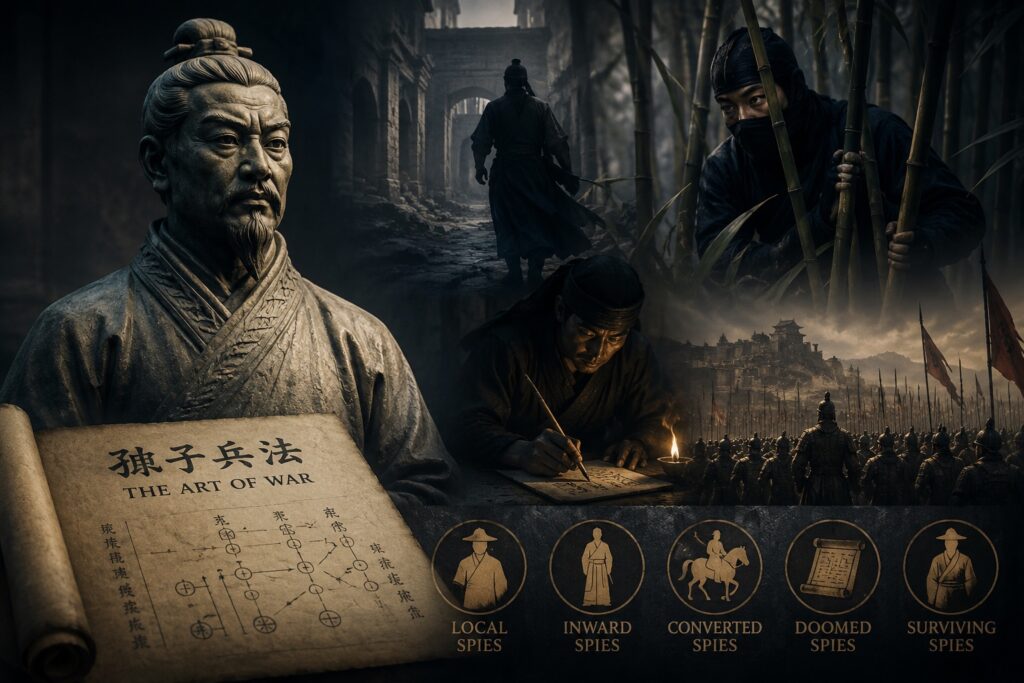
In corporate contexts, the mapping is equally uncomfortable. The local spy becomes a competitor’s disgruntled employee. The inside spy is the senior executive who quietly briefs a rival. The doomed spy is the false roadmap leaked to misdirect a competitor’s product strategy. The converted spy is the industrial espionage operative who is caught, turned, and used to feed the original attacker precisely the wrong intelligence.
💬 “Spies are a most important element in warfare, because on them depends an army’s ability to move.” — Sun Tzu, Chapter 13, The Art of War
The implication for any organization—military or commercial—is consistent: the human layer of intelligence is simultaneously the most valuable and the most vulnerable. Systems can be upgraded. People cannot be patched.
Nuances, Counterpoints, and What’s Next
Sun Tzu’s taxonomy is not without serious complications.
The most pointed objection is ethical. The doomed spy category requires the deliberate sacrifice of a human being, or at minimum knowingly placing someone in lethal danger for strategic gain. Operation Mincemeat used the body of a man who had no opportunity to consent to his posthumous role in wartime deception. In other historical cases, living agents were sent into situations their handlers knew were fatal. Modern intelligence ethics frameworks, developed under the scrutiny of parliamentary and congressional oversight, wrestle directly with this tension.
A second limitation concerns verification. Sun Tzu assumes that intelligence obtained through spies is reliable. But the history of espionage is densely populated with triple agents, fabricated reports, and selectively truthful sources whose partial accuracy was more dangerous than outright lies. The Double Cross System worked not because British handlers were brilliant alone, but because they could independently verify German reactions through Enigma decryption. Without that verification layer, the entire system could have been reversed against them.
The emerging domain of AI-generated disinformation creates a scaled-up version of the doomed spy: algorithmically produced personas capable of flooding information environments with plausible falsehoods simultaneously, at a volume no human network could achieve. Sun Tzu understood the mechanism precisely. The scale and automation are entirely new—but the objective, to make the adversary act on false beliefs, is unchanged.
The most intellectually honest position is that Sun Tzu provided a durable map but not the territory. The territory keeps changing. The map, used carefully, still helps you navigate it.
Conclusion
Sun Tzu composed Chapter 13 as the capstone of a philosophy built on a single conviction: wars are decided before the first blow, and they are decided with information.
His five types of spies are not a historical relic. They are a functional taxonomy of human intelligence that has proven accurate across vastly different technologies, geographies, and centuries. From a corpse dressed in Royal Marines uniform floating toward fascist Spain, to a KGB colonel quietly briefing Margaret Thatcher’s government on Soviet nuclear intentions, to a competitive intelligence analyst mapping a rival’s executive departures—the categories hold.
What Sun Tzu grasped, and what history has confirmed repeatedly, is that the most decisive intelligence is always human in origin. Systems can be hacked. Networks can be compromised. But the person with the right access, the right motivation, and the right handler remains the irreplaceable key to foreknowledge.
The question for any strategist—in any domain—is not whether to deploy all five types. It is whether they have already considered which ones are being used against them.
🔑 KEY TAKEAWAYS
- Sun Tzu’s five spy types—local, inside, converted, doomed, and surviving—were codified around 500 BCE and map with near-perfect accuracy onto the human intelligence categories still used by the CIA, MI6, and every modern intelligence service.
- The doomed spy is the most morally complex category: an agent used—often unknowingly—to deliver fabricated intelligence. Operation Mincemeat (1943), which diverted Nazi armor from Sicily with a planted corpse and forged documents, is its defining real-world example.
- The converted spy is Sun Tzu’s keystone agent: a turned adversary operative whose existing knowledge enables the entire network to function. Cold War KGB colonel Oleg Gordievsky, who spied for MI6 for eleven years, is history’s clearest illustration.
- Sun Tzu’s deepest insight was systemic—all five types must operate simultaneously, with none aware of the others’ routes. Britain’s wartime Double Cross System, which ran virtually every German agent in the UK as a double, achieved this ideal.
- Modern AI-driven disinformation, cyber espionage, and competitive corporate intelligence all operate within Sun Tzu’s five-type logic. The technology of execution has changed entirely; the underlying human functions have not.
Frequently Asked Questions
What are Sun Tzu’s five types of spies?
Sun Tzu identifies five types in Chapter 13 of The Art of War: the local spy (recruited from enemy territory), the inside spy (an enemy official), the converted spy (a turned enemy agent), the doomed spy (fed false information to deceive the enemy), and the surviving spy (a field operative who gathers intelligence and returns to report). Together, Sun Tzu argued, they form an invisible network he called “divine manipulation of the threads”—the highest expression of strategic intelligence.
What does Sun Tzu mean by a “doomed spy”?
A doomed spy is an agent—often without their knowledge—used to carry fabricated intelligence to an enemy. They are “doomed” because once the adversary discovers the deception, execution typically follows. In modern practice, this function is called a disinformation or deception operation. The canonical example is Operation Mincemeat (1943), in which British intelligence used a corpse laden with falsified invasion plans to divert Nazi forces ahead of the Allied landing in Sicily—one of WWII’s most successful strategic deceptions.
How do Sun Tzu’s five spy types relate to modern intelligence agencies?
Sun Tzu’s five types correspond directly to recognized categories in modern HUMINT doctrine. Local spies are recruited foreign assets; inside spies are moles or insider threats; converted spies are double agents; doomed spies are assets used in active disinformation campaigns; and surviving spies are field officers or deep-cover agents. Every major intelligence service—including the CIA, MI6, Israel’s Mossad, and Russia’s SVR—runs operations that match each of these categories, often simultaneously.
Why is the converted spy the most important of the five types?
Sun Tzu argued that the converted spy is the keystone of the entire intelligence network. Because this operative comes from inside the adversary’s apparatus, they reveal which locals are willing to inform, what falsehoods the enemy will believe, and how to direct field agents most effectively. Without the converted spy, the other four types lack coordination. This insight anticipates the modern concept of the double agent as a “window” into an adversary’s counterintelligence thinking—used to identify vulnerabilities, not just collect data.
What is a real historical example of Sun Tzu’s spy types being used?
Operation Mincemeat (1943) is the definitive doomed-spy operation: British intelligence planted forged documents on a staged corpse, deceived Hitler into repositioning his forces, and helped secure the Allied invasion of Sicily. Oleg Gordievsky represents the converted spy: a senior KGB colonel recruited by MI6 in 1974 who spent eleven years passing Soviet intelligence to the West while rising through KGB ranks. Britain’s wartime Double Cross System—which turned virtually every German agent in the UK—is the closest historical approximation of Sun Tzu’s “divine manipulation of the threads.”
Is Sun Tzu’s spy framework still used in the 21st century?
Yes—directly and demonstrably. Cambridge University Press’s 2024 academic study Three Faces of Sun Tzu maps Sun Tzu’s intelligence principles onto current US-China strategic competition, cyber warfare, and high-technology espionage. While signals intelligence and cyber capabilities have added new collection methods, they have not displaced the five human intelligence functions Sun Tzu described. Corporate espionage, state-sponsored cyber intrusion, and AI-driven disinformation campaigns all operate within the same functional logic—the technology is new; the categories are ancient.
What is the main lesson of Chapter 13 of The Art of War?
Sun Tzu’s central argument is that victory depends on foreknowledge, and foreknowledge must come from people with direct knowledge of the adversary’s situation—not from calculation, divination, or historical analogy alone. He also argues that spies deserve the highest pay, the deepest trust, and the most careful management of any asset in the army. Leaders who invest inadequately in intelligence are, in his view, making the costliest possible strategic error. Chapter 13 is, in essence, the oldest surviving case for taking human intelligence seriously.
Sources & further reading:
- Sun Tzu’s The Art of War, Chapter 13: On the Use of Spies — MIT Translation
- Sun Tzu on Espionage: How I Learned to Stop Worrying and Love the Double Agent — Small Wars Journal
- Sun Tzu in Hollywood: The Art of War, Espionage, and the Use of Spies — Spyscape
- Operation Mincemeat — History.com
- Three Faces of Sun Tzu — Cambridge University Press, 2024
- Oleg Gordievsky: Cold War Double Agent — Spotter Up
- Chapter 13 Analysis — Aseem Gupta