Table of Contents
Before governments legislated workplace safety and before trade unions fought for injury benefits, a group of outlaws operating beyond the reach of any law had already solved the problem. Seventeenth-century pirates — romanticised in fiction as bloodthirsty anarchists — had written, signed, and enforced some of the most sophisticated injury compensation schemes the Atlantic world had ever seen. A sailor who lost his right arm in a raid could claim the equivalent of six years’ wages from a communal fund. A man who lost an eye received what amounted to a year’s pay, immediately, no questions asked.
This is not maritime mythology. It is documented in primary sources, corroborated by economic historians, and structurally sophisticated enough to have drawn serious academic attention. The pirate disability compensation system predated the first modern American workers’ compensation law by roughly two centuries.
This post traces exactly how it worked, why pirates built it, what it tells us about the relationship between risk and labour, and what modern workplace policy can still learn from buccaneers.
The World That Made Pirate Welfare Necessary
To understand why pirate crews formalised injury compensation, you first need to understand the world they left behind. Life aboard legitimate naval and merchant vessels in the seventeenth and early eighteenth centuries was brutally exploitative. Captains had near-absolute authority. Sailors could be pressed into service against their will, flogged at the captain’s discretion, underpaid, and denied any recourse if they were maimed in the course of their duties. An injured merchant sailor who could no longer work was simply discarded — no pay, no medical care, no future.
Pirates, by contrast, were largely former merchant and naval sailors who had made a deliberate, if desperate, calculation. They had traded the relative security of legitimate employment for the dangerous freedom of the pirate life. And because they were recruiting from men who knew exactly what bad workplace conditions looked like, pirate captains had to offer something better.
That something better was contractual. Before joining a pirate crew, every member signed or marked the ship’s Articles — a written constitution governing everything from the share of plunder each rank would receive to the precise penalties for fighting aboard ship. These articles were binding. Breaking them could mean marooning or death. But crucially, they also protected crew members.
💬 “Every man shall have an equal vote in the affairs of moment.” — Opening line of Bartholomew Roberts’ Articles, c. 1721, encoding democratic participation nearly a century before the American Revolution.
The pirate articles were not guidelines. They were enforceable contracts, and the disability compensation clauses were among their most carefully constructed provisions. Historian Marcus Rediker, Distinguished Professor of History at the University of Pittsburgh and author of Villains of All Nations, characterises pirate governance as genuinely proto-democratic and proto-socialist — a rare early modern example of a labouring class setting its own terms of employment in writing.
The Central Discovery: A Formal Disability Schedule
The intellectual core of the pirate disability compensation system is deceptively simple: injury payments were not discretionary gifts from a benevolent captain. They were predetermined, scheduled, and drawn from a communal fund — the “public stock” — that existed specifically to pay them.
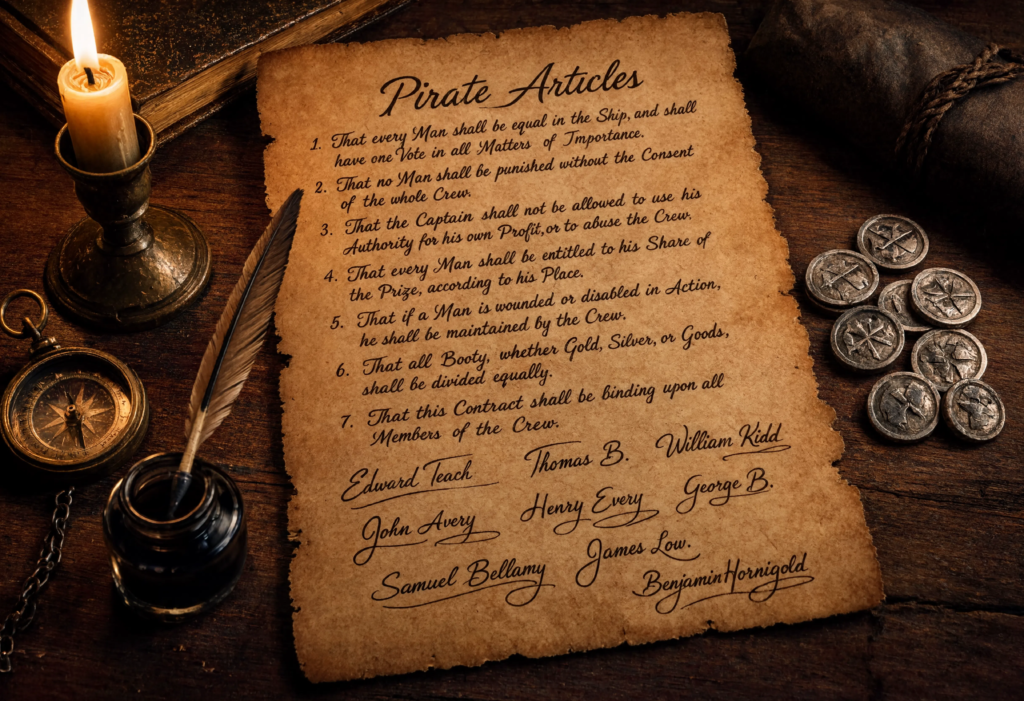
The most thoroughly documented examples come from two primary sources: the articles attributed to Henry Morgan (1660s) and those of Bartholomew “Black Bart” Roberts (c. 1721), preserved in Captain Charles Johnson’s A General History of the Pyrates (1724). Morgan’s schedule was explicit:
| Injury | Compensation |
|---|---|
| Loss of right arm | 600 pieces of eight |
| Loss of left arm | 500 pieces of eight |
| Loss of right leg | 500 pieces of eight |
| Loss of left leg | 400 pieces of eight |
| Loss of one eye | 100 pieces of eight |
| Loss of one finger | 100 pieces of eight |
Roberts’ code took a slightly different approach, setting a ceiling rather than an itemised schedule: “If any man should lose a limb, or become a cripple in their service, he was to have eight hundred dollars, out of the public stock, and for lesser hurts, proportionately.”
The economic significance of these figures only becomes clear in context. Average weekly wages for colonial Americans in this period ran to approximately two pieces of eight per week. A pirate who lost his right arm was therefore entitled to the equivalent of 300 weeks of wages — just under six years of full-time earnings. An eye or finger merited 50 weeks. These ratios are, as insurance historians have repeatedly noted, strikingly close to modern injury compensation schedules.
📌 KEY INSIGHT
Pirate disability compensation was not charity — it was calculated risk pricing. Crews ran the same actuarial logic that underpins modern insurance: dangerous work demanded a credible promise of compensation, and without that promise, no one capable would sign the articles. Pirates solved the moral hazard problem through contractual obligation, not goodwill.
There was one major structural exception, and it matters enormously. Pirate disability compensation paid nothing to the dead. Death in battle produced no benefit for a sailor’s family because pirates — operating outside of society — typically had no legal families to support. The compensation system was designed exclusively around surviving the injury and collecting in person. This was not cruelty but a practical constraint: a dead pirate had no dependants in any legally recognised sense, and the fund’s purpose was to retain skilled labour, not to provide posthumous charity.
Evidence, Data & Examples: Tracing the Timeline
The pirate compensation system did not emerge from nowhere. It evolved through several distinct stages across roughly six decades, and its documentary trail is solid enough to give historians confidence in the basic outlines.
📅 Timeline of Pirate Disability Compensation
c. 1655–1685 — Earliest buccaneer codes in the Caribbean include informal compensation clauses. Alexandre Exquemelin documents that loss of an arm or leg entitled a crewman to 500 pieces of eight in his eyewitness account Buccaneers of America (first published in Dutch, 1678).
1660s–1680s — Henry Morgan’s articles formalise a tiered limb-loss schedule, the most detailed surviving early example. Morgan, operating as a privateer with British Crown backing, demonstrates that the compensation principle extended beyond purely illegal piracy into state-sanctioned raiding.
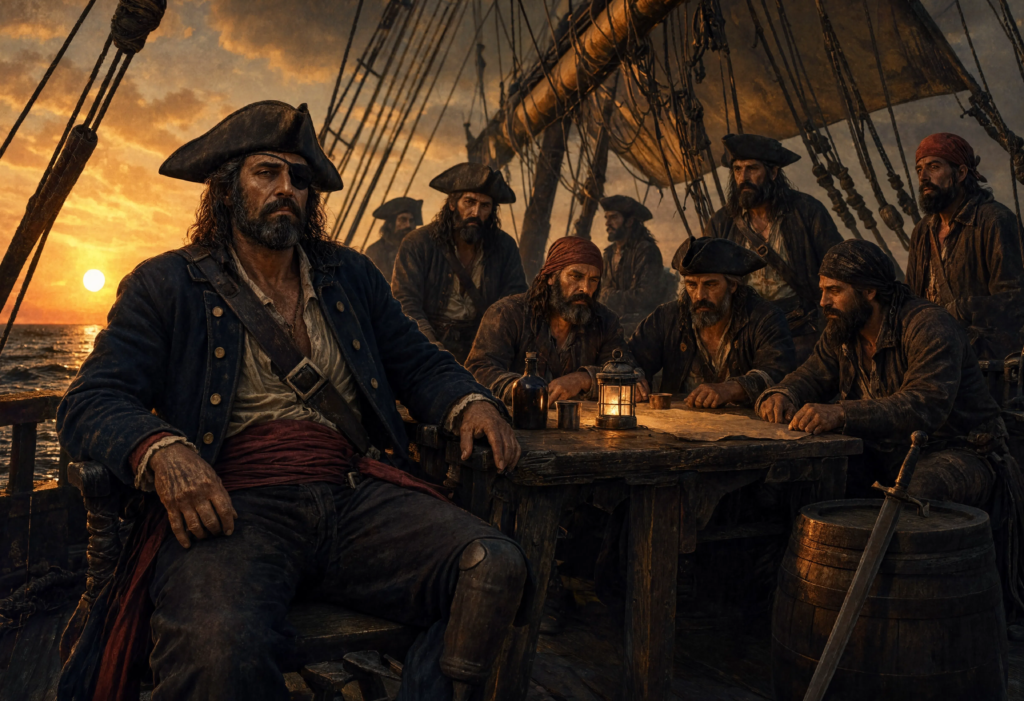
1693 — The privateer code used by the pirate consortium operating out of Madagascar establishes that injury pay precedes the general division of plunder — the compensation fund is senior to profit-sharing, establishing priority of claim.
1719–1722 — Bartholomew Roberts captures over 400 vessels and enforces his articles with unusual discipline. His disability clause, preserved by Charles Johnson, becomes the most frequently cited example: 800 pieces of eight for full disability, with proportionate payments for lesser injuries, and guaranteed right to remain with the company.
1724 — Johnson publishes A General History of the Pyrates, preserving four near-complete sets of pirate articles, the primary source for most subsequent scholarship.
1881–1884 — Bismarck’s Germany introduces Workers’ Accident Insurance, the first modern European analogue, roughly 200 years after the pirate codes.
1911 — Wisconsin becomes the first US state to pass comprehensive workers’ compensation legislation, 250 years after the pirate system was operating in the Caribbean.
The Statista data visualisation drawn from the Freakonomics analysis (2007) charts the compensation values by body part and confirms that the pirate scale closely mirrors the relative valuation modern systems assign to different limbs and sensory organs — right-side dominance premiums, with the primary working arm worth the most.
Practical Implications: What the Pirate System Actually Did
The pirate disability compensation system solved three distinct, practical problems simultaneously — and understanding those problems helps explain why it was so durable.
First, it solved a recruitment problem. Piracy was extraordinarily dangerous. Cannon fire, hand-to-hand combat, falls from rigging, and shipboard accidents all produced serious injuries at high rates. Any rational sailor evaluating a pirate crew knew this. A compensation guarantee was not a luxury — it was the price of recruiting capable men who had other options.
Second, it solved a morale problem. Once at sea, crew cohesion was essential. A sailor who feared that a serious injury would see him dumped ashore with nothing had every incentive to avoid combat, shirk dangerous duties, or mutiny. A credible compensation promise — backed by a communal fund whose balance everyone could verify — changed that calculation.
Third, it created the first documented return-to-work programme. Injured pirates were not discharged. According to multiple articles, including those documented by Exquemelin and Johnson, an injured crew member was entitled to “remain with the company as long as he shall think fit.” Less strenuous duties — navigation, cooking, watchkeeping, repair — kept experienced sailors aboard even after physical incapacitation. As Christopher J. Boggs, writing for insurance industry trade publications, puts it: this was the creation of the first return-to-work programme in Western documented history.
💬 “Pirates did so before their legitimate contemporaries achieved anything like the same.” — Peter T. Leeson, economist at George Mason University, commenting on pirate workers’ compensation in The Invisible Hook (2009).
The counterintuitive lesson here is about institutional design rather than morality. Pirates were criminals. Their compensation system served criminal ends. But the institutional logic — distribute risk across the group, price it in advance, guarantee it in writing, enforce it through communal accountability — is exactly the logic that underlies every modern workers’ compensation scheme. Good institutional design can come from very bad people solving very concrete problems.
Nuances, Counterpoints & What’s Next
The romantic version of pirate welfare — plucky outlaw democrats inventing social insurance — deserves some qualification. Several important caveats apply.

Source reliability is genuinely contested. Charles Johnson’s General History, the primary repository of pirate articles, has long been debated by historians. Some passages appear to blend fact with embellishment, and cross-referencing with trial records and gazette accounts — as contemporary historians now routinely do — suggests a more complicated picture than a clean set of founding documents.
The “public stock” that funded compensation was itself funded by plunder, often extracted through violence and coercion from merchant sailors who were not volunteers. The egalitarianism of pirate codes applied to crew members, not to their victims.
Enforcement was also imperfect. Historian Marcus Rediker acknowledges that the democratic and compensatory ideals of the articles depended on crew solidarity, which was itself fragile. Captains who stopped winning battles quickly lost authority, and with it the ability to enforce compensation obligations.
Finally, the comparison to modern workers’ comp has limits. Pirate compensation paid a lump sum with no ongoing provision for medical care or rehabilitation — the crude surgery available aboard ship was typically performed by the ship’s carpenter, not a surgeon. Modern systems recognise ongoing disability in ways the pirate codes never contemplated.
Still, the core institutional achievement stands: a group of people with no legal protection, no government backing, and no stable society created a functional, written, enforceable system for sharing risk and compensating injury — and they did it two centuries before industrial capitalism made such systems politically necessary on shore.
📚 Go deeper
If this history has you reaching for more, Workers’ Comp for Buccaneers: The Pirate Disability Insurance System offers the most comprehensive single-volume treatment of the subject, tracing the pirate codes through their historical context, their documentary sources, and their surprising legacy in modern labour law. It is the natural next step for anyone who wants to move beyond the outline presented here into the archival detail.
Conclusion
The story of pirate disability compensation is not really a story about pirates. It is a story about what happens when a group of people — regardless of their moral standing — must confront the economics of dangerous work honestly. When you cannot hide the risk, cannot ignore the injured, and cannot rely on the goodwill of a landlord or employer, you build a system. The pirates built one, and it worked.
Modern workers’ compensation arrived in America in 1911, after decades of industrial carnage, landmark court cases, and a catastrophic factory fire. The pirate system arrived in the Caribbean around 1660, driven by nothing more elevated than the need to recruit skilled sailors willing to risk their limbs. Two very different paths to the same institutional logic.
The question worth sitting with is not whether pirates were admirable. They were not. The question is why their labour system was, in this one specific respect, more advanced than anything legitimate society would produce for another two centuries.
🔑 KEY TAKEAWAYS
- Pirate articles from the 1660s–1720s included formal, tiered compensation schedules for lost limbs and sensory organs, drawn from a communal “public stock.”
- At ~2 pieces of eight per week in colonial wages, losing the right arm paid out roughly 300 weeks of earnings — ratios closely comparable to modern workers’ compensation schedules.
- Injured pirates were guaranteed the right to remain aboard in lighter duties, creating the first documented return-to-work programme in Western history.
- The system was built from economic necessity, not altruism — compensation was the price of recruiting capable men into dangerous work.
- America’s first comprehensive workers’ compensation law (Wisconsin, 1911) came roughly 250 years after pirates were already enforcing comparable protections at sea.
Frequently asked questions
What was pirate disability compensation, and how did it work?
Pirate disability compensation was a formal, contractual system written into each crew’s Articles of Agreement. Crew members who suffered injuries during raids or service received predetermined lump-sum payments from a shared communal fund. Payment amounts varied by the severity and type of injury, with major limbs valued highest. Every crew member signed the articles before sailing, making the compensation schedule legally binding within the crew’s own governance system.
How much did pirates pay for a lost limb?
Under Henry Morgan’s documented articles from the 1660s, the compensation schedule ran from 100 pieces of eight for a finger or eye, 400–500 for a leg, and up to 600 pieces of eight for a right arm. Bartholomew Roberts’ later articles set a ceiling of 800 pieces of eight for full disability. At an average colonial wage of approximately 2 pieces of eight per week, losing a right arm paid the equivalent of six years of earnings.
Did pirate injury payment systems really predate modern workers’ comp?
Yes, significantly. Documented pirate compensation clauses appear in historical sources from as early as the 1650s and 1660s. Bismarck’s Germany introduced the first modern European Workers’ Accident Insurance in 1881, and Wisconsin became the first US state to pass comprehensive workers’ compensation legislation in 1911 — roughly 250 years after pirate crews were already enforcing equivalent protections.
Why did pirates create a disability insurance system in the first place?
The pirate disability compensation system existed because of practical labour economics, not generosity. Recruiting capable sailors into extremely dangerous work required a credible promise that injuries would be compensated. Without that guarantee, the most experienced men would not sign on. The compensation fund also maintained crew morale and incentivised engagement in combat, since sailors knew they would not be abandoned if wounded.
Were injured pirates allowed to keep sailing after losing a limb?
Yes, in many documented cases. Multiple sets of pirate articles — including those preserved in Charles Johnson’s 1724 General History of the Pyrates — guaranteed injured crew members the right to “remain with the company as long as they shall think fit.” Disabled pirates were assigned lighter duties such as navigation, cooking, or watchkeeping, creating what historians now describe as the first documented return-to-work programme.
What are the primary historical sources for pirate disability compensation?
The most important primary sources are Alexandre Exquemelin’s Buccaneers of America (1678), an eyewitness account that documents compensation clauses among Caribbean buccaneers, and Captain Charles Johnson’s A General History of the Pyrates (1724), which preserves four near-complete sets of pirate articles. These are cross-referenced with trial testimonies, colonial gazette accounts, and depositions from the 1710s–1720s to establish authenticity.
Is there a common mistake people make when thinking about pirate welfare?
The most common misconception is that pirate generosity extended to death benefits. It did not. The pirate disability compensation system paid only survivors. A pirate killed in battle left nothing to dependants under the articles. This was not callousness but a structural feature: the system was designed to retain valuable labour, and dead men required no retention. Understanding this distinction separates the pirate proto-welfare system from the more comprehensive protections modern workers’ comp eventually provided.
Sources & further reading
- Marcus Rediker, Villains of All Nations: Atlantic Pirates in the Golden Age (Beacon Press, 2004) — The definitive scholarly account of pirate social organisation and its democratic and egalitarian dimensions.
- Peter T. Leeson, The Invisible Hook: The Hidden Economics of Pirates (Princeton University Press, 2009) — Economic analysis of pirate institutions, including the disability compensation system and its incentive structure.
- Statista / Freakonomics, “Compensation received by pirates for the loss of a limb or body part between 1655 and 1685” (2007) — Visualised compensation schedule drawn from primary historical sources.
- Christopher J. Boggs, “Workers’ Compensation History: The Great Tradeoff,” MyNewMarkets.com / Insurance Journal (2015) — Insurance industry analysis linking pirate codes to the genealogy of modern workers’ compensation.
- Maryanne Sherman, “Pirates, Peg Legs and US Workers Compensation Insurance,” AXA XL (2015) — Accessible overview of the pirate-to-modern-workers’-comp lineage.
- Kenneth Maxwell, “Pirate Democracy,” New York Review of Books (1997) — Scholarly review essay examining pirate governance and the Articles of Agreement as primary documents.