
Table of Contents
September 1848. A hired servant crouches over a man on a rocking boat outside Shanghai, shaving his head with all the confidence of someone who has never done this before. The man — a Scottish botanist — winces, then watches a false queue, the long braided pigtail worn by Chinese men of the era, get fastened into place. He pulls on silk robes, adopts a new Chinese name — Sing Wang, “brilliant flower” — and prepares to enter territory that is forbidden to foreigners under penalty of death.
His name was Robert Fortune. His mission: to steal the most jealously guarded agricultural secret on the planet on behalf of the British Empire. The target was tea. What he accomplished over the next three years permanently shattered one of history’s greatest monopolies, created an industry that still produces billions of cups every day, and wrote the template for every act of industrial espionage that followed.
This is the full story of the Robert Fortune tea heist — and what it still teaches us about power, knowledge, and the hidden history in every cup.
Britain’s Tea Crisis: A Monopoly Worth Fighting For
To understand why Britain would send a lone botanist into forbidden territory, you have to understand the scale of the empire’s addiction.
Tea arrived in British coffeehouses in the mid-17th century. The diarist Samuel Pepys first tried it in 1660, calling it “a cup of tee (a China drink) of which I never had drank before.” Within a century, it had displaced beer as the national drink. British per capita tea consumption stood at 1.1 pounds per year in 1820; by 1900, that figure had grown to 5.9 pounds, reaching 9.6 pounds by 1931. One account notes that nearly one pound in every ten pounds of British government revenue came from tea import duties alone.
Every single leaf came from China.
China had cultivated, processed, and traded tea for over 5,000 years. Its knowledge was tightly controlled, its processing methods opaque, and its monopoly seemingly unbreakable. European botanists, studying only dried samples, could not even agree on basic facts — many believed black and green tea came from entirely different plant species. The empire was built on a beverage it could neither grow nor fully understand.
Britain had nothing China wanted in return. The Qing Emperor had no interest in British manufactured goods, and silver flowed eastward in exchange for tea, creating a chronic trade deficit that bled the empire’s reserves. The East India Company’s makeshift solution — cultivating opium in Bengal and smuggling it into China — created mass addiction, and eventually two brutal Opium Wars. Even that dark arrangement left Britain dangerously dependent on a foreign power for its most essential commodity.
The only permanent solution was to grow tea somewhere Britain controlled. That meant India — and that meant secrets.
💬 “The task required a plant hunter, a gardener, a thief, a spy. The man Britain needed was Robert Fortune.” — Sarah Rose, For All the Tea in China (2009)
Robert Fortune and the Art of Industrial Espionage
Robert Fortune was born in 1812 in rural Berwickshire, Scotland, into a poor family. He worked his way up through botany without a university degree, earning his reputation through hands-on skill rather than academic pedigree. By the late 1840s, he had already survived one trip to China for the Royal Horticultural Society — fighting off pirates, bandits, and tropical disease — and published a travelogue colourful enough to capture the attention of the East India Company.
In 1848, the prominent botanist Dr. John Forbes Royle approached Fortune on behalf of the EIC. The salary on offer — £500, five times his annual wage — made refusal difficult. The task was simple to state and extraordinary to execute: travel into China’s most guarded tea-growing districts in disguise, observe and document the full production process, and return with enough living plants, seeds, and knowledge to establish a commercial tea industry in colonial India.
Exportation of tea plants was illegal under Chinese law. Anyone caught assisting a foreigner faced execution.
📌 KEY INSIGHT BOX
Fortune made a discovery that solved one of botany’s longest-running debates: black tea and green tea come from exactly the same plant — Camellia sinensis. The difference is entirely in the processing. Green tea is dried and steamed immediately; black tea is oxidized and fermented. European botanists had argued over this for decades. Fortune confirmed it by watching both processes unfold, firsthand, inside factories no Westerner had entered before.

Arriving in Shanghai in September 1848, Fortune began his transformation. He shaved his head, adopted Chinese dress and his new name, hired a manservant to announce his arrival as a visiting official from a distant province, and travelled into the Wu Yi Shan hills and the Yellow Mountains — regions that appeared on no Western map. Factory superintendents bowed and granted him access. Tea masters demonstrated techniques refined over centuries. Fortune took meticulous notes in a journal tucked beneath his robes.
The disguise held. The secrets flowed. And back in London, the empire waited.
Evidence in the Fields: How the Tea Heist Changed the World
Getting knowledge out of China was one challenge. Getting living plants across thousands of miles of open ocean was another.
Earlier botanical missions had ended in disaster — plants wilted in salt air, rotted in waterlogged containers, or arrived as useless husks. The solution came from an English doctor named Nathaniel Bagshaw Ward, who had developed sealed glass cases — later called Wardian cases — that functioned as portable, self-sustaining greenhouses. Moisture condensed on the glass, dripped back into the soil, and recycled. Plants could survive months at sea without opening the containers or adding water.
Fortune deployed them systematically, becoming the first person to use the technology at industrial scale for a covert mission. The first attempt still nearly failed — a careless EIC employee opened the cases to water the plants, destroying half of them and all the seeds. But Fortune persisted, adapted, and tried again.
By the time he left China for the last time in 1851, reportedly with a price on his head from Chinese authorities, his haul was staggering:
| Cargo | Approximate Quantity |
|---|---|
| Living tea plants (in Wardian cases) | ~20,000 |
| Tea seeds | Thousands |
| Skilled Chinese tea workers recruited | Small specialist team |
| Production processes documented | Cultivation, drying, oxidation, rolling |
The plants and workers were delivered to Darjeeling and Assam in India. Darjeeling — high-altitude, cool, with terraced slopes — proved a near-perfect mirror of China’s best tea districts. The first commercial plantation opened there in 1856. By 1874, Darjeeling alone had 112 tea gardens in operation.
The collapse of China’s monopoly was swift and devastating. In 1879, China still supplied over 70% of teas sold in London. By 1900, that share had crashed to 10%, with Indian and Ceylonese teas filling the rest of the market. A monopoly held for millennia was dismantled within two decades by the contents of a few glass boxes and a Scottish botanist’s journal.
From a 19th-Century Spy Mission to a $28 Billion Industry
The practical legacy of the Robert Fortune tea heist is visible in every supermarket aisle on the planet.
India today produces approximately 1.3 million metric tons of tea annually — about 20% of global output — with Darjeeling and Assam as its internationally celebrated crown jewels. The global tea market was valued at $28.32 billion in 2024 and is projected to reach $54.68 billion by 2034. The world consumed over 7.3 billion kilograms of tea in 2023. Every morning cup of Darjeeling, every bag of Assam, every pot of English Breakfast traces its commercial origins, in some direct way, to Fortune’s mission.
But the heist offers lessons that extend far beyond tea gardens and trade statistics.
Fortune’s operation was not simple theft — it was a complete transfer of intellectual capital. He didn’t just steal a product. He stole the manufacturing process, the agricultural knowledge, the craft expertise, and the human capital that made the product possible. He recruited workers who carried centuries of accumulated skill in their hands. He used cutting-edge technology to transport what he had taken. He operated under a false identity in prohibited territory, with state backing and plausible deniability.
💬 “What can today’s business leaders learn from China’s 19th-century failure to protect its most valuable industry? China assumed its tea knowledge was secure because no outsider had ever learned it. Many companies think their proprietary research is untouchable — until it’s not.” — Paul Curwell, cybersecurity strategist (2025)
The modern parallels write themselves: state-backed hackers penetrating pharmaceutical research servers, semiconductor designs crossing borders without authorisation, corporate spies at technology conferences with recording devices instead of journals. The playbook Fortune used in 1848 is functionally identical to the methods employed today. Only the tools, and the scale, have changed.
The Myth, the Man, and the Moral Reckoning
The heroic narrative — lone spy breaks China’s tea monopoly, seeds an empire — is compelling. Historians have complicated it.
Some researchers argue that Britain was already developing an Indian tea industry independently of Fortune. A native subspecies, Camellia sinensis var. assamica, had been identified in Assam as early as the 1820s, and British colonists were cultivating it before Fortune’s mission was conceived. The first Assam tea gardens predate his arrival. Fortune’s most durable contribution, by this reading, may have been scientific — confirming the single-species question — rather than the decisive act of industrial theft that popular history celebrates.
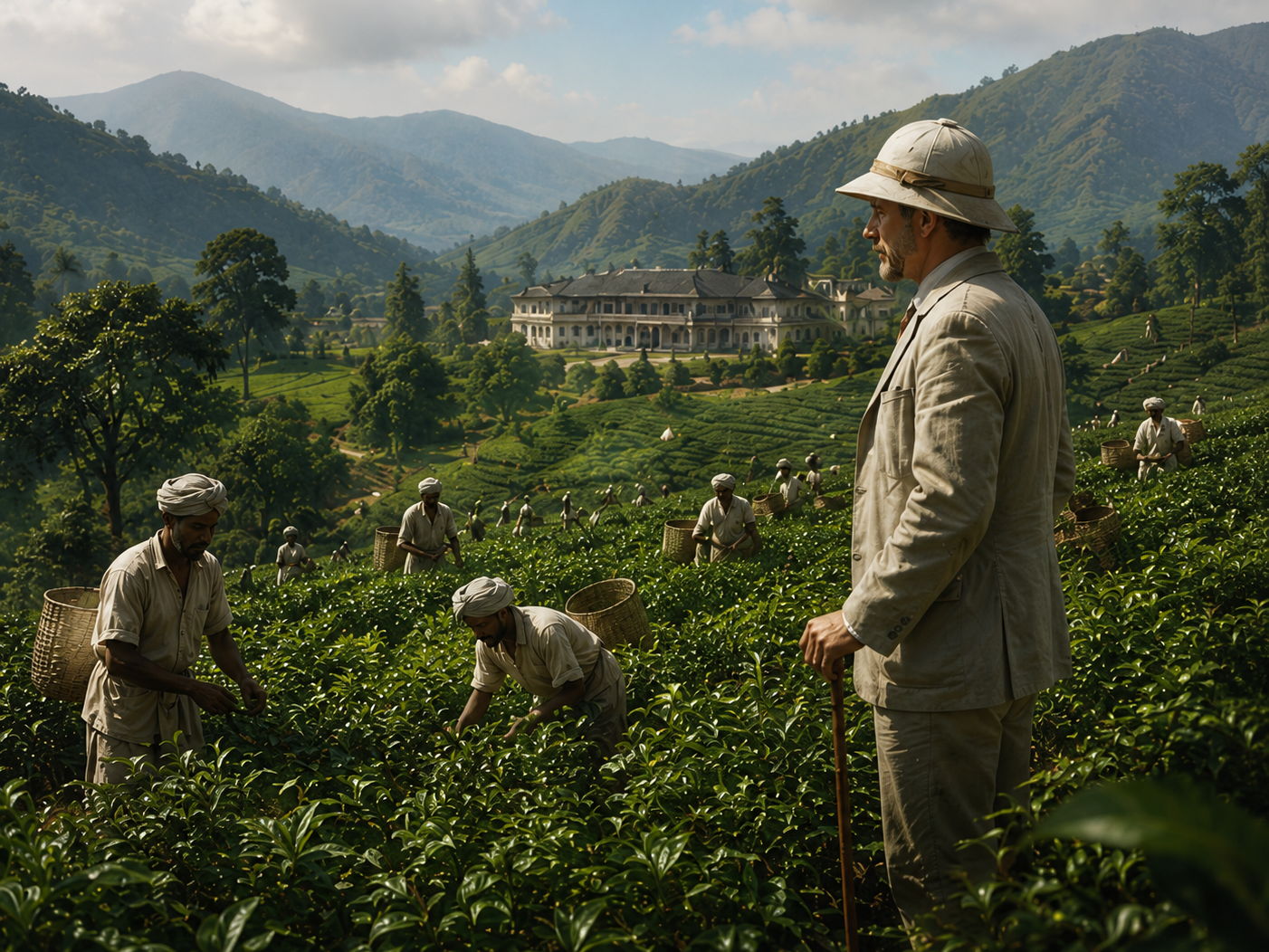
The ethical reckoning is harder to sidestep. Fortune lied, operated under false identity, violated Chinese sovereign law, and extracted knowledge that generations of farmers, processors, and merchants had developed over centuries. He was operating in service of an empire that simultaneously flooded China with opium to finance its tea habit, then waged war when China tried to stop the trade. The plantation industries his mission helped create were built on colonial land and, for generations, on deeply exploited labour in Darjeeling and Assam — a legacy those communities still live with today.
Viewed from London in 1851, Fortune was a brilliant agent who solved an imperial problem. Viewed from Beijing — then or now — he was a thief in a stolen disguise who helped accelerate what China still calls its “Century of Humiliation.” Both framings contain truth. Sitting comfortably with only one of them is a form of historical selective attention.
Conclusion
A single botanist in a borrowed identity accomplished something that military force rarely achieves: he transferred the entire intellectual capital of a five-thousand-year-old industry across a continent. The Robert Fortune tea heist was not simply an act of theft — it was a geopolitical pivot point, the moment when the global tea map was permanently redrawn.
The world drinks its way through more than seven billion kilograms of tea every year. A significant share of that tea grows in Indian soil that was, in direct botanical lineage, seeded by Fortune’s Wardian cases and the workers he persuaded to leave China. The Darjeeling estates, the Assam gardens, the Ceylon highlands — all trace their commercial origins to a man with a shaved head and a false name.
The question Fortune’s story leaves with us is whether the category of “trade secret” can hold its meaning when national survival is at stake. When controlling a commodity means controlling an empire’s revenue, its people’s daily sustenance, and its geopolitical leverage, the line between corporate espionage and statecraft dissolves entirely. In that light, Fortune was less a spy than a symptom — of an empire that refused to accept dependency and would go to extraordinary lengths to eliminate it.
The next time you put the kettle on, you are steeping in that history.
🔑 KEY TAKEAWAYS
- Robert Fortune’s 1848 mission — disguised as a Chinese official in forbidden territory — is widely considered the greatest single act of corporate espionage in recorded history, commissioned by the East India Company.
- The driving force was Britain’s catastrophic trade dependency on China, which it had partially financed through the illegal opium trade; Fortune offered a structural, permanent solution.
- Fortune’s most significant scientific discovery was that black and green tea come from the same plant (Camellia sinensis), differing only in post-harvest processing — a fact European botanists had debated for decades.
- China’s share of the London tea market collapsed from over 70% in 1879 to just 10% by 1900, a direct consequence of the Indian tea industry Fortune helped create; Darjeeling had 112 gardens by 1874.
- The ethical legacy is genuinely contested: Fortune was a hero of empire to the British and a state-sponsored thief to China — and the colonial plantations he enabled carried their own legacy of exploitation that historians continue to examine.
Frequently Asked Questions
Who was Robert Fortune, and what did he steal from China?
Robert Fortune (1812–1880) was a Scottish botanist commissioned by the British East India Company in 1848 to steal China’s tea secrets. Disguised as a Chinese official, he infiltrated forbidden tea-growing regions, documented cultivation and processing methods, and smuggled approximately 20,000 living plants and seeds out of China using sealed glass containers called Wardian cases. He also recruited skilled Chinese tea workers to accompany him to India. His mission is widely regarded as the greatest act of corporate espionage in history.
Why did Britain want to steal tea from China in the first place?
Britain had developed a total dependence on Chinese tea by the mid-19th century — tea duties contributed roughly one pound in every ten of government revenue. China controlled the entire global supply and accepted only silver in exchange, creating a debilitating trade deficit. Britain needed to break that monopoly by growing tea in colonial territory it controlled, which required China’s plants, seeds, and closely guarded production knowledge. Fortune was the agent chosen to obtain them.
How did Robert Fortune smuggle tea plants out of China without them dying?
Fortune used a recently invented technology called the Wardian case — a sealed glass-and-wood container that functioned as a portable greenhouse. Moisture condensed on the glass and recycled back into the soil, sustaining the plants without opening the cases or adding water. After a failed early attempt where a well-meaning employee opened the cases and destroyed half the plants, Fortune refined his approach and ultimately delivered approximately 20,000 living specimens to the Himalayan foothills.
What did Robert Fortune discover about tea that Europeans didn’t know?
One of Fortune’s most significant findings was that black tea and green tea are produced from the same plant — Camellia sinensis. European botanists had long debated whether the two types came from different species. Fortune observed the full cultivation and processing cycle firsthand inside Chinese factories and confirmed they were botanically identical; the difference lay entirely in what happened after harvest, specifically the degree of oxidation and fermentation applied to the leaves.
What was the long-term impact of the tea heist on India and global trade?
Fortune’s mission directly seeded what became two of the world’s most celebrated tea industries. The first commercial plantation in Darjeeling opened in 1856; by 1874, the region had 112 gardens. China’s share of the London tea market — over 70% in 1879 — had collapsed to just 10% by 1900. India today produces approximately 1.3 million metric tons of tea annually, second only to China globally, and its Darjeeling and Assam teas remain among the most sought-after in the world.
Is the Great Tea Heist morally defensible?
This is genuinely debated. From a British perspective, Fortune broke a monopoly causing economic harm and served a legitimate imperial objective. From a Chinese perspective, he was a state-sponsored thief who violated national sovereignty, stole millennia of accumulated knowledge, and helped dismantle China’s most valuable export industry. The plantations he helped create also depended on colonial land and exploited labour for decades. Most contemporary historians acknowledge both the undeniable historical significance and the serious ethical complexity.
How does the Robert Fortune tea heist compare to modern industrial espionage?
The parallels are remarkably direct. Fortune did not merely steal a product — he stole an entire system of intellectual capital: agricultural methods, processing techniques, and embedded human expertise. He operated under false identity in prohibited territory, used cutting-edge technology to transport what he took, and had state backing with deniability. Modern equivalents include nation-state cyberattacks on pharmaceutical or semiconductor firms, the theft of manufacturing trade secrets, and the targeted recruitment of employees who carry proprietary knowledge. The strategic logic is nearly identical; only the medium has changed.
Sources & further reading:
- The Great British Tea Heist — Smithsonian Magazine
- Tea Tuesdays: The Scottish Spy Who Stole China’s Tea Empire — NPR The Salt
- How A Scottish Botanist Stole the Secrets of Tea from China — ExplorerWeb
- The History of the International Tea Market, 1850–1945 — EH.net Encyclopedia
- The 2025 Global Tea Report — Tea & Coffee Trade Journal
- The Great Tea Heist and the History of Trade Secrets Theft — Paul Curwell (2025)
- How Scientist Robert Fortune Fueled Britain’s Expansion — Fast Company (Sarah Rose interview)