
Table of Contents
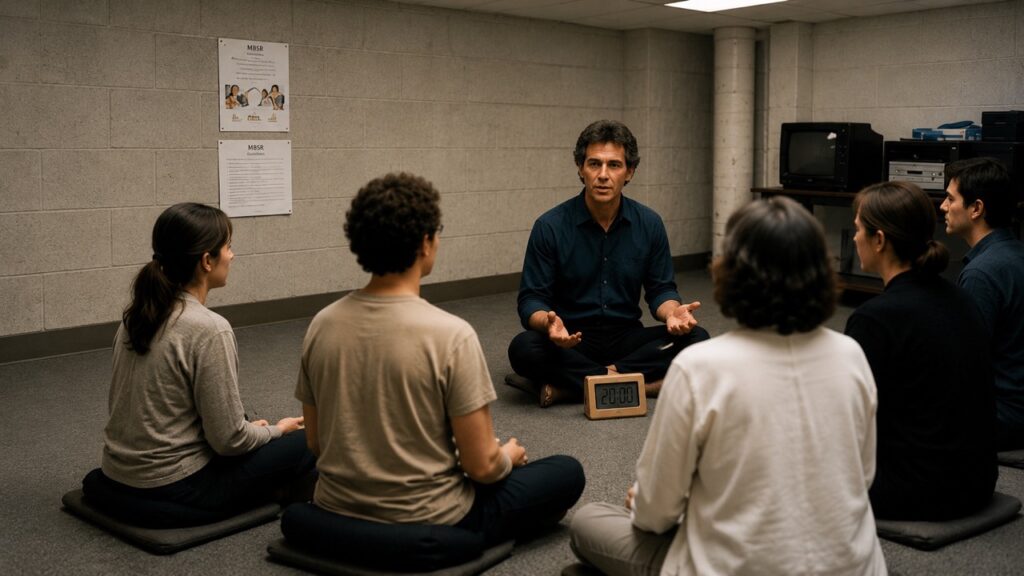
Something curious happened inside a hospital basement in Worcester, Massachusetts, in the autumn of 1979. A molecular biologist who had spent years studying under Zen masters sat down with a group of chronically ill patients and began teaching them to breathe. He had no robes, no incense, and no Sanskrit mantras. He had a curriculum, a timer, and a medical school affiliation.
That scientist was Jon Kabat-Zinn, and the eight-week programme he built in that basement — Mindfulness-Based Stress Reduction — would eventually reshape how hundreds of millions of people relate to their own minds. It would spawn a market now worth over $2 billion in corporate programmes alone, draw Google engineers, Wall Street traders, and U.S. Marines into meditation rooms, and trigger one of the sharpest philosophical debates in contemporary wellness culture.
The question at the centre of that debate is not whether mindfulness works. The science is largely settled on that. The question is what we lose — and what we gain — when a 2,500-year-old contemplative tradition gets repackaged as a productivity tool.
What Mindfulness Actually Is — and Where It Came From
Before examining how mindfulness travelled from ancient Asia to the modern corner office, it helps to understand what the word actually means. Jon Kabat-Zinn’s now-canonical definition is paying attention, on purpose, in the present moment, and non-judgmentally.
That sounds deceptively simple. But the practice draws from sati — a Pali term in the Buddhist canon that refers not just to present-moment awareness, but to clear-seeing, ethical discernment, and liberation from attachment. In its original Theravāda Buddhist context, mindfulness was inseparable from a broader ethical framework: the Noble Eightfold Path, which addresses right action, right livelihood, and the reduction of suffering for all sentient beings — not just the individual meditator.
For centuries, these practices lived primarily inside monastic communities in Southeast Asia, Tibet, China, and Japan. They required sustained retreat, years of instruction, and a commitment to an entire way of life. The first significant wave of transmission to the West arrived in the late 19th century through the efforts of scholars and practitioners like Anagarika Dharmapala and, later, D.T. Suzuki, whose writings introduced Zen to American intellectuals in the 1950s and 1960s. Figures like Alan Watts, Jack Kerouac, and later the Beat poets made meditation culturally legible — if somewhat romanticised — for a Western audience.
By the 1970s, Transcendental Meditation had entered American living rooms, the Insight Meditation Society had opened in Barre, Massachusetts, and a young MIT-trained biologist named Jon Kabat-Zinn was sitting his first silent retreats.

💬 “Hospitals and medical centers in this society are Dukkha magnets. People are drawn to hospitals primarily when they’re suffering, so it’s very natural to introduce programs to help them deal with the enormity of their suffering in a systematic way.” — Jon Kabat-Zinn, 1991
The Pivotal Translation: From Dharma to Diagnosis
Kabat-Zinn’s genius — and, for his critics, his original sin — was recognising that the health sector offered the most viable route to secularising Buddhist practice. Hospitals were credible. Clinicians were trusted. If meditation could be submitted to randomised controlled trials and survive, it could move into institutions that would have dismissed it as mysticism.
His Mindfulness-Based Stress Reduction programme launched in September 1979 with chronically ill patients who had exhausted conventional medical options. By stripping away what he called the “cultural and religious baggage” of Buddhism and reframing meditation as a set of trainable attentional skills, Kabat-Zinn created something genuinely new: a secular, evidence-based intervention that was functionally Buddhist without being doctrinally so.
The programme consisted of eight weekly two-hour sessions, a full-day silent retreat, and daily home practice. Participants learned breath awareness, body-scan meditation, mindful movement, and open monitoring of thoughts and sensations. No references to karma, rebirth, or enlightenment. No requirement for belief. Just a systematic attention-training protocol dressed in the language of neuroscience.
This was, as historian Jeff Wilson has noted, an extraordinary act of translation. Kabat-Zinn himself described it in terms of upāya — the Buddhist concept of “skillful means,” adapting teachings to what an audience can receive. He once called his work at the hospital an act of “stealth Buddhism.”
📌 KEY INSIGHT
The same innovation that made mindfulness accessible to millions may have simultaneously hollowed it out. By extracting meditation from its ethical and philosophical framework, Kabat-Zinn opened the door to mass adoption — and to what critics would later call McMindfulness, a commodified, individualised practice stripped of its original social and moral dimensions.
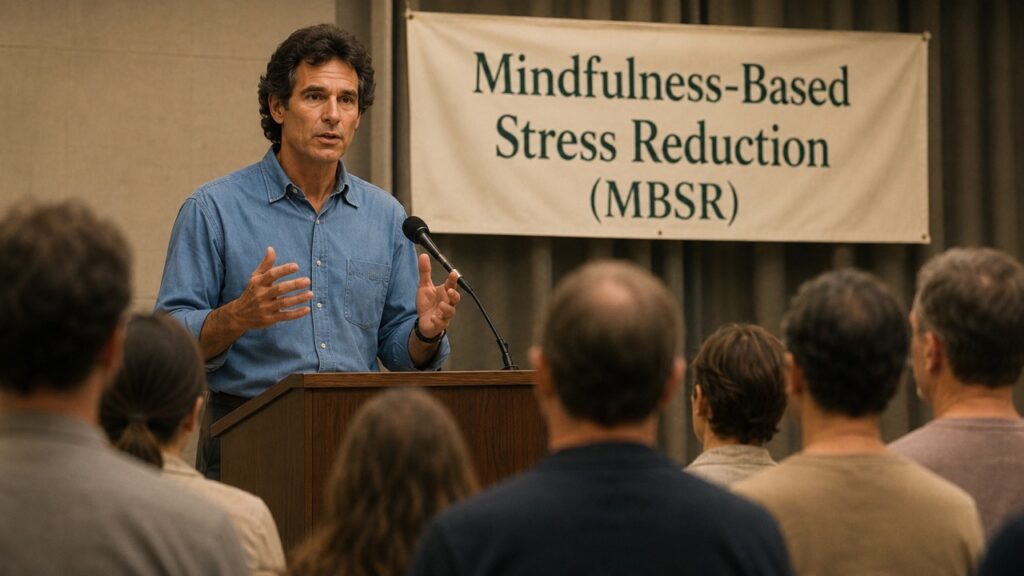
A 1993 public television documentary, Healing and the Mind by journalist Bill Moyers, catapulted MBSR into mainstream awareness. Kabat-Zinn’s office was reportedly inundated with calls from healthcare professionals wanting training. By the mid-1990s, MBSR programmes had spread to hospitals and clinics across the United States and Europe, and a rigorous body of peer-reviewed research had begun to accumulate around its clinical benefits.
The Evidence, the Economy, and the Corporate Embrace
The science on mindfulness is genuinely impressive, though more nuanced than its advocates often admit. A 2024 review published in Frontiers in Psychology found that MBSR participants demonstrated sustained reductions in anxiety, burnout prevention, and improved attention at follow-up intervals of three months, one year, and three years post-programme. A 2024 study in the Journal of Economic Behavior & Organization involving a three-month within-firm mindfulness training at three large companies found measurable improvements in cognitive performance and stress reduction across treatment groups.
The business case crystallised most visibly at Aetna, the American health insurance giant. After CEO Mark Bertolini survived a life-threatening ski accident and discovered yoga and meditation as pain-management tools, he introduced structured mindfulness programmes company-wide. The results were striking: over 13,000 employees who participated reported a 28% reduction in stress levels, a 20% improvement in sleep quality, and a 19% reduction in pain. More compellingly for the finance department, those employees gained an average of 62 extra minutes of productive time per week — a value estimated at approximately $3,000 per employee per year.
The numbers spread fast. Soon, the conversation in executive suites changed from “is this real?” to “when do we launch our programme?”
Corporate Mindfulness Market Growth (2018–2033)
| Year | Market Size (USD) | CAGR |
|---|---|---|
| 2018 | ~$1.0 billion | — |
| 2024 | $2.14 billion | 11.8% (2018–2024) |
| 2028 | ~$3.5 billion | 11.8% (projected) |
| 2033 | $5.8 billion | 11.8% (projected) |
Source: Growth Market Reports, 2024
In Silicon Valley, the adoption took on a distinctive flavour. Google engineer Chade-Meng Tan developed “Search Inside Yourself” — a programme combining mindfulness with emotional intelligence training that became so successful it was eventually spun out into an independent institute and taught worldwide. In 2011, Google invited the revered Vietnamese Buddhist monk Thich Nhat Hanh to its Mountain View headquarters. Twitter installed meditation spaces in its offices. Salesforce added mindfulness zones to its towers. The annual Wisdom 2.0 conference, founded by Soren Gordhamer in 2010, became a regular gathering of high-profile tech executives discussing contemplative practice.
By 2024, North America accounted for over 38% of the global corporate mindfulness market, with Fortune 500 companies including Goldman Sachs, General Mills, Intel, and Microsoft operating formal programmes.
What This Means for Anyone Sitting at a Desk Right Now
If you work in a modern office and your employer offers a mindfulness programme, you face a practical question: is this worth your time? The research is encouraging.
Meta-analyses consistently show that even modest daily practice — 10 to 20 minutes — produces meaningful reductions in perceived stress, improvements in focus, and better emotional regulation. Structured programmes with trained facilitators produce stronger outcomes than casual app use. A 2024 clinical trial overview from Frontiers in Public Health found that mobile mindfulness training demonstrated statistically significant effects on stress, burnout, and work engagement in office workers compared to controls.
The evidence supports engaging seriously rather than treating corporate mindfulness as a tick-box exercise. A few practical principles have emerged from the research:
Consistency matters more than duration. Ten minutes daily outperforms a 60-minute session once a week. Formal body-scan and breath-awareness practices, as taught in MBSR, produce more durable changes than informal “mindful coffee” approaches. And the workplace context genuinely helps: teams that practise together develop a shared attentional culture that improves communication and reduces reactive conflict.
That said, mindfulness is not a cure for a bad manager, chronic under-resourcing, or a toxic organisational culture. The strongest outcomes in workplace research appear where mindfulness programmes are combined with broader organisational changes — flexible work policies, sustainable workloads, and psychologically safe environments — rather than used as a standalone sticking plaster.
💬 “By extracting meditation from its ethical and philosophical framework, [Kabat-Zinn] made it accessible to millions who would never have walked into a Buddhist center. That’s genuinely important. But he also opened the door to McMindfulness — where meditation becomes another productivity tool, a way to be a more efficient worker without questioning the systems causing the stress.” — TheNow App Blog, reflecting on MBSR’s legacy
The Backlash, the Debate, and What Comes Next
No account of mindfulness in the workplace is complete without engaging its most pointed critics. Ron Purser, a management professor at San Francisco State University and the author of McMindfulness: How Mindfulness Became the New Capitalist Spirituality (2019), makes a case that deserves a fair hearing.
Purser’s central argument is not that mindfulness is ineffective. It is that corporate mindfulness systematically relocates stress from its social and structural sources to the individual mind. When a company runs a meditation programme in the morning and then returns employees to an unsustainable workload, impossible deadlines, and zero job security in the afternoon, the meditation is functioning as a pressure-release valve — maintaining the system rather than questioning it. As Purser put it to Fast Company: “There’s a lot of money to be made by telling people that they’re responsible for their own problems.”
This critique lands harder when you notice what silicon-valley mindfulness programmes tend to omit: the Buddhist concepts of sīla (ethical conduct), karuṇā (compassion for others’ suffering), and the notion that individual liberation is inseparable from collective liberation. You will not find references to the Noble Eightfold Path in most corporate wellness portals.
Buddhist communities themselves are divided. Some teachers, including Thich Nhat Hanh himself, have participated in Silicon Valley events and appeared to endorse the adaptation. Others point to a protest at the 2014 Wisdom 2.0 conference, where activists interrupted the proceedings to ask why the nation’s wealthiest executives were discussing liberation from suffering while their real estate and policy decisions were displacing poorer San Franciscans.

The future of mindfulness in the workplace points in two directions simultaneously. On one hand, AI-integrated wellness platforms, VR-assisted mindfulness, and neuroscience-backed biofeedback tools are converging with mindfulness principles in increasingly sophisticated ways. The corporate wellness market is expanding, and employers are treating mental health with growing seriousness. On the other hand, a quiet renaissance of “secular dharma” — mindfulness that retains its ethical and social dimensions without requiring religious belief — is gaining ground among practitioners who feel that the corporate version has gone too far in its simplifications.
The most honest answer to the question of where mindfulness goes next may be: in both directions at once.
Conclusion
Mindfulness has travelled further from its origins than almost any practice in human history. A framework for liberation developed in 5th-century BCE India passed through Buddhist monasteries, Japanese Zen halls, a Massachusetts medical school basement, a Google campus, and tens of thousands of corporate wellness portals — and is now generating nearly $2 billion a year in corporate programme spend.
At each stage, something was gained. Jon Kabat-Zinn made a powerful tradition available to people who needed it. Workplace programmes have produced measurable reductions in human suffering. That is not nothing.
But something is also at stake in the translation. A practice that was originally designed to reveal the interdependence of all beings and the social roots of suffering can function very differently when it is positioned as a personal performance tool. The monastery taught mindfulness as a path out of a burning world. The boardroom teaches it as a way to stay calm inside one.
The most productive question for anyone encountering mindfulness today — whether as an employee, an executive, or a curious reader — may not be “does it work?” but “work for what, exactly — and for whom?”
🔑 KEY TAKEAWAYS
- Mindfulness has Buddhist roots over 2,500 years old; its secular, Western form was largely invented by Jon Kabat-Zinn at UMass in 1979, through deliberate removal of religious framing.
- The corporate mindfulness market reached $2.14 billion in 2024 and is projected to hit $5.8 billion by 2033, driven by workplace stress and mental health awareness.
- Hard evidence from companies like Aetna shows real productivity and healthcare cost benefits — but these results are strongest when mindfulness is paired with genuine organisational change, not used as a substitute for it.
- The “McMindfulness” critique (Ron Purser) argues corporate adoption privatises stress, placing all responsibility on individuals while structural and organisational causes go unexamined.
- The future of workplace mindfulness is bifurcating: increasingly tech-enabled and AI-assisted on one track, and increasingly ethics-focused and community-oriented on the other.
Frequently Asked Questions
What is mindfulness and where does it originally come from?
Mindfulness is the practice of paying deliberate, non-judgmental attention to the present moment. It originates from sati, a concept in Theravāda Buddhism dating back approximately 2,500 years. In its original context, mindfulness was one element of a broader ethical and meditative path aimed at reducing suffering for both the individual and the community. Modern secular mindfulness retains the attentional techniques while largely removing the religious and ethical framework.
How did mindfulness become popular in Western corporate culture?
The key turning point was Jon Kabat-Zinn’s creation of Mindfulness-Based Stress Reduction (MBSR) in 1979 at the University of Massachusetts Medical School. By reframing meditation in clinical, secular, and evidence-based language, Kabat-Zinn made it acceptable to medical institutions. From hospitals, mindfulness moved into psychology, then into Silicon Valley through programmes like Google’s “Search Inside Yourself,” and from there into mainstream corporate wellness worldwide.
Does corporate mindfulness actually work? What does the research say?
Yes, with caveats. Robust peer-reviewed research supports mindfulness for reducing perceived stress, burnout, and anxiety in workplace settings. Aetna’s programme, studied with a control group, showed a 28% stress reduction and approximately 62 minutes of extra weekly productivity per participating employee. However, outcomes are strongest with structured, facilitator-led programmes and weakest when mindfulness is treated as a quick app-based fix.
What is “McMindfulness” and why do critics use that term?
McMindfulness is a term coined by scholar Ron Purser to describe the commodified, decontextualised version of mindfulness promoted by corporations. Critics argue it strips away the social and ethical dimensions of the original practice, placing all responsibility for stress on individuals rather than examining the organisational systems that produce it. The analogy to McDonald’s is deliberate: fast, standardised, widely distributed, but stripped of depth.
Is mindfulness the same as meditation?
They overlap but are not identical. Meditation is the formal practice — sitting quietly and directing attention. Mindfulness is the quality of awareness that meditation cultivates, but which can also be applied to any everyday activity: walking, listening, eating. In corporate wellness contexts, the two terms are often used interchangeably, though technically mindfulness is the broader capacity and meditation is one method for developing it.
Why have mindfulness app downloads declined even as the market grows?
Downloads for major consumer apps like Calm and Headspace dropped significantly between 2018 and 2024 (Calm by 61%, Headspace by 74%), while revenue remained high. This reflects a shift in the market rather than a decline in demand: the industry is moving from individual consumer subscriptions toward B2B enterprise contracts, where companies purchase programme access in bulk for employees. The corporate mindfulness market is expanding even as the solo-user app segment matures.
Can mindfulness help with burnout, or is it just a band-aid?
Mindfulness reduces symptoms of burnout — particularly emotional exhaustion and depersonalisation — as confirmed by multiple clinical studies. However, it does not address the organisational conditions that cause burnout: chronic overwork, lack of autonomy, poor management, or unfair treatment. The most honest evidence-based answer is that mindfulness is a valuable coping and resilience tool, but it works best as one component of a broader organisational health strategy, not as a substitute for structural change.
Sources & further reading:
- Growth Market Reports — Corporate Mindfulness Program Market 2033
- The Mindfulness Movement — Skeptical Inquirer
- Harvard Divinity School — Mindfulness in Silicon Valley
- Corporate Wellness Magazine — Aetna CEO on Wellness & Functionality
- TheNow App Blog — Jon Kabat-Zinn: The Father of MBSR
- Fast Company — Is Modern Mindfulness a Corporate Scam?
- Frontiers in Psychology — Sustained Impact of MBSR: A Thematic Analysis (2024)